
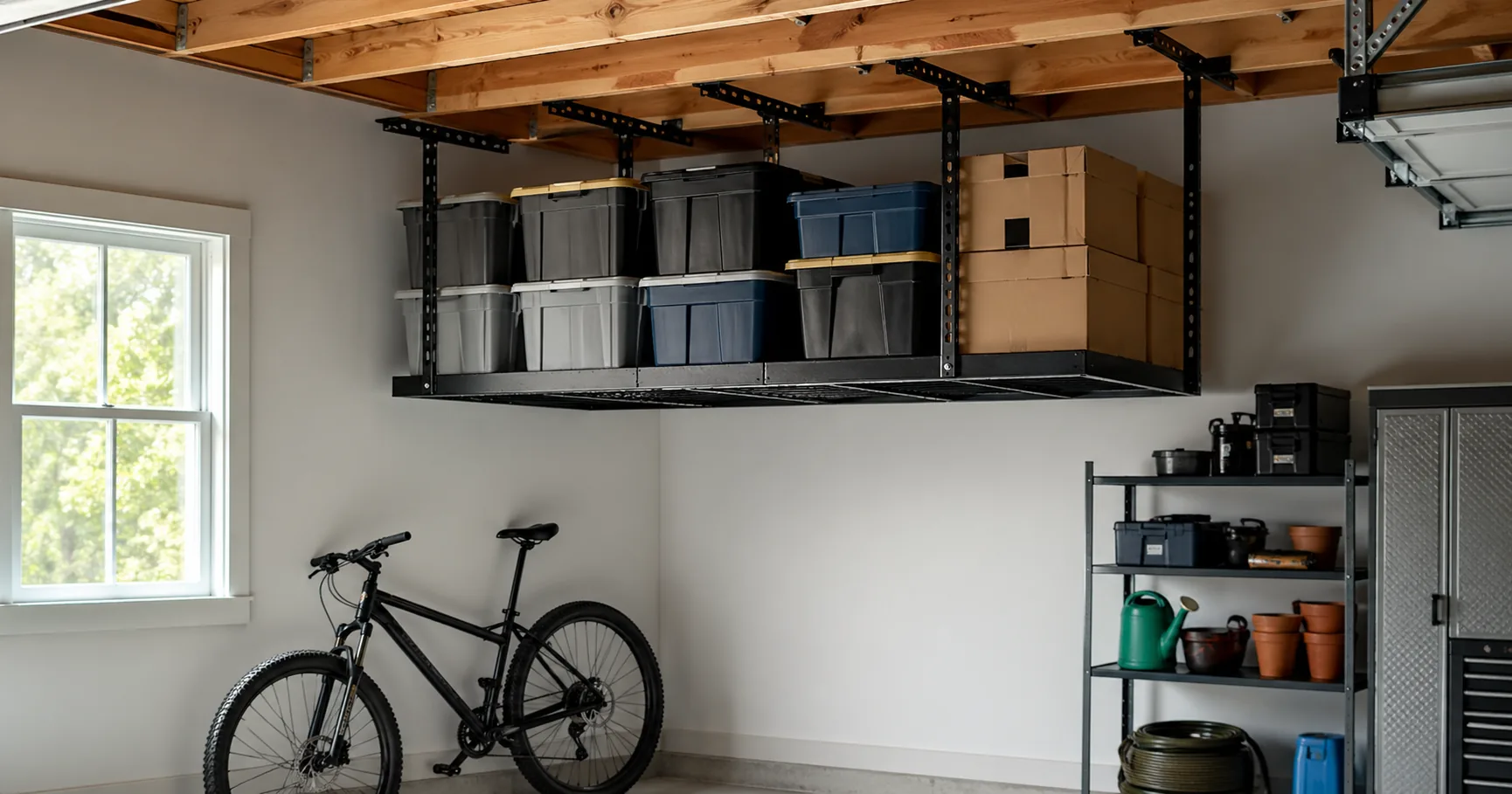
A garage floor is where everything goes to sit unused. Holiday tubs, camping gear, suitcases, the seasonal pile of shoes nobody wants in the house, all of it parked for most of the year on the only patch of the house big enough to hold a car. Overhead storage racks fix that by lifting the dead-weight clutter up to the ceiling and handing you back the floor. It’s one of the highest-payoff weekend projects a homeowner can do.
The catch is that “overhead rack” covers very different things, and the right one depends almost entirely on your ceiling and what you plan to put up there. A garage with low ceilings can’t take the same rack as one with tall ceilings, and a renter who’ll patch the holes later wants a different system than an owner maximizing storage. So this list is built to be matched to your space, not ranked as if one rack wins for everyone.
The picks span three broad types: full-size hanging decks for serious capacity, a compact rack for tight or low-ceiling spots, and a modular bin-rail system that goes up fast and expands as you need. Find the one that fits your ceiling height, your load, and your tolerance for install work, and you’ll get the floor back without a callback to the drawing board.
The best all-around choice is the FLEXIMOUNTS 4×8 deck. It carries a serious load on a sturdy frame, adjusts to hang at different heights for tall ceilings, comes with a strong warranty, and has by far the deepest, most positive review base in the category. For most two-car garages, it’s the default.
Who Each Rack Is For
A quick map before the details:
- Maximum capacity in a standard or tall-ceiling garage: the FLEXIMOUNTS deck.
- Heavy loads plus room to add hooks, lights, and bike hangers later: the MonsterRax deck.
- A full deck plus hanging hooks included out of the box: the SafeRacks deck.
- Low ceilings, corners, or above the garage-door track: the HyLoft compact rack.
- Fast, expandable, renter-friendly bin storage: the HANDT bin rails.
The FLEXIMOUNTS deck is the most-bought ceiling rack in the category, and the rating and review depth back that up. Owners who put up two, three, or four of them keep coming back to write long updates, which is the signal you want for something bolted over your car. The frame is heavy powder-coated steel built as a separate frame with a wire deck rather than a flimsy stamped shelf, and it uses extra vertical hangers to spread the load, with long brackets meant to span more than one joist for safety.
It carries a serious load, hangs from a generous adjustable drop so it suits tall garage ceilings while still leaving room to walk underneath, and is backed by a strong long-term warranty. Owners routinely report no noticeable sag after months of holding totes, tires, and seasonal gear.
The install is the part that rewards planning. Hanging the assembled deck is a two-person job, and a cordless impact driver makes it far less painful. Joist orientation matters, so check which way your ceiling framing runs before you start. A few owners mention some sway before the rack is loaded, which settles once it’s carrying weight.
Skip this if your garage ceiling is low; this deck needs real vertical clearance for the drop plus the bins on top.
FLEXIMOUNTS 4x8 Deck
The MonsterRax deck is a heavy-duty, well-finished rack whose real edge is its accessory ecosystem. It uses thick industrial steel with a rust-resistant powder coat, which matters in an unconditioned garage where humidity swings hard between seasons. It carries a strong load and hangs from a slightly deeper adjustable drop than the FLEXIMOUNTS, which makes it the better choice if your ceiling is on the taller side and you want the deck closer to head level.
What sets it apart is expandability: it accepts a line of add-ons like light kits, hooks, and bike hangers, so you can start with a deck and grow into a full overhead system over time. Owners also note you can mount it against the back wall rather than fully suspending it, which simplifies a back-of-garage install.
The install is straightforward but time-consuming, and faster with a helper. The wire decks aren’t fastened to the frame from the factory, so many owners zip-tie them down if they’re storing anything that could shift.
Skip this if you just want one rack and nothing more; you’d be paying for an ecosystem you won’t use.
MonsterRax 4x8 Deck
The SafeRacks deck lands in the middle of the pack on price but is the only full-size deck here that includes a set of hanging hooks in the box, which is real added value since you’d otherwise buy those separately. The frame is powder-coated steel with a strong load rating and the same generous adjustable drop as the MonsterRax. The included hooks let you hang bikes, hoses, or cords directly off the frame so long items don’t eat up deck space.
This is also a brand with a long track record in big-box warehouse channels, and owners regularly compare it favorably to similar racks they bought years ago. The install documentation gets singled out as the clearest in the category, and the support team has a good reputation for sorting out issues quickly.
The same caveats as the other decks apply: the wire grates rest on the frame and benefit from zip ties, and a reliable stud finder helps a lot on a finished ceiling.
Skip this if you don’t need the hooks and can find a comparable deck cheaper; the hook bundle is the main reason to pick this one.
SafeRacks 4x8 Deck
Not every garage has a long, clear stretch of ceiling. The HyLoft is a smaller-footprint rack and the most-reviewed compact option here. It carries a modest load, hangs from a shorter drop than the big decks, and that low profile is exactly what makes it the right call for low ceilings, the space above a garage-door track, or a tucked-in corner.
It’s built from sturdy powder-coated steel, and owners who’ve had theirs for many years report it still holding up. The compact size makes it a realistic one-person install in well under an hour, far easier than wrestling a full-size deck up a ladder alone.
The standout feature is modularity: multiple units bolt together into L-shaped layouts that wrap around a back corner, and it accepts add-ons like a tire loft and hooks. Plenty of owners buy one, decide the storage is worth it, and come back for more. The main complaint is some sway when empty, which disappears once it’s carrying even modest weight.
Skip this if you need maximum capacity; this trades load and size for the ability to fit where big decks can’t.
HyLoft Compact Rack
The HANDT bin rails take a different path entirely. Instead of one big deck, you get short paired rails that mount to your ceiling joists, and you slide standard large storage totes straight into them. There’s no shelf to assemble and no heavy deck to hoist into place. It’s the cheapest and fastest-to-install option in this roundup.
Because each rail is short, the install is forgiving: you don’t have to span across two joists to mount one, so joist alignment is far less stressful than with a full deck. You can chain as many rail sets in a row as your ceiling allows, which is how people line the back of a two-car garage with bins. The kit includes the bolts and the driver bit you need, and it works just as well in a finished basement, where a white finish blends into the drywall.
Two things to know: each rail set holds a modest load compared with the big decks, so this is for bins of lighter household stuff rather than heavy tools, and the system is designed around a common large-tote size, so off-size or shallow bins may not seat correctly. Match your totes to the rails before you commit.
Skip this if you need to store heavy gear; the per-rail capacity is well below the decks.
HANDT Bin Rails
The Trade-Off Worth Naming
The real tension here is capacity versus install effort and ceiling clearance. The decks that hold the most are also the heaviest to lift overhead, the fussiest about joist orientation, and the hungriest for vertical space. The bin rails and the compact rack give up raw capacity in exchange for going up fast, fitting tight ceilings, and being far easier to live with, especially solo or as a renter.
So the smart move is to buy the least rack that actually covers your load and your space. If you’re storing heavy tools and have a tall ceiling and a helper, a full deck is the high-value buy. If you’re stashing light seasonal bins, have a low ceiling, or want it done in an afternoon by yourself, the compact rack or the bin rails will make you happier than a big deck you dread installing.
Start with ceiling height
Every hanging rack drops some distance below the joists, and you need clearance for that drop plus the bins on top. Standard lower ceilings suit the compact rack’s shorter drop; taller ceilings can take the full decks and still let you walk underneath. If your garage-door track sits just below the ceiling, plan to mount above the door rather than behind it.
Then size it to what you're storing
Light, bulky things like holiday decorations and luggage let a big deck carry a lot of bins. Heavy things like tools and hardware fill that same deck far faster, so plan for fewer bins. The bin-rail system is counted differently: you size by how many bins you want in a row, not by one deck’s total load.
Then weigh the install
A full deck is a two-to-four-hour job and much easier with two people, one on the ladder and one passing parts. The compact rack and the bin rails go up quickly and solo. Renters should favor the bin rails, which leave smaller holes to patch. Owners chasing maximum capacity get the best value from the full decks. One detail the marketing skips: stud finders fail on finished garage ceilings more often than you’d expect. A small magnet that locates the drywall screws is the common workaround. Find two, measure out the rest of the joist line, and budget a little extra layout time on a finished ceiling before you start drilling.
How much weight can an overhead garage rack hold?
It varies a lot by type. The full-size decks here carry heavy loads and are the right choice for tools, tires, and stacks of full totes. The compact rack handles a more modest load, and each bin-rail set holds a lighter, per-bin amount meant for everyday household stuff. Every rating assumes the load is spread evenly and the rack is anchored into wood ceiling joists, never into drywall alone.
Will an overhead rack fit above my garage door?
Often yes, if you measure the gap between the top of the open door and the ceiling. Tight gaps suit the low-profile compact rack, while the full-size decks need more clearance because they hang lower. If you have a high-lift door track, you’ll have room for just about any rack here, so the measurement is the deciding factor.
Can I install one of these alone?
The compact rack and the bin rails are realistic one-person jobs. The full-size decks can be done solo but are much easier with a helper for the final lift of the assembled deck. Either way, a cordless impact driver and a working stud finder cut the install time roughly in half compared with hand-ratcheting everything.
What kind of ceiling do these work with?
All of them mount into wood ceiling joists or studs. None are meant for bare drywall or a metal ceiling grid. If your garage has a metal-pan ceiling, you’ll need to locate the wood framing above it or add a wood backer to anchor into. Hitting solid wood is what makes an overhead rack safe to load.
Do I have to anchor into joists, or is drywall enough?
Joists, always. Drywall alone cannot hold weight overhead safely. The full-size decks are designed so each bracket lands on a joist at standard spacing, and the compact rack and bin rails are more forgiving but still need wood behind the fasteners. Pre-drill pilot holes before driving lag screws, since they can snap if driven into wood dry.
Will these rust in a humid garage?
They all use powder-coated steel, which holds up well in humid and even coastal garages, and long-term owners commonly report no visible rust after many years. Powder coat is tougher than ordinary paint, so a minor scratch won’t start rust unless a real patch of bare steel gets exposed. For most garages, rust isn’t a practical concern with any of these.