
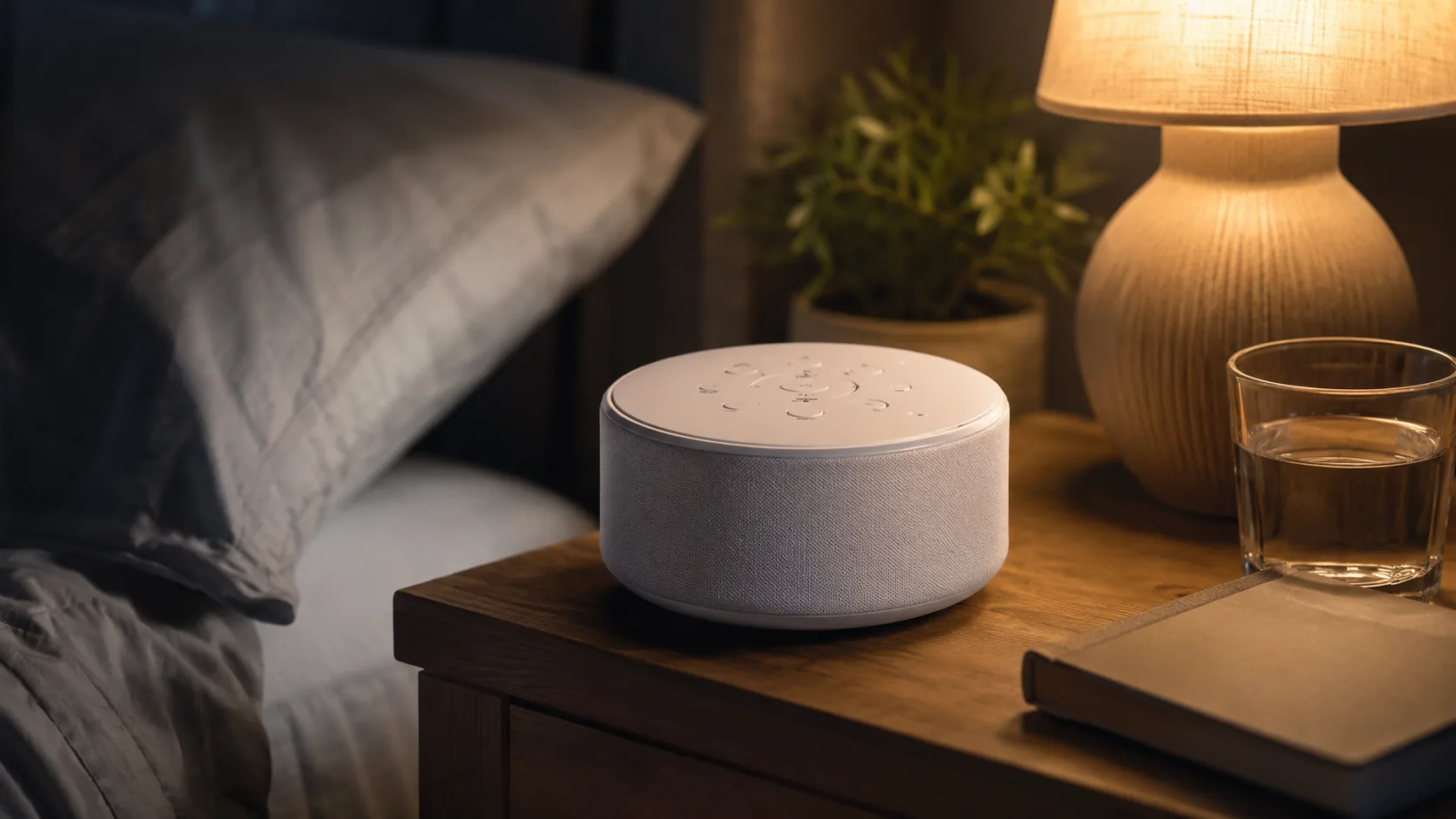
If you are a light sleeper, you know the cruel detail that no general sound machine guide will tell you. Most of these things play a recorded loop, a minute or three of audio that quietly restarts forever. A heavy sleeper never notices. Your brain, the same brain that wakes you when the refrigerator clicks on, catches the seam every time. The machine that was supposed to help you sleep becomes another little disturbance you cannot quite explain.
So this list is built around one specific quality. Whether the sound is genuinely continuous or has a hidden seam. The five picks below split neatly into the two camps, and the answer to which you should buy depends almost entirely on how sensitive your hearing actually is at night.
Best for genuine light sleepers: the Yogasleep Dohm Classic. A real fan inside means no recorded loop, no audible restart, and a sound that has been quietly putting people to sleep since the 1960s.
The split you actually care about
If you are a true light sleeper, the loop is the enemy. Pick a machine that does not have one. The Yogasleep Dohm is the classic answer, a real fan spinning inside a sealed housing, and there is simply nothing to repeat. The SNOOZ is the same idea with a phone app and a battery. The LectroFan is the digital take that pulls it off with software clever enough to keep the audio from cycling for hours.
If your sleep is not quite that sensitive, the loop-based machines open up. The Magicteam is the value pick by a wide margin, with the largest pool of happy owners here, and the Housbay adds more sounds and better speakers if a bigger library appeals. Both work for many people; both can betray a genuinely light sleeper.
The Magicteam is the value pick most people land on, and the pool of owners behind it is the deepest in this group by a clear margin. It throws twenty different sounds at you, white, pink, and brown noise, plus fans, rain, ocean, and a few more, with thirty-two volume levels and a memory that remembers your last setting. As a first sound machine for a partner who snores, a noisy street, or a baby’s room, it does the job for a striking price.
The thing it cannot do, and the reason it sits last for true light sleepers, is play genuinely loopless audio. Its sounds are extended digital loops that stretch out their seams as much as software can. Most people never hear them; the most sensitive sleepers do. If you have ever returned a sound machine because something about it bothered you, that something was probably the loop, and the Dohm is the better answer.
Skip this if you have already tried a couple of digital sound machines and woken up to each of them.
Magicteam Sound Machine
The Yogasleep Dohm has been doing one thing since the early 1960s and doing it well. Inside the housing is an actual fan, and the sound you hear is air moving through a chamber, not an audio file. There is nothing to repeat, nothing to restart, nothing for a sensitive brain to catch. That is the entire appeal, and it is the right appeal for the buyer this guide is aimed at.
Two speeds, a dial that nudges both pitch and volume, and it runs until you turn it off. No app, no timer, no library of sounds. That minimalism is part of the durability story too, several owners describe units that have been running nightly for many years on a single trip to the workshop. For somebody who has been let down by digital sound machines, this is the upgrade that ends the search.
Yogasleep Dohm Classic
The LectroFan is the clever middle ground. It does not have a real fan, but its software generates sound so cleverly that the audio does not repeat for hours, which is long past the point where any sleeping brain might catch a seam. The result is the closest digital experience to the Dohm’s mechanical sound, with a fuller volume range that can mask louder rooms, thinner apartment walls, and the kind of irregular noise the Dohm’s narrower output sometimes leaves through.
Its sound library is narrower than the cheap digital machines, ten fan textures and ten white-noise variations, no rain or ocean. That is deliberate; the focus is on masking, not entertainment. For a light sleeper who finds the Dohm’s fan tone too narrow and wants the loop problem solved without a moving part, this is the pick.
LectroFan Classic
The Housbay is the comfortable upgrade from the Magicteam without leaving the digital category. It carries the largest sound library on this list, more than thirty options across white noise, fan, lullabies, and several nature scenes, and pushes them through a proper stereo speaker that sounds noticeably richer than the cheap mono boxes. A physical knob handles volume, which is easier in the dark than reaching for a button.
For nurseries, where the buyer is usually a parent who wants lullabies and ocean alongside white noise, this is the smart pick at the price. The same caveat as the Magicteam applies, though: the audio is looped, and at higher volumes some of the natural sounds reveal their seams. For a baby, that almost never matters. For a parent in the same room who is also a light sleeper, it might.
Housbay White Noise
The SNOOZ takes the Dohm’s mechanical approach, a real fan inside a housing, and wraps it in modern conveniences. A phone app lets you set sound schedules, fade the volume in and out across the night, and start or stop the machine from bed. It pairs with voice assistants and ships with an internal battery, which makes it the rare sound machine you can take to a hotel or a friend’s spare room without worrying about an outlet near the bed.
The cost is the price itself, by a clear margin the highest of the five, and the small overhead of app setup compared to the Dohm’s single dial. For a light sleeper who already loves the idea of a real-fan machine and would genuinely use the schedules and travel battery, the premium pays. For someone who just wants the loopless sound at home, the plain Dohm gets there for less.
SNOOZ Smart Sound Machine
The trade-off that actually decides this
Most sleep sound machine guides treat all five units as roughly the same kind of product. They are not. There are two products here masquerading as one, real-fan machines and digital loop machines, and the choice between them maps directly to how sensitive your hearing is at night. If you fell into this category by accident, a partner snores, a street is loud, a baby is in the next room, the digital picks are perfect and you can stop reading. If you fell into it because you genuinely wake at small sounds nobody else hears, the digital picks will eventually annoy you and the real-fan picks are the right buy.
Spending more inside each camp buys less than it looks like. Inside the digital camp, going from the cheapest Magicteam to the richer Housbay adds sound variety and stereo, not better masking. Inside the real-fan camp, going from the Dohm to the SNOOZ adds an app and a battery, not better sleep. Match the camp to your hearing first; spend on extras second.
How to use one without making things worse
Whichever you buy, set it lower than your instinct says. The right level is the lowest one that erases the noise you are trying to hide, not the loudest the room can stand. Running a sound machine at full volume night after night is fatiguing in ways that take a while to show up, and for children specifically the volume guidance is to keep it at conversation level and at a safe distance from the crib. Place the machine between you and the noise source rather than next to your ear; a few feet of distance softens everything without losing the masking effect.
What is the difference between looping and non-looping sound machines?
Looping machines play a recorded clip on repeat. The most sensitive sleepers can catch the seam each time it restarts, which defeats the point. Non-looping machines use either a real fan or software that generates continuous audio without repeating, so there is no seam to detect.
Do I need a sound machine if I already use a fan?
A regular fan does the same job for many people, since the air movement creates a similar broadband sound. A dedicated machine is the upgrade when you want the sound without the airflow, more variety than a fan can offer, or independent control of volume and pitch in a small footprint.
How loud should a sleep sound machine be?
Low enough that you can hold a quiet conversation over it from a few feet away. The right volume just covers the noise you are trying to hide, and no more, because running anything loud all night is fatiguing over time and can affect hearing across years.
Are sound machines safe for babies?
Yes, when used at a sensible volume and a safe distance from the crib. The simple rule is to keep the machine across the room rather than right next to the baby’s head, and to run it no louder than a normal conversation. Several picks here are marketed for nurseries.
How long do these machines last?
Real-fan units tend to run for many years before the motor needs attention, and several owners report units that have been working nightly for a long time. Digital machines have a shorter typical life because the electronics and speakers wear out sooner, but most still serve well past their warranty.