
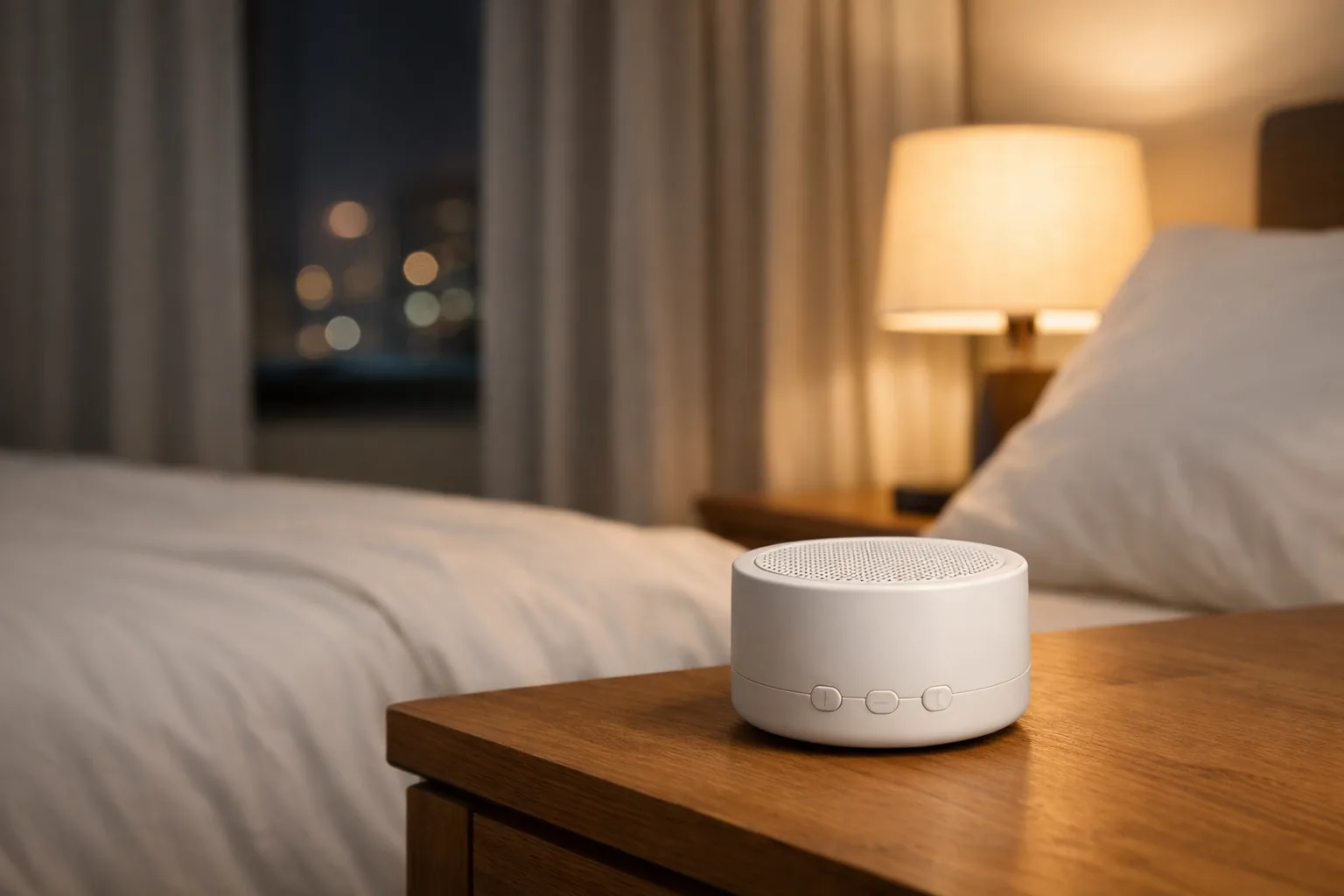
Here’s the part most people miss: a white noise machine doesn’t make noise go away. It makes noise stop standing out. Your brain is built to flag irregular sounds, the door slam at 2 a.m., the dog that starts and stops, the bass thudding through the floor, and each one yanks you out of deep sleep whether you fully wake or not. Raise the steady background sound in the room and those intrusions stop registering as new events worth waking for. That’s masking, not silencing, and for apartment living it’s the difference that matters.
Which also means the right machine depends entirely on your noise problem. A whisper-quiet unit won’t touch a stomping upstairs neighbor. A single-pitch hiss won’t cancel low bass coming up through the floorboards. The five below range from a tiny budget masker to a smartphone-controlled real-fan machine, and each suits a different kind of disturbance. Match the machine to your noise, not just to the price, and you’ll actually sleep.
The LectroFan Classic is the most apartment-smart pick. It spans a wider range of pitches than anything else here, so you can match the masking sound to your exact problem, sharp white noise for voices through a wall, deep brown noise for bass through the floor. It’s compact, travels well, and reaches genuinely loud when you need it.
Why White Noise Works in an Apartment
Apartment noise is unpredictable by design. It isn’t a steady hum you tune out, it’s a door at 2 a.m., a bark that starts and stops, a TV bass line cutting through drywall. Each irregular sound creates contrast against a near-silent room, and that contrast is what pulls you awake.
White noise, along with its cousins brown noise and fan noise, raises the room’s noise floor. When the background goes from near-silence to a steady whoosh, each intrusion produces far less contrast, and your brain stops tagging it as something new. The two variables that decide whether it works in a dense building are output and pitch: enough volume to cover the disturbance, and a pitch matched to it, low for bass, higher for voices. The picks below were chosen with that apartment math in mind.
Which One Fits Your Noise
- Moderate noise, tight budget: the Magicteam covers a TV through a wall or occasional door slams cheaply.
- You need real volume to cover a loud street or stomping: the Housbay’s forward speaker or the LectroFan’s high ceiling.
- You want a natural, organic sound to sleep through for years: the Yogasleep Dohm’s real fan.
- Your noise has a specific pitch (bass, voices, HVAC): the LectroFan’s frequency range.
- You want scheduling and phone control with real-fan sound: the SNOOZ Smart.
The Magicteam is the bestselling sleep sound machine on Amazon and the obvious starting point for anyone who wants to try white noise without committing real money. It plays a broad set of non-looping sounds, white, brown, pink, and blue noise, fan variations, plus rain, ocean, brook, birds, and bonfire, all generated without the repeating cycles that make cheap looping machines feel artificial after a few nights.
It gives you fine volume control across many steps, remembers your last sound and level on power-up, and runs on either AC or USB, so it works on a nightstand or a desk. A built-in timer offers shutoff at set intervals or continuous play through the night, and the footprint is tiny. For moderate apartment noise, kitchen sounds, door closings, a neighbor’s TV, it does the job at a price that makes it easy to recommend.
Skip this if your problem is heavy traffic or construction-level noise, since the small speaker tops out below what that needs, or you want crisp high-volume room fill. For that, step up to the Housbay or LectroFan.
Magicteam Sound Machine
The Housbay sits a step above the Magicteam in both price and output, and its forward-facing speaker is the reason. By directing sound toward you rather than diffusing it around the room, it masks effectively at lower volume, which is kinder on your hearing over a full night. When you do need it loud, it has more to give than most budget machines.
It carries the widest sound library in this group, spanning white noises, fan sounds, and a deep bench of nature options, and it remembers your last setting. Auto-shutoff comes with a soft volume fade rather than an abrupt cutoff, so the transition to silence doesn’t itself wake you, and a tilted face makes adjusting sound and volume easy in the dark. The wood-grain shell looks like furniture instead of a gadget. People on rotating shifts who sleep through daytime household noise tend to gravitate to it.
Skip this if you want the most precise pitch targeting, where the LectroFan does better, or you’re particular about details, since the mismatched white power cord is a small recurring gripe.
Housbay Wood Grain
The Dohm doesn’t play a recording of a fan. It contains one. A real motor spins inside a sealed housing, and what you hear is the genuine sound that fan makes, shaped by two rotating rings on the outside that adjust tone and perceived volume. That gives you a physical, tactile way to dial in the exact whoosh that puts you under, across two speeds.
This design has been around for decades, and the Dohm is its direct descendant, hand-assembled in the USA. Because the fan is fully enclosed, you get the sound with no draft, and because it’s mechanical, there’s no digital loop to ever notice, the sound simply is the sound, indefinitely. Apartment users who’ve lived with one for years describe its output as smoother and less harsh than digital machines over long listening, and the units are known to run steady for the better part of a decade without rattles.
Skip this if you want fine volume control or a sleep timer, since it’s deliberately analog with just two speeds and no extras, or you like variety, because it makes one sound and one sound only.
Yogasleep Dohm Classic
The LectroFan addresses the apartment problem at a technical level better than anything else here. Its non-looping sounds span a wider frequency range than any competitor in this group, from deep brown noise to sharp high-frequency white noise, with a stack of fan tones in between. Each variation targets a different slice of the spectrum, and that targeting is the whole point.
The difference in practice is real. When the intrusion is a phone speaker playing music upstairs, a higher-pitched white noise cuts that mid-range better. When it’s bass from a subwoofer coming through the floor, a low brown noise does what a single-pitch machine simply can’t. It also offers precise volume that climbs to genuinely loud, runs on USB, packs small, and ships with international adapters, which makes it a strong travel machine too. A sleep timer handles shutoff. It’s the most versatile digital masker on the list.
Skip this if you specifically prefer the organic feel of a real fan, where the Dohm or SNOOZ will satisfy you more, or you want app scheduling, since the timer here is shutoff-only.
LectroFan Classic
The SNOOZ is the premium pick, and it earns it by combining real-fan acoustics with phone control that nothing else here offers. Like the Dohm, it houses a genuine brushless fan motor rather than a recording, so you get the natural, non-looping quality digital engines only approximate. Unlike the Dohm, it adds discrete volume levels, tone adjustment via a rotating shell, and a free app.
The app is where it pulls ahead: schedule it to switch on at bedtime and off at wake-up, customize by day, and adjust volume from across the room without reaching for the unit. A nursery calibration feature uses your phone’s mic to measure the actual sound level in real time, which is genuinely useful for setting a safe level around a sleeping baby. The brushless motor is built for the long haul, and it runs without LEDs once set up. Owners in dense, loud neighborhoods consistently note that the real-fan sound quality is a more obvious upgrade over digital than they expected.
Skip this if you want variety like rain or ocean, since it makes only the fan sound, or you won’t use scheduling, because without that the simpler Dohm gets you the same real-fan sleep for less.
SNOOZ Smart
Match output to your noise
The Magicteam suits moderate disruptions like a TV through a wall. For a stomping neighbor or a street-facing window in a loud city, the Housbay’s forward speaker or the LectroFan’s high ceiling will serve you far better.
Decide real fan versus digital
Real-fan machines (Dohm, SNOOZ) make an organic, continuously varying sound many people find easier to sleep through for years. Digital machines (Magicteam, Housbay, LectroFan) give you more sound variety and usually finer volume control. Neither is better in the abstract, it’s variety versus authenticity.
Use pitch control if your noise has a signature
The LectroFan’s frequency range is its defining feature. If your problem is consistent and identifiable, a bass speaker, a high-pitched HVAC unit, voices through a thin wall, matching the masking pitch to the noise beats simply running the loudest machine you own.
Don't dismiss the timer
Light sleepers who’d rather not run a machine all night get auto-shutoff on the Magicteam and LectroFan, and the Housbay’s soft fade keeps the drop to silence from becoming its own wake-up.
The app only matters if you'll use it
SNOOZ’s scheduling is genuinely handy for a consistent routine. For everyone else, the Dohm’s mechanical simplicity or the LectroFan’s buttons do the same job without pairing a phone.
Will a white noise machine actually block out my upstairs neighbor's footsteps?
It depends on how loud and low the footsteps are and how much output the machine has. These machines don’t soundproof a room, they raise the noise floor so intrusions create less contrast. Heavy stomping on hardwood at 1 a.m. is hard for any machine, but the LectroFan and Housbay have the highest output here and are best suited to loud disruptions. For very heavy low-frequency impact, you may also need rugs or heavy curtains.
Is it safe to run a white noise machine all night, every night?
Yes, at reasonable volume. Audiologists suggest keeping bedroom sound below about 70 dB for extended listening, and most machines here sit comfortably in the 50 to 65 dB range at normal bedroom distance. The Yogasleep Dohm’s real-fan design in particular has a long track record of nightly use.
What's the difference between white noise, brown noise, and pink noise?
They describe how the sound’s energy spreads across frequencies. White noise is even across all frequencies and sounds like bright TV static. Brown noise emphasizes the low end and sounds like a deep rumble or heavy rain. Pink noise sits between them. For low sounds like bass through a wall, brown noise tends to mask better. For higher sounds like voices or sharp street noise, white noise is more targeted.
Can I use a white noise machine without bothering my neighbors?
Yes. These machines are room-contained and not built to push sound through walls. At normal bedroom volume the sound doesn’t travel meaningfully beyond your room. Placing the machine between you and the noise source, a few feet from your head, maximizes masking without needing high volume.
Do white noise machines help with tinnitus?
Many people use them for tinnitus relief and report good results, because the steady ambient sound gives the auditory system something to focus on that competes with the internal ringing. This isn’t medical advice, though, so for tinnitus management it’s worth talking to a healthcare provider.