
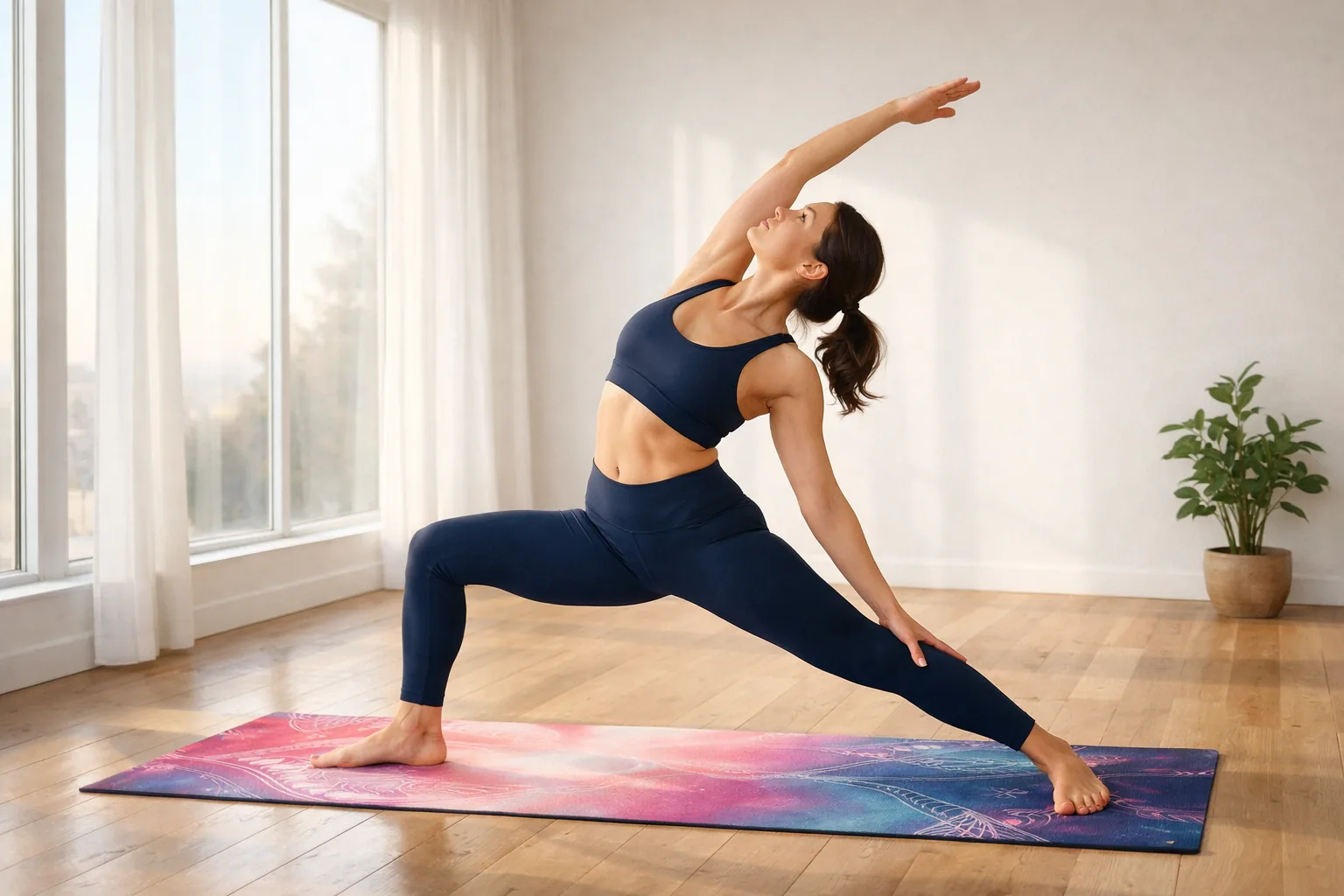
You find out whether your mat is any good about ten minutes into a flow, when your palms start creeping forward in downward dog and you spend the next pose fighting the floor instead of breathing into it. That slow slide is the single most common complaint about cheap mats, and it has almost nothing to do with the brand on the label. It comes down to grip, which depends on the material and how much you sweat, and on whether the mat was built to hold traction once it gets damp.
A yoga mat is one of the rare bits of fitness gear where spending more does not reliably buy you more. The variables that decide whether a mat works for you are simpler than the marketing suggests: how thick it is, which sets the trade between joint cushioning and balance stability, how well it grips dry and wet, and what it is made of. Get those matched to your practice and an affordable mat will serve you for years.
So treat this less as a ranking and more as a sorting exercise. Two questions settle most of it. How much cushion do your knees and wrists want, and how much do you sweat in a session? Your answers point straight at one of the five mats below.
Two questions that point you to a mat
- You practice a few times a week and want one mat that does everything. Medium thickness, reliable grip, easy to carry. That is the Gaiam Essentials.
- You are starting out and your joints want padding. Go thicker for knee and wrist comfort while you learn. The Amazon Basics or the Retrospec cover this.
- You sweat a lot, or you slide on your current mat. Prioritize wet grip over everything. The Gruper handles moderate sweat; the Gaiam Dry-Grip is built for genuinely hot, sweaty practice.
- You do balance-heavy work and want floor feel. Lean thinner and firmer, which means the Gaiam Dry-Grip’s profile over the thick beginner mats.
The Gaiam Essentials at 10mm is the all-purpose mat most people are looking for without realizing it. The thickness is the sweet spot: enough padding to protect knees and wrists on a hard floor, but not so much that you wobble in standing balance poses, which is where very thick mats betray you. It is one of the most-bought mid-thickness mats around, and the rating has held across a large base of regular practitioners, which is the signal that matters more than any single feature.
The textured surface grips well on smooth studio floors and copes with the light sweat of a steady flow. It is widely recognized in group classes for a reason. For someone practicing a few times a week who wants dependable cushioning without lugging a heavy mat to the studio, this is the complete package.
Skip this if you run hot and sweat heavily. The texture handles moderate moisture but is not a dedicated hot-yoga surface.
Gaiam Essentials 10mm
The Amazon Basics Extra Thick mat is the no-overthinking starting point. It is one of the most-reviewed mats anywhere, holds a strong rating, and sits at the bottom of the price range, which is a rare combination. The roughly half-inch thickness is the most generous here, and that extra padding is exactly what new practitioners want while knees and wrists adapt to floor work. A carrying strap comes included, which is a practical touch at this price.
It is honest about its limits. It will not survive years of daily hot yoga, and the surface lacks a premium grip texture, so it can slide if you sweat heavily. But for a couple of practices a week at home or a casual class, it does its job reliably and cheaply.
Skip this if you do a lot of balance work. The thick, soft cushion that helps beginners works against stability in single-leg poses.
Amazon Basics Extra Thick
The Retrospec Solana pairs above-average thickness with a dual-layer build that adds stability a single slab of thick foam cannot. That combination is why it keeps turning up in recommendations for a first mat: you get the joint comfort a beginner wants without the full instability penalty that usually comes with thick mats. Its rating among newer practitioners is consistently strong.
The closed-cell surface is the underrated feature. It stops sweat soaking into the mat, which keeps it from getting funky and makes wiping it down simple, so the mat lasts longer. The included strap with a shoulder pad takes the sting out of carrying a thicker mat to class.
Skip this if you are an advanced practitioner doing precise balance work. The cushioning is more than you need and dulls floor feedback.
Retrospec Solana
The Gruper leads this list on grip. Its textured, double-sided surface holds traction in sweatier conditions where plain PVC turns slick, and that is the whole point of it. If you practice power yoga or any dynamic flow that gets you genuinely damp, grip failure is not a minor annoyance, it is the thing that stops your practice. This mat is the answer for moderate sweat without stepping all the way up to a hot-yoga-specific surface.
It is also made of TPE rather than PVC, so it is lighter and latex-free, which suits anyone avoiding those materials. At a thickness that balances cushion and stability, it competes with the all-purpose mats while solving a problem they do not.
Skip this if you do gentle, restorative practice on dry days. The grippier texture can feel rough for long-held floor poses, and you will not need the wet traction.
Gruper Non-Slip
The Gaiam Dry-Grip is the specialist. Its surface is built to grip better as it gets wetter, which is the opposite of how an ordinary mat behaves, and that flips the worst part of heated practice into a non-issue. For Bikram, hot power, or any infrared class where you are dripping, a mat that holds dry but slides wet is worse than useless, and this one is designed around exactly that failure.
Its rating sits a touch below the standard Gaiam mats, and that is worth reading correctly: people who buy a hot-yoga-specific mat compare it to studio-grade rubber, not to a budget beginner mat, so expectations run higher. For the narrow job of heated, sweaty practice, it outperforms everything else here. Its thinner profile also makes it the steadiest pick for standing balance work.
Skip this if your practice is gentle and dry. In non-heated conditions its dry grip trails the other picks, and you are paying for a feature you will not use.
Gaiam Dry-Grip
The thickness trade-off nobody warns beginners about
The instinct when you are new is to buy the thickest mat you can, because padding sounds like comfort and it is, in floor poses. But thickness cuts both ways. The same cushion that protects your knees in a lunge makes the ground feel unstable under one foot in tree pose or half-moon, and that wobble can make a beginner feel less capable than they are. Above a certain point, more foam actively works against the balance side of practice.
So match thickness to what you actually do. If your practice leans toward restorative, yin, or gentle flow with lots of kneeling, go thick (the Amazon Basics or Retrospec) and enjoy the padding. If you do vigorous, balance-heavy vinyasa, a thinner, firmer mat (the Gaiam Dry-Grip’s profile) gives you the floor connection that keeps standing poses solid. The 10mm Gaiam Essentials sits in the middle on purpose, which is why it suits the widest range of people. There is no single right thickness, only the one that fits your poses.
How to Choose a Yoga Mat
Thickness is the first decision, and it is the cushion-versus-stability trade above: thin and firm for balance and travel, medium for all-purpose use, thick for joint comfort and gentle practice. Decide where your practice sits before anything else.
Material sets grip and feel. PVC is cheap, durable, and grips well dry but is not eco-friendly. TPE, like the Gruper, is lighter and latex-free. Premium natural-rubber mats grip best wet and last longest, but they are heavier, pricier, and unsuitable for latex allergies. For casual to regular practice, PVC or TPE is the sensible range.
Grip is really a dry-versus-wet question. Standard mats grip fine dry and lose it as they absorb sweat. If you sweat, choose a moisture-channeling texture (the Gruper) or a dedicated hot-yoga surface (the Gaiam Dry-Grip). For gentle, dry practice, ordinary grip is plenty.
Last, weigh size and weight against how you practice. Standard mats run about 68 inches long, so taller practitioners should look for extra-long versions, and if you carry a mat to a studio, the weight of a thick mat matters more than home users expect.
What thickness should a beginner get?
Somewhere in the range of about 6 to 10mm is the usual recommendation, enough to cushion knees, wrists, and spine while you learn the foundational poses. The Amazon Basics and Retrospec are the most cushioned options here for anyone with sensitive joints. Many practitioners later move to a thinner mat for better floor feel once balance improves.
How long should a yoga mat last?
A quality mat lasts roughly three to five years with regular use a few times a week. Replace it when the surface starts peeling or flaking, when you feel the floor through the cushioned areas, or when the grip has permanently faded. Premium natural-rubber mats can run much longer, which is the trade for their higher cost.
Can I use a yoga mat for other workouts?
Yes, for Pilates, stretching, bodyweight work, and floor-based training it works well. For jumping or heavy weights the cushion compresses and the mat can shift, so a dedicated interlocking foam floor is better there. For stretching and core work, a yoga mat is fine.
How do I clean it?
For PVC and TPE mats, wipe with a damp cloth and mild soap, then air dry, and avoid soaking or machine washing, which degrades the surface. A diluted spray of vinegar or tea tree oil handles odor after sweaty sessions. Wipe natural-rubber mats gently and keep them out of prolonged water.
Is a sweaty-practice mat worth it if I only sometimes get warm?
If you only occasionally work up a sweat, a good general mat like the Gaiam Essentials or the grippy Gruper is enough. Reserve the dedicated hot-yoga surface for genuinely heated, consistently sweaty practice, since its dry grip is weaker than the alternatives in a normal room.