
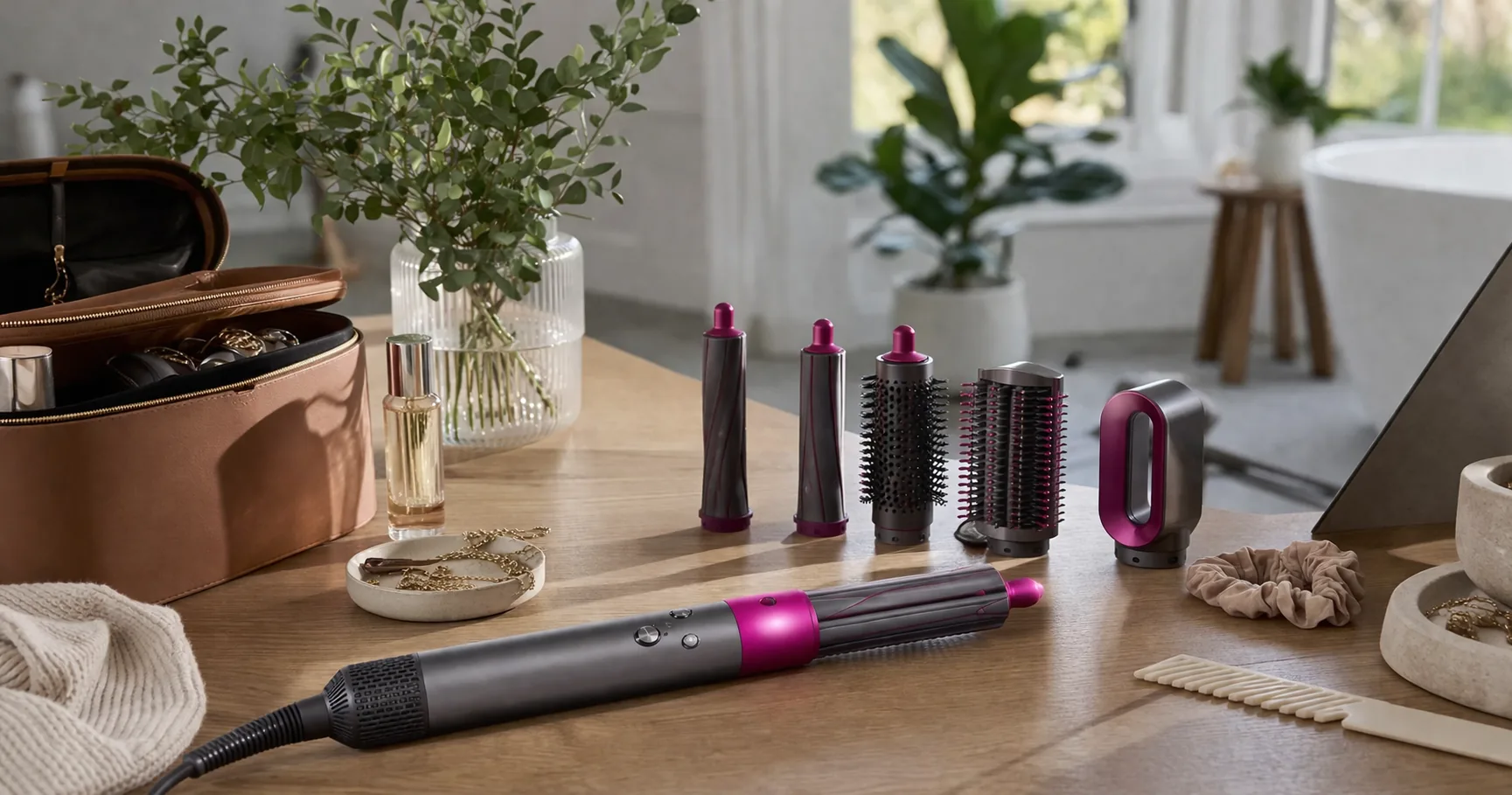
The question with the Dyson Airwrap was never whether it works. It is whether it still earns its price now that the products people cross-shop against it have caught up on the part that actually matters: styling your hair with less heat.
So this review starts where the marketing does not. The Airwrap is the most expensive way to solve a problem that two other tools in this group solve for a lot less. That does not make it a bad product. It makes it a specific one, and the honest answer to “should I buy it” depends entirely on whether you want the thing the Airwrap does that the cheaper options cannot quite match.
The Airwrap Complete Long is the tool this review is really about. If you want one styler that dries, smooths, volumizes, and curls without the scorch of a traditional hot tool, it is still the most refined version of that idea. The only real question is whether you need that refinement enough to pay for it.
Three Tools, Three Different Jobs
It helps to see what you are actually choosing between, because these are not three versions of the same thing. The Airwrap is a multi-styler built around drying and shaping with lower heat. The Shark FlexStyle chases that same all-in-one idea at a far lower price. The Dyson Airstrait ignores curling entirely and focuses on straightening hair from wet to dry.
That split is the whole decision. Most buyers are not picking between three Airwraps. They are picking between three ways to simplify a hair routine, and the Airwrap only wins if its particular approach, multi-styling with airflow instead of high heat, is the one your hair actually needs.
Start with the hard part. The Airwrap is the priciest tool here by a wide margin, and its rating has slipped a little as the buyer base has grown, which usually means more people bought it on hype than on fit. If you want a styler mainly to save money or time, this is the wrong place to start, and nothing about the price gets easier to justify the longer you look at it.
What you are paying for is genuine, though. The multi-styling system, the airflow-driven shaping, and the lower-heat approach add up to a tool that can dry, smooth, add body, and curl without the dry-fried feel of a hot iron. If you have fine or heat-stressed hair and you want one tool that does several jobs gently, the Airwrap still feels more considered and more capable than almost anything that tries to copy it.
So the verdict is narrow on purpose. Buy it if you specifically want the Airwrap experience and the lower-heat styling is worth real money to you. Do not buy it on the assumption that the most famous premium tool is automatically the best-value one, because in this lineup it is not.
Skip this if: your routine is mostly straightening, or you are shopping on value and would be happy with a tool that does most of this for much less.
Dyson Airwrap
The Shark FlexStyle is the comparison the Airwrap cannot dodge. It runs the same all-in-one playbook, drying, smoothing, curling, and shaping with swappable attachments, for a fraction of the cost. That is exactly why it belongs in this review: it forces the Airwrap to prove its premium rather than assume it.
It also carries the deepest buyer base in this group by a wide margin, so the trust signal is the strongest here on pure validation. For someone who likes the Airwrap concept but balks at the price, the FlexStyle is usually the smarter starting point, and many people never feel the need to upgrade past it.
Where it gives ground is feel. The Dyson hardware is more polished, the attachments seat more cleanly, and the whole system reads as a higher-end object. If that refinement matters to you, the FlexStyle will feel like a compromise. If it does not, you will struggle to see where your extra money would have gone.
Skip this if: you specifically want the most refined styling experience and are willing to pay for it.
Shark FlexStyle
The Dyson Airstrait is not an Airwrap replacement, and it is not trying to be. It is the tool to consider if you are set on a premium Dyson but your real goal is straight, smooth hair rather than curls and volume. It dries and straightens in one pass with less heat than traditional plates, and it currently holds the highest rating in this group.
That narrower job is its strength. If you almost never curl and you mostly want to cut drying-plus-straightening into a single step, the Airstrait is the sharper buy and the easier one to justify than the Airwrap. If you want brush styling, waves, or curls, it simply does not do that, and the Airwrap goes back to making more sense.
It is still a premium-priced tool with a smaller buyer base than the FlexStyle, so it asks for commitment. But for a straightening-first routine, it is the most logical pick of the three.
Skip this if: you want curls, waves, or brush-based volume, since the Airstrait only straightens.
Dyson Airstrait
Is the Dyson Airwrap Worth It in 2026?
Yes, if you want a premium multi-styler, you care about lower-heat styling, and you are paying for refinement rather than raw function. For fine or heat-stressed hair especially, the Airwrap still does something the cheaper tools only approximate.
No, if what you actually want is an affordable all-in-one styler. There the Shark FlexStyle is the test the Airwrap keeps failing on value, because it handles too much of the same job for too much less to wave away. And if your routine is mostly straightening, the Airstrait is the more sensible premium pick.
The practical takeaway: buy the Airwrap because you specifically want the Airwrap, not because the highest price tag feels like the safe choice. In this category, the safe choice and the expensive one are not the same product.
Is the Dyson Airwrap still worth buying in 2026?
Yes, but mainly for buyers who specifically want a premium multi-styler with lower-heat styling. It is much harder to justify if you are shopping on value, since cheaper tools now cover most of the same routine.
Is the Shark FlexStyle a better buy than the Airwrap?
For a lot of shoppers, yes. It gives up some polish and prestige, but the price gap is large enough that the FlexStyle is often the stronger value, and it has the deepest review base in this group.
Should I get the Airwrap or the Airstrait?
Choose the Airwrap if you want curls, waves, smoothing, and volume from one tool. Choose the Airstrait if your routine is mostly getting hair straight and dry in a single pass.
Does the Airwrap actually reduce heat damage?
Its whole design leans on airflow and lower heat rather than a hot plate or barrel, which is the main reason fine and heat-stressed hair tends to do better with it. It is not magic, but the gentler approach is real and is most of what you are paying for.
What is the biggest mistake buyers make with the Airwrap?
Buying it because it is the famous premium option rather than checking whether their routine needs what makes it special. If you mostly straighten, or you are happy with a cheaper multi-styler, the Airwrap is not the obvious win its reputation suggests.