
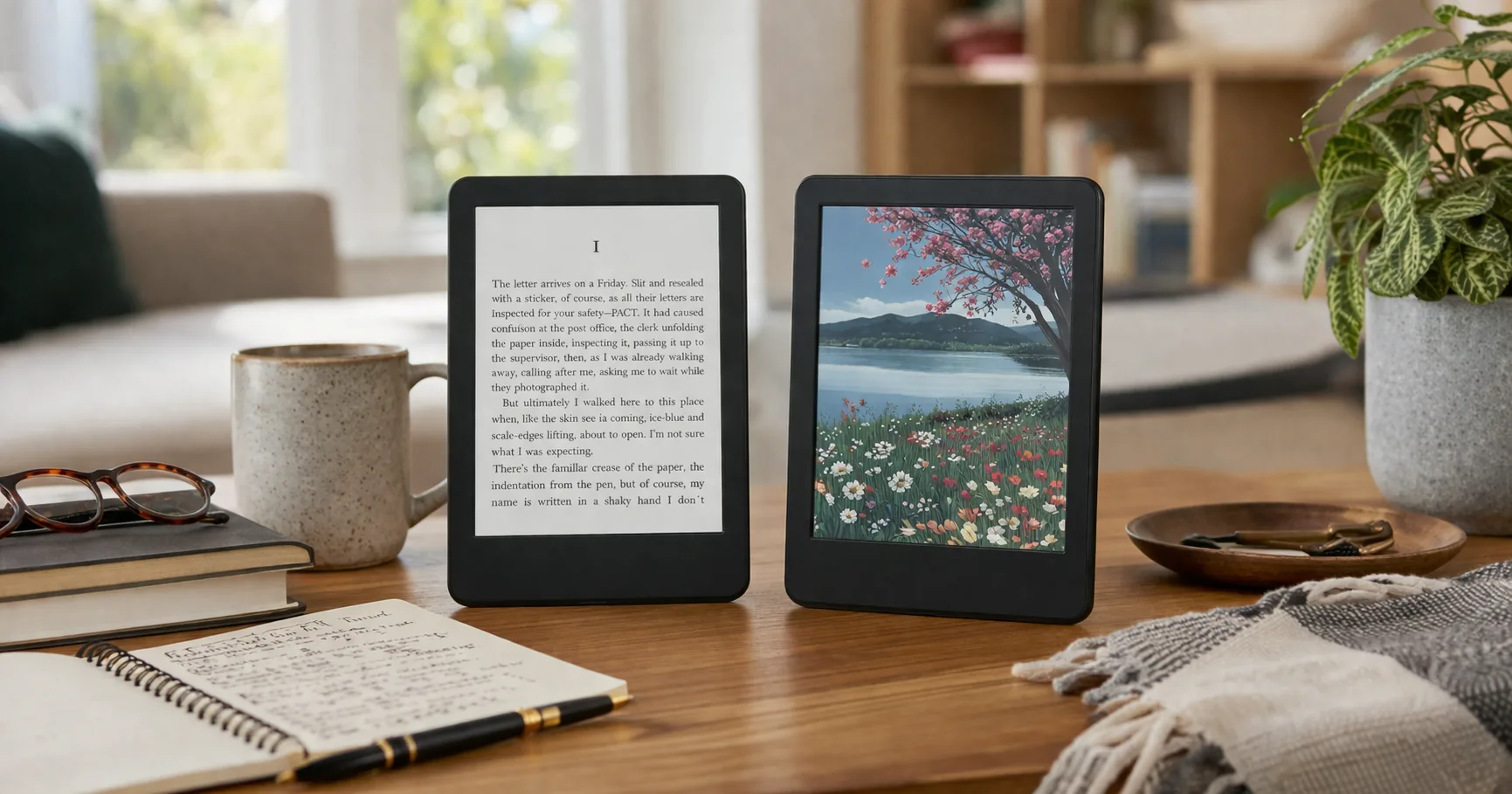
Color is the headline, but it is not really the question. Both of these Kindles render text beautifully, hold a charge for weeks, and shrug off a splash at the beach. What separates them is whether a color screen changes your reading enough to justify a price that sits well north of the Paperwhite. For most people the honest answer is no. For a specific kind of reader, it is an easy yes.
This comparison puts the Paperwhite, the mainstream choice with years of owner feedback behind it, against the newer Colorsoft, the specialist. The gap between them is wide enough that the premium side needs a real everyday payoff rather than novelty. Below are the scenarios where each one clearly wins, then the tie-breakers for when you are still on the fence.
What Both Kindles Get Right
It helps to be clear about what is not in question, because the two readers share most of their DNA. Both use a paper-like screen that is easy on the eyes in bright sun and in a dark room alike. Both take an adjustable warm light that shifts the tone toward amber at night, both survive a drop in the bath or a splash at the pool thanks to waterproofing, and both charge over USB-C and run for weeks on a charge rather than days. Both tap into the same Kindle store, the same library syncing across devices, and the same reading software you already know if you have owned a Kindle before.
That overlap is the whole reason this decision narrows down so cleanly. You are not weighing battery life against build quality or one ecosystem against another. The hardware that defines a good e-reader is effectively a tie. The single axis that actually differs is the screen’s color, and a price that follows from it. Once you accept that, the choice stops being a spec comparison and becomes a simple question about what sits in your reading queue.
When the Paperwhite Is the Right Call
If your reading is mostly novels and nonfiction, the decision is already made. A wall of prose gains nothing from a color screen, and the Paperwhite presents black text on a clean, glare-free page about as well as any e-reader does. You would be paying a large premium for a feature your library never triggers.
It is also the obvious pick when price matters at all, which for most buyers it does. The Paperwhite covers the entire Kindle promise, including an adjustable warm light, waterproofing, USB-C charging, and battery life measured in weeks, for far less money. That makes it the safer gift and the safer first e-reader, since you are not betting on a reading habit the recipient may not have.
And it is the more proven device. It carries a higher rating across a vastly larger base of owner feedback, so the pattern behind it is far more stable than a newer, pricier model can offer yet. Unless color itself is the reason you are shopping, the Paperwhite is the lower-risk buy.
When the Colorsoft Earns the Jump
The Colorsoft stops being a luxury the moment your library leans visual. Comics, graphic novels, and manga are the clearest case: color is the entire point of the medium, and reading them in grayscale flattens the experience. If that is a real part of your week, the premium reads as money well spent rather than novelty.
It also pulls ahead for illustrated nonfiction, cookbooks, children’s books, and art or photography titles, where covers, diagrams, and images carry meaning that black-and-white loses. Heavy highlighters get a quieter benefit too: color highlighting is something the Paperwhite simply cannot do, and for studying or annotating it changes how usable the device feels.
The catch is honesty about your own habits. Owners who bought the Colorsoft specifically for color content tend to feel the upgrade pays off, while those who bought it “just in case” often realize a Paperwhite would have served them fine. Buy it because you already read in color, not because you might someday.
The Paperwhite is the safer buy for most people because it pairs a much deeper ownership base with the features Kindle shoppers actually use. It rates at the top of this matchup and costs dramatically less than the Colorsoft while still covering the essentials well: a glare-free screen, adjustable warm light, waterproofing, USB-C charging, and long battery life.
Its strength is focus. For novels, nonfiction, and standard black-and-white ebooks, this is already the right tool. The reading experience holds up comfortably over long sessions, which matters far more in an e-reader than feature novelty. It is also the more defensible buy on the numbers, with a higher rating and a vastly larger feedback base than the Colorsoft.
Unless color is the reason you are shopping, this is the model that makes the least risky case.
Kindle Paperwhite
The Colorsoft is the specialist, and its case rests almost entirely on whether you will make real use of the color display. The natural audience is readers who spend meaningful time with comics, graphic novels, illustrated nonfiction, or libraries where seeing covers and highlights in color genuinely improves daily use.
That is what sets it apart from an ordinary Paperwhite upgrade. It is not a slightly nicer Kindle. It is a different reading proposition. The color screen and color highlighting give it a real edge for visual material, and the buyers most likely to feel the premium is worth it are the ones who came for color in the first place.
The trade-off is value. Text-first reading is better served by the cheaper Paperwhite, and the feedback base here is smaller because this is a newer, more premium device. If your library is mostly regular ebooks, it is hard to justify. If color content is a real part of your routine, it becomes easy to understand.
Kindle Colorsoft
Which One Should You Buy?
Still undecided? A few questions usually settle it.
Audit your last twenty books. Count how many would actually have benefited from color. If the answer is two or three, the Paperwhite wins easily. If it is closer to half, the Colorsoft starts paying for itself.
Be honest about the price gap. If the difference makes you hesitate, that hesitation is your answer. The Paperwhite delivers the same core reading experience, and the saved money buys a lot of books.
Weigh text sharpness. Some dedicated prose readers prefer the crisp, high-contrast look of a black-and-white panel and find it the more comfortable long-session screen. If you never read anything but novels, that is a point for the Paperwhite, not against it.
Do not buy color as insurance. “I might read comics later” is the most common reason people overspend here. Buy the color device when color is already part of your reading, and buy the Paperwhite when it is not.
For most buyers, the Kindle Paperwhite is the answer. It costs far less, carries a higher rating and a much deeper feedback base, and already nails the features mainstream Kindle owners care about.
Choose the Kindle Colorsoft only if color is the reason you are shopping. If you know you want an e-reader for comics or illustrated content, the premium makes sense. If not, the Paperwhite is the cleaner buy.
Is the Kindle Colorsoft worth it over the Paperwhite?
Only if you will use the color display regularly. For most text-first readers, the Paperwhite is the stronger value because the price gap is so large.
Which Kindle is better for novels and regular ebooks?
The Paperwhite. It is cheaper, more proven, and already optimized for long black-and-white reading.
Which one is better for comics or graphic novels?
The Colorsoft. Color is the whole point of that material, and the screen changes the experience in a way the Paperwhite cannot match.
Is the Kindle Paperwhite outdated now?
No. It remains the safer mainstream buy here. Its core reading experience is still excellent and its feedback base is far deeper.
Why does the Paperwhite win on owner-trust signals?
It has a slightly higher rating and a vastly larger feedback base, which makes its pattern much more stable than the newer Colorsoft’s at this stage.