
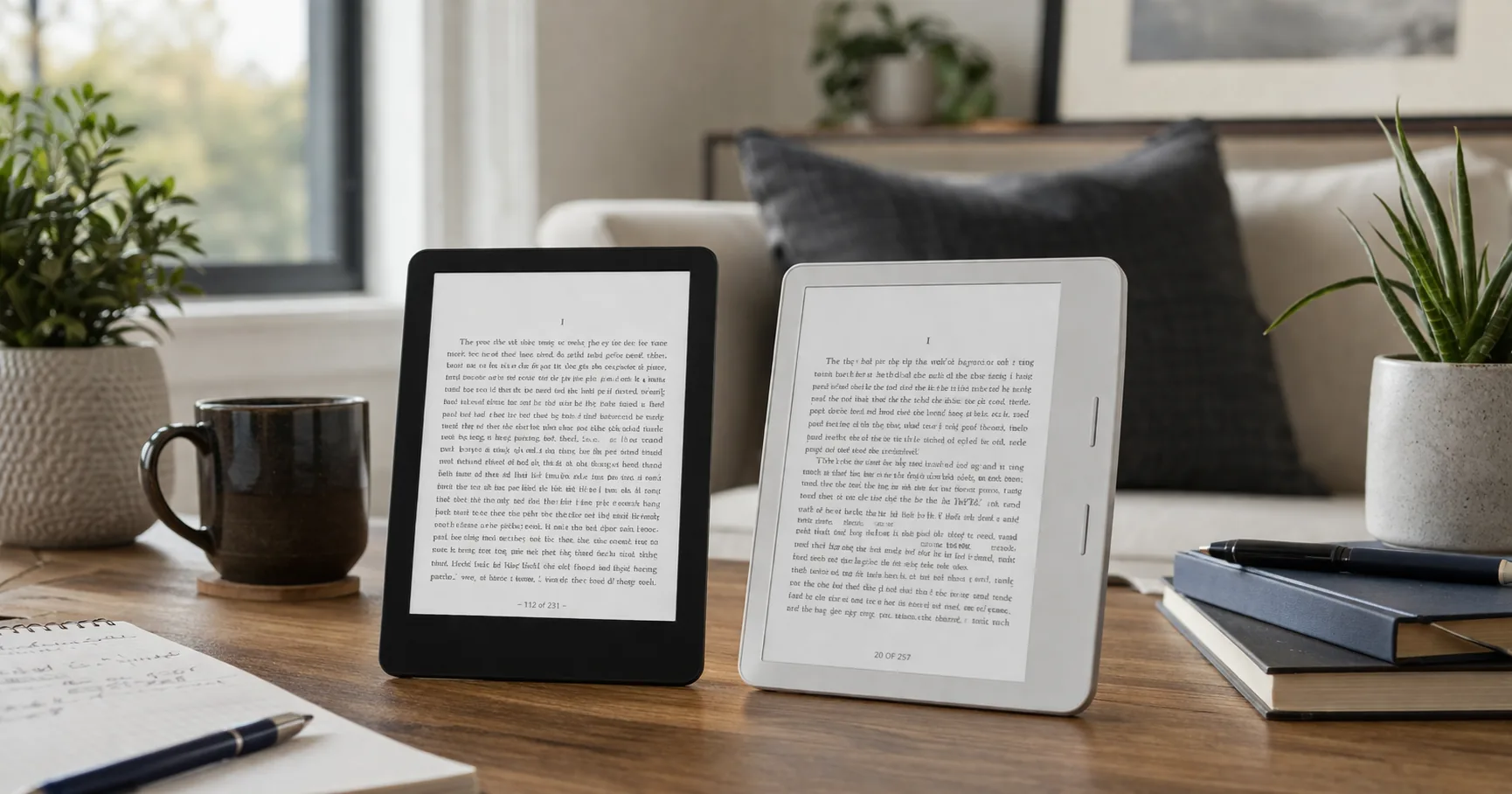
Both of these read books beautifully, so the comparison isn’t really about quality. It’s about a fork in the road. One path is the safe, mainstream ereader that does the core job with the least friction. The other is the more distinctive device built around color and physical page-turn buttons, for readers who want their ereader to do a little more than turn black text on a white page.
That’s the honest way to frame Kindle versus Kobo this year. The Kindle Paperwhite is the default, the device most people will be happy with and never think twice about. The Kobo Libra Colour is the specialist, the one that makes sense when its specific extras are exactly what you came for. Neither is a mistake. The question is which reader you are.
Below are the two models most people cross-shop, with the part that actually decides it: which one fits how you read, not which one wins a spec sheet.
When the Kindle Paperwhite Is the Right Call
Buy the Kindle when you mostly read words and want the least fuss. If your library is novels, nonfiction, and the occasional long article, the Paperwhite covers that with a fast, glare-free screen, long battery life, and the deepest track record of any ereader here. It’s the lower-priced of the two, and it carries the strongest buyer-confidence signal by a wide margin, which matters when both devices are otherwise doing the same basic job.
It’s also the safer gift or first ereader. The Amazon ecosystem is the path of least resistance: buying, syncing, and borrowing library books all just work, and there’s a vast catalog behind it. For someone who wants to open the box, load a few books, and start reading without learning anything, the Paperwhite is the easy answer.
The honest limit is that it plays it safe. The screen is black and white, and there are no physical page-turn buttons, so if either of those is a priority, the Paperwhite isn’t built for you. Skip the Kindle if color or buttons are the reason you’re shopping in the first place.
When the Kobo Libra Colour Is the Right Call
Buy the Kobo when the extras are the point. Its color E Ink screen gives comics, graphic novels, illustrated books, and cookbooks a genuinely different feel than any black-and-white reader, and the physical page-turn buttons are a real day-to-day comfort, especially one-handed or in bed. For a reader who annotates, highlights, or reads visual content, the Libra Colour earns its keep in ways a plain ereader can’t.
It also appeals to readers who want out of the Amazon walled garden. Kobo leans into open formats and library-borrowing workflows that some readers strongly prefer. If you’ve consciously decided you don’t want your reading tied to Amazon, that alone can settle it.
The trade-offs are straightforward: it costs more, and its track record is smaller, simply because fewer people own it. Skip the Kobo if you’d never actually use color or buttons, because then you’re paying a premium for a more specialized device whose advantages you’d leave on the table.
Where They Feel the Same
For straight text reading, the two are closer than the price gap suggests. Both have sharp, glare-free 7-inch screens, both are comfortable to hold for hours, and both handle the fundamental job, getting out of the way so you can read, with no real drama. If all you ever do is read novels in black and white, you’d be happy with either, and the decision comes down to price and ecosystem rather than experience.
The separation only appears at the edges: color content, button-based page turns, and which bookstore and library system you’d rather live inside. Those are the things worth deciding on, because the core reading experience won’t push you either way.
The Kindle Paperwhite is the ereader to recommend when you don’t know anything else about the buyer. It has the stronger rating, the far deeper review base, and the lower price in this matchup, which is a hard combination to argue with in a category where daily comfort beats novelty.
Its strengths are the boring, important ones: a fast 7-inch glare-free display, long battery life, and an ecosystem that makes buying and borrowing books effortless. For reading novels and nonfiction with as little friction as possible, it’s the path of least resistance, and the enormous base of long-term owners behind it gives you confidence the experience holds up over years, not just out of the box.
Its weakness is exactly its strength turned around. It’s the conventional choice, so it doesn’t offer color or page-turn buttons. If you specifically want either, the Paperwhite will feel a step behind, and the Kobo is the better home for you.
Best for: most readers who want a dependable, low-fuss ereader for text.
Kindle Paperwhite 16GB
The Kobo Libra Colour is the more distinctive device, and it knows it. It costs more and has a smaller base of owners, but it offers what the Kindle here doesn’t: a color E Ink display, physical page-turn buttons, and a setup that suits readers who care about comics, illustrated content, and annotation.
That doesn’t make it the automatic winner. It makes it the better fit for a narrower reader. If color or buttons or open-format flexibility is the reason you’re shopping, the Libra Colour makes a genuine case. If those things don’t matter to you, the higher price gets harder to justify, and you’d be buying capability you’d never use.
There’s enough of a track record here to take it seriously, just not the deep, years-long base of feedback the Paperwhite carries. For the right reader, that’s a fine trade.
Best for: readers who want color, page-turn buttons, or a non-Amazon ecosystem.
Kobo Libra Colour
Which One Should You Buy?
If the scenarios leave you torn, a few quick questions usually settle it.
What do you actually read? Mostly text means the Kindle is the rational pick. Comics, illustrated books, or cookbooks tilt it firmly toward the Kobo’s color screen.
Do you want buttons? If turning pages with a physical button matters to you, especially one-handed or lying down, only the Kobo offers it. If you’re happy tapping the screen, it’s a non-issue.
Which ecosystem do you want? If you’re already in Amazon’s orbit and value the smoothest buying and borrowing, lean Kindle. If you’d rather avoid the walled garden and prefer open formats, that points to Kobo.
Does the price difference matter? When you’d never use color or buttons, paying the Kobo premium buys you nothing you’ll notice, and the Kindle is the smarter spend.
Most readers should start with the Kindle Paperwhite. It’s cheaper, far more proven, and easier to recommend to the average reader who mainly wants to read text without thinking about the device. For everyday reading, that balance is hard to beat.
The Kobo Libra Colour is the better buy when its advantages are precisely what you want. If color, page-turn buttons, or a non-Amazon ecosystem are the reasons you’re shopping, it’s worth the premium. If not, the Kindle remains the better pick for most people.
In short, Kindle wins on safety and value. Kobo wins on distinctiveness.
What matters most when choosing between Kindle and Kobo?
How you actually read. If you want the safest mainstream choice with the deepest track record, the Kindle has the edge. If you specifically want color or page-turn buttons, the Kobo becomes much easier to justify.
Which is the better value right now?
For most buyers, the Kindle, because it costs less and has a far larger base of owners behind it. The Kobo is worth the premium only if its color display and button-based design genuinely matter to you.
Should I just buy the cheaper one?
In this matchup the lower-priced Kindle also has the stronger confidence signal, so it’s the easy default unless you have a clear reason to prefer the Kobo’s features.
Is the color screen worth paying more for?
Only if you read content that benefits from it, like comics, illustrated books, or cookbooks. For plain text, color adds little, and the extra cost is hard to justify.
When is the Kobo the right choice?
When its specific strengths are what you came for: color, physical page-turn buttons, or a preference for a non-Amazon ecosystem. If none of those apply, the Kindle is the better buy.