
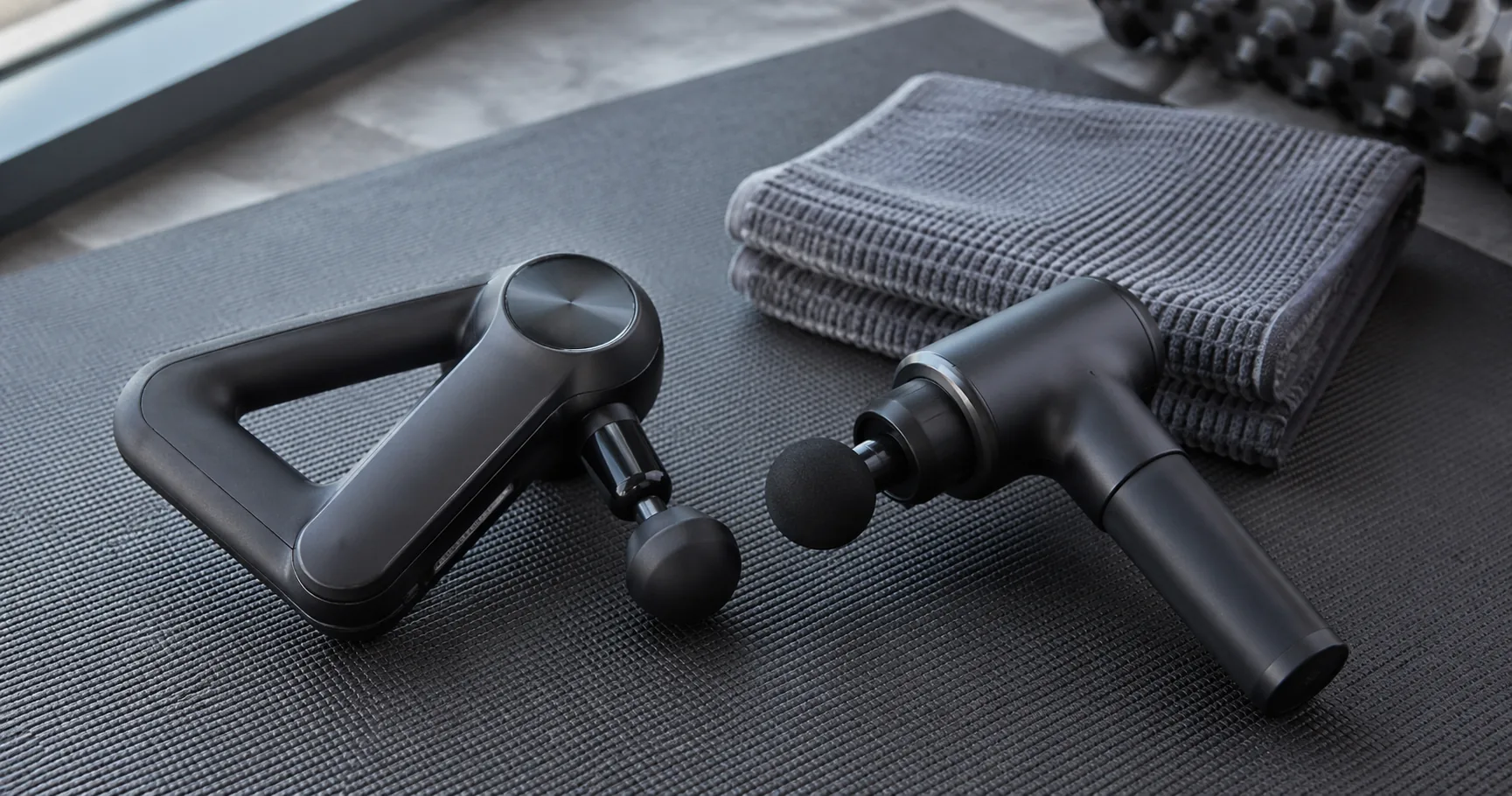
Two brands sit at the top of the percussion massager market, and most buyers end up choosing between exactly these two. Therabody’s Theragun line and Hyperice’s Hypervolt line have been trading blows for years. Both show up in pro locker rooms, both land in the same premium price bracket, and both promise the same payoff: faster recovery, less stiffness, fewer trips to a massage therapist.
The two flagships that go head to head are the Theragun Prime and the Hypervolt 2 Pro. They carry the same star rating, the same five speed settings, and the same Bluetooth-and-app setup. So a feature checklist will not separate them. What separates them is how each one feels in your hand and how you plan to use it. The rest of this comparison is built around that, not a spec sheet.
For most buyers the Theragun Prime is the safer pick. Its triangle handle makes working your own back and shoulders far easier, it has the deeper review base of the two, and it usually costs a little less. Choose the Hypervolt 2 Pro instead if a lighter body and a stronger motor matter more to you than the grip.
The Theragun Prime is Therabody’s mid-tier flagship, built to deliver the core Theragun experience without the heated head of the Pro Plus or the premium build of the Elite. It holds a strong rating across the larger review base in this matchup.
Its defining feature is the patented triangle handle. Nearly every long review brings it up unprompted, because the three-grip shape lets you switch orientations and reach your own upper back, shoulder blades, and hamstrings without bending your wrist into an awkward angle. Owners coming from cheaper massagers tend to describe the Prime as reaching muscle that the budget guns never touched, and many single out the handle as the reason solo back work is finally comfortable. The current generation also runs quieter than older Theraguns, quiet enough to use during an evening on the couch.
It runs five speed settings shown on individual indicators and ships with four foam attachments. The Therabody app pairs over Bluetooth and adds guided routines for common issues like plantar fasciitis and sciatica. Battery life draws steady praise, with owners running several full sessions before a recharge.
Skip this if you mostly want raw intensity in the lightest possible body, because it is the heavier of the two and its motor is tuned for comfort more than peak punch. As with most premium massagers, a few owners report a battery giving out after the first year, so a protection plan is worth considering.
Theragun Prime
The Hypervolt 2 Pro is Hyperice’s most powerful percussion device, and that is the whole reason to choose it. Owners describe the top settings as a clear step up in intensity from standard guns, deep enough that most people never need the higher speeds at all. The Quiet Glide design keeps it about as quiet as the Theragun despite the stronger motor.
It ships with five interchangeable heads, one more than the Prime, and pairs with the Hyperice app over Bluetooth for automatic speed adjustment and guided athlete routines. The body is noticeably lighter than the Theragun, which is its other real advantage. On a quick five-minute session that hardly registers, but across a long full-body cooldown the lighter weight means your arm gives out later than your muscles do.
Owners who do daily, lengthy recovery sessions tend to land here for exactly that reason. The standard handle is comfortable and familiar, just not as clever as the Theragun’s for reaching your own back.
Skip this if your main use is treating yourself solo, since the straight handle makes back and shoulder angles harder to hit than the triangle grip does. Long-term durability draws the same caution as its rival, with isolated reports of battery or heat trouble, so factor in a protection plan here too.
Hypervolt 2 Pro
Tie-Breakers
The handle is where the Theragun pulls ahead, and it matters most when no one is helping you. If you treat your own back, your own shoulders, and the backs of your legs with no partner driving the gun, the triangle grip removes the wrist contortion that straight-handle guns force on you. It is the single most-praised thing about the Theragun line, and it is a genuine quality-of-life difference for solo users. The moment someone else can hold the gun for you, that edge mostly disappears and the decision shifts to weight and power.
Weight swings the choice the other way for long sessions. On a quick targeted pass over one sore muscle, the difference between the two is irrelevant. On a fifteen- or twenty-minute full-body routine after a hard run or lift, the Hypervolt’s lighter body means your arm stays fresh longer. People who recover daily with long sessions often name this as the reason they went Hypervolt, while weekend users with shorter sessions rarely notice it.
Motor power is the Hypervolt’s clearest argument. Its motor is the stronger of the two, and owners describe a deeper, more aggressive percussion at the top of the range. The Theragun is no weakling, but if you have larger muscle groups or a higher pain tolerance and you actually use the upper speeds, the Hypervolt’s extra headroom is something you will feel. If you live on the lowest couple of settings like most owners do, both guns give you the same effective treatment and this stops mattering.
Price tends to settle it for everyone in between. The Theragun usually lands a little cheaper while giving you the more ergonomic handle and the deeper review base, which is why it is the default recommendation. The Hypervolt’s lighter body and stronger motor are real, but they are only worth the step up if you have already decided that weight or peak power solves a specific problem you are having.
If you are still split after all that, a few smaller factors usually tip it.
Who runs the gun is the first. Solo treatment leans Theragun for the handle every time. A partner who can reach your back for you neutralizes that advantage and frees you to pick on weight and power.
Session length is the second. Short, targeted sessions make the weight difference vanish, so the cheaper, better-gripped Theragun wins. Long daily cooldowns make the Hypervolt’s lighter body the kinder choice for your arm.
Speed habits are the third. Most owners of both guns settle on the lowest one or two speeds for everyday use. If that is you, the two are effectively the same machine and the lower price wins. If you genuinely lean on the top setting against dense muscle, the Hypervolt’s stronger motor earns its keep.
Durability is the last, and it applies to both. Each gun has scattered reports of a battery failing somewhere after the first year, and each carries a one-year manufacturer warranty. Owners of both brands tend to recommend a protection plan, and on a purchase at this price that may or may not outlive its warranty, the small add-on is reasonable insurance either way.
How to Choose Between Theragun and Hypervolt
Start with how you will actually hold the thing. Treating your own body with no helper makes the Theragun’s triangle handle a tangible everyday benefit, because it removes the wrist strain that comes with a straight handle. Hand the gun to a partner and that edge cancels out, leaving weight and power to decide.
Then weigh your typical session. Quick, focused work on a single muscle makes the gun’s weight a non-issue, so the Theragun’s handle and price carry the day. Long full-body recovery makes the Hypervolt’s lighter body the gentler option for your arm over time.
Finally, be honest about the speeds you use. If you live on the low end like most owners, both guns deliver the same result and the Theragun’s value wins. If you need the top setting on heavy muscle, the Hypervolt has the headroom for it. Either way, plan for a protection plan, because both brands ask you to take a small durability gamble at this price.
Is the Theragun or Hypervolt better for athletes?
For self-treatment after training, the Theragun Prime’s triangle handle wins because it makes solo back and shoulder work easier. For long sessions where arm fatigue matters, the Hypervolt 2 Pro is the lighter gun. Both reach the intensity range most athletes need.
Which is quieter, Theragun Prime or Hypervolt 2 Pro?
They are effectively tied in everyday use, and owners of both call them quiet enough to run while watching TV. The current Theragun is a clear improvement over older models that had a noise reputation, and the Hypervolt’s Quiet Glide design holds up in practice.
Is the Hypervolt 2 Pro worth paying more than the Theragun Prime?
For most people, no. The Theragun usually costs less, has the deeper review base, and its triangle handle is the more ergonomic design for solo use. The Hypervolt earns the upgrade only if you specifically want its stronger motor or its lighter body.
How long does the battery last on each?
Both run several full sessions per charge in real use, and owners of both consistently call battery life a strength. Each also has isolated reports of a battery giving out after the first year, which is the main reason long-term owners suggest a protection plan.
Can either replace going to a massage therapist?
For routine maintenance like post-workout soreness, desk stiffness, and basic recovery, both can stand in for most therapist visits. For deeper structural problems such as a frozen shoulder or a serious injury, neither replaces a trained professional, though both work well between appointments.
Which one comes with more attachments?
The Hypervolt 2 Pro ships with five heads, one more than the Theragun Prime’s four. In practice a few attachments do most of the work, so the count matters less than the handle design and the weight.