
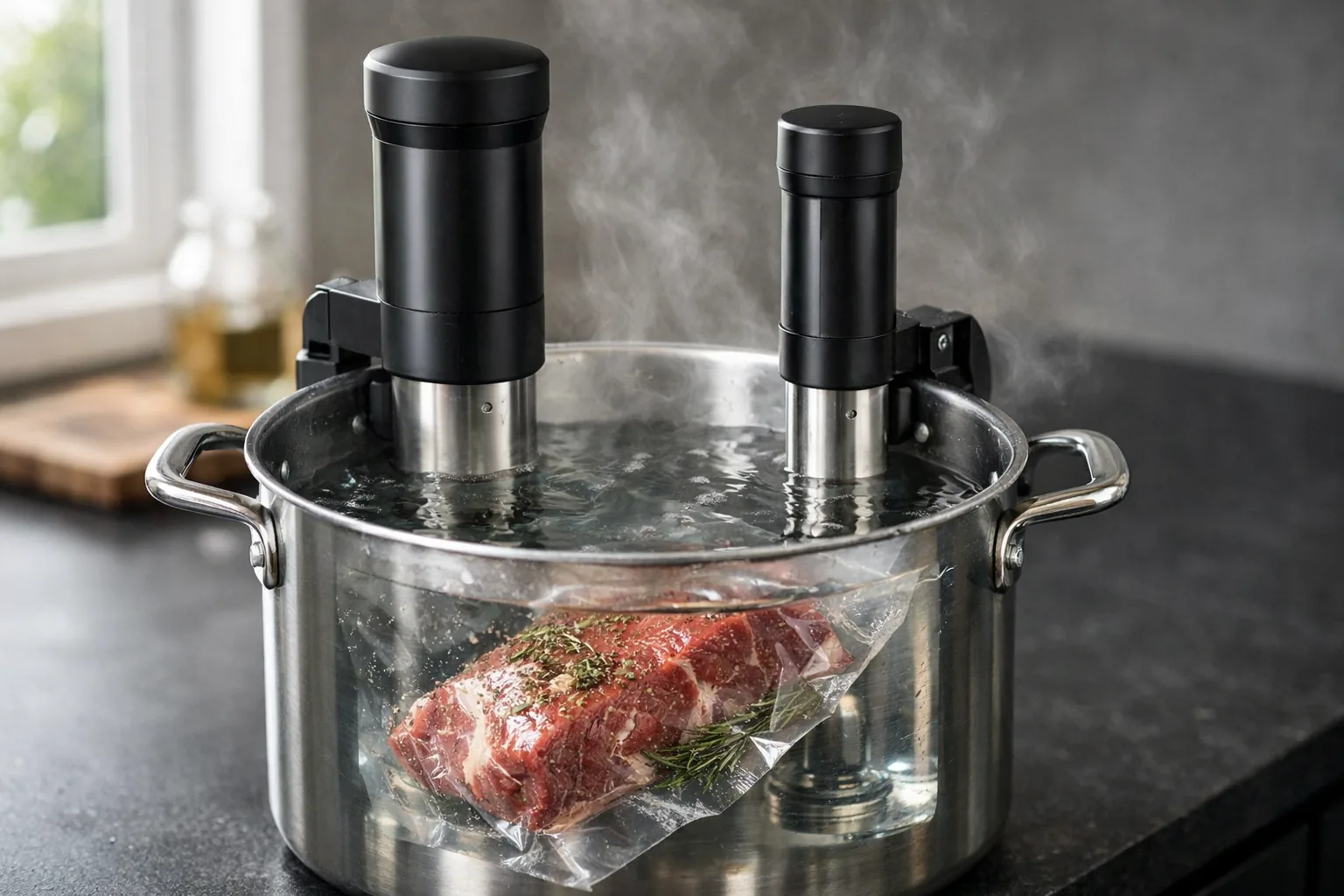
Sous vide is the rare appliance you leave running unattended for hours, sometimes overnight, sometimes across a full day. That single fact reshapes the whole buying decision. You are not just picking a cooker, you are deciding how much you trust a piece of software to keep a water bath at temperature while you sleep. And that is exactly where Anova and Breville’s Joule split apart, because one of them puts a dial and a screen on the machine itself, and the other runs entirely through your phone.
Almost every shopper narrows the home sous vide market down to this same pair: an Anova Precision Cooker or the Breville Joule Turbo. They look close on a spec sheet, but they are built for two different kinds of cook. One is a workhorse with a deep, long-tested recipe library and physical controls. The other is a smaller, premium, software-first tool with a clever Turbo mode. The rest of this guide sorts out which one matches your kitchen, and your patience with apps.
Our pick for most home cooks is the Anova Precision Cooker 2.0: the higher-rated of the head-to-head pair, with the deepest review record in the category, a longer warranty, and a price well below the Joule Turbo. Physical controls on the unit mean you can cook even when the app, or your router, has a bad day.
The Anova Precision Cooker 2.0 is the model most people actually buy, and its review record dwarfs anything else in the category. It heats a water bath up to roughly three gallons through a strong pump, and it clamps to the side of a pot with an adjustable clip. The reason it stays the default recommendation is the interface: a physical dial and display let you set time and temperature right on the unit, with WiFi and Bluetooth sitting on top as options rather than requirements. If the app is being difficult, or your network drops, the cook keeps going.
Owners coming from older Anova Pro units consistently note that this generation runs noticeably quieter, which matters when a batch of short ribs is humming away in the kitchen overnight. The other quiet advantage is the recipe library, which has been refined over many years and remains one of the deepest in the category. That depth is a real part of why Anova still leads on Amazon even after the Joule Turbo arrived.
Skip this if your kitchen is tight on space or you store appliances in a drawer. The clamp is wider than the Joule’s and wants a bigger-mouthed pot. One durability note worth knowing: owners report the internal impeller on this generation is plastic rather than the stainless of older models, and a small fraction have had it fail, which is part of why the longer warranty matters here.
Anova Precision 2.0
The Breville Joule Turbo is the premium, design-forward pick. It is physically much smaller than the Anova, narrow and tall, so it slips into containers the Anova can’t and tucks into a drawer for storage. Its headline feature is Turbo mode, which Breville says can cut cook time nearly in half on thinner proteins like chicken breast and steak. The software is the best in the category: visual doneness previews, finish-time estimates, and step-by-step cook guides all live in the Joule app, and a magnetic base helps it sit securely on steel or cast-iron pots.
For a cook who wants a compact gadget that drives everything through a phone, this is the machine. The design genuinely impresses owners, who single out how small it is and how well it works in narrow pots. If your kitchen already runs through your phone and you like the idea of guided cooks, the Joule leans into exactly that.
Skip this if you want any kind of physical control or you cook long, unattended sessions. The Joule Turbo has no buttons at all. Every setting runs through the app over a wireless connection, so a router hiccup or an app problem can interrupt a cook in progress. That single design choice drives the bulk of its critical reviews, which cluster heavily around connectivity dropping mid-cook. Its warranty is also shorter than Anova’s, and it costs considerably more.
Breville Joule Turbo
Anova's Full Lineup, Briefly
The set-it-overnight cook. If you run long, unattended sessions, short ribs overnight, a brisket across a workday, the Anova is the safer machine by a wide margin. Its physical controls mean the cook does not depend on your home network staying up for eight or twenty-four hours straight. The Joule’s reliance on a live connection is precisely the wrong trait for a hands-off, all-night cook, and its critical reviews bear that out.
The phone-first, guided cook. Flip the situation and the Joule shines. If you already run your kitchen through your phone, want guided recipes that shorten the learning curve, and mostly cook thinner proteins where Turbo mode pays off, the Joule’s software is genuinely better and the experience feels modern in a way the Anova’s does not. For a confident, connected cook doing weeknight steaks and chicken, it’s a pleasure.
The small-kitchen cook. Storage decides a lot of purchases. If your appliances live in a drawer and you cook in narrow pasta pots, the Joule’s compact body is a real, daily advantage. The Anova wants a wider container and more shelf space, and in an apartment kitchen that can be the whole decision on its own.
The value-first cook. For someone testing whether sous vide will even become a habit, the Anova is the lower-risk entry. It costs well under the Joule, has far more long-term data behind it, and a longer warranty to back it up. Spending premium money on a technique you might use twice is the classic sous vide regret, and the Anova sidesteps it.
When you’re genuinely torn, three smaller things settle it. The first is how much you want to lean on an app. If the honest answer is “as little as possible,” the Anova’s dial wins by default, and if it’s “I’d happily run everything from my phone,” the Joule’s software is the better tool. The second is the kind of food you cook most. Thin proteins on weeknights tilt toward the Joule’s Turbo mode; thick roasts, eggs, and long projects make Turbo mostly irrelevant and favor the Anova’s steadier, hands-off approach. The third is durability insurance. Because a sous vide spends hours submerged in moving hot water, the longer warranty is not a throwaway spec, it’s the protection most likely to actually get used. Anova holds the edge there. App appetite, food type, and warranty length usually break the tie before price even enters the picture.
The Precision 2.0 sits in the middle of Anova’s range, and if it isn’t quite right, three siblings round it out. The Anova Nano is the entry-level model: smaller, Bluetooth-only, sized for modest pots, and the highest-rated of the Anova units, which makes it the easy first sous vide for an occasional cook. The Precision Cooker 3.0 is the newer-generation step up, with a stronger pump and faster heat-up, though at today’s prices the 2.0 still tends to be the better value unless you specifically want the extra power. The Precision Cooker Pro is the commercial-grade unit, built for continuous duty and multi-day projects. It’s overkill for most kitchens, but it’s the right call if you cook for big crowds or want a machine that will outlast everything else on your counter.
How to Choose Between These Two
The decision really comes down to three questions. First, how much do you want to rely on an app? If the answer is “as little as possible,” buy the Anova 2.0 or one of its siblings, since you can set a temperature and time on the unit and never open the app. If you already live in your phone, the Joule’s software is the better experience.
Second, how much does kitchen size matter? A small kitchen or drawer storage tilts hard toward the Joule’s compact footprint. Plenty of counter space and a dedicated sous vide container make the Anova’s size a non-issue.
Third, what’s your budget and how committed are you? The Joule Turbo is a premium buy for a connected cook who’s sure they’ll use it. The Anova 2.0 is the solid mid-range choice with more data and a longer warranty behind it, and the Anova Nano is the low-risk way to find out whether sous vide earns a permanent spot in your routine before you spend more.
Which is better for a beginner, Anova or Breville Joule?
Anova. Physical controls on the unit let a beginner set a target temperature and time without learning the app first. The Joule Turbo requires app setup before the first cook, which adds friction for someone who just wants to try the technique.
Does the Breville Joule Turbo work without WiFi?
No. The Joule Turbo has no physical buttons, so all controls run through the app over a wireless connection. Owners report that dropped connections can interrupt long cooks, which is the single most common theme in its critical reviews.
Is Turbo mode on the Joule actually faster?
On thin proteins like chicken breast and steak, yes, owners confirm meaningful time savings. Turbo mode matters far less for thick roasts or eggs, where the long, gentle cook window is the whole point of sous vide.
Why does Anova have so many more reviews than the Joule?
Anova has sold immersion circulators for many years, and the Precision 2.0 has broad distribution. The Joule Turbo arrived more recently with a smaller installed base. The gap reflects time on shelf, not which one is better today.
Which one has the better warranty?
Anova. Its Precision 2.0 and higher models carry a longer manufacturer warranty than the Joule Turbo. For an appliance that runs in moving hot water for hours, that extra coverage is real protection against pump or heating-element failures that tend to show up after heavy use.
What pot size do I need for the Anova 2.0 vs the Joule Turbo?
The Anova 2.0 clamp wants a wider-mouthed pot and is happiest in a large stockpot or a dedicated sous vide container. The Joule Turbo is smaller and works in narrower pots, which is why cooks with tight kitchens often prefer it despite the higher price.