
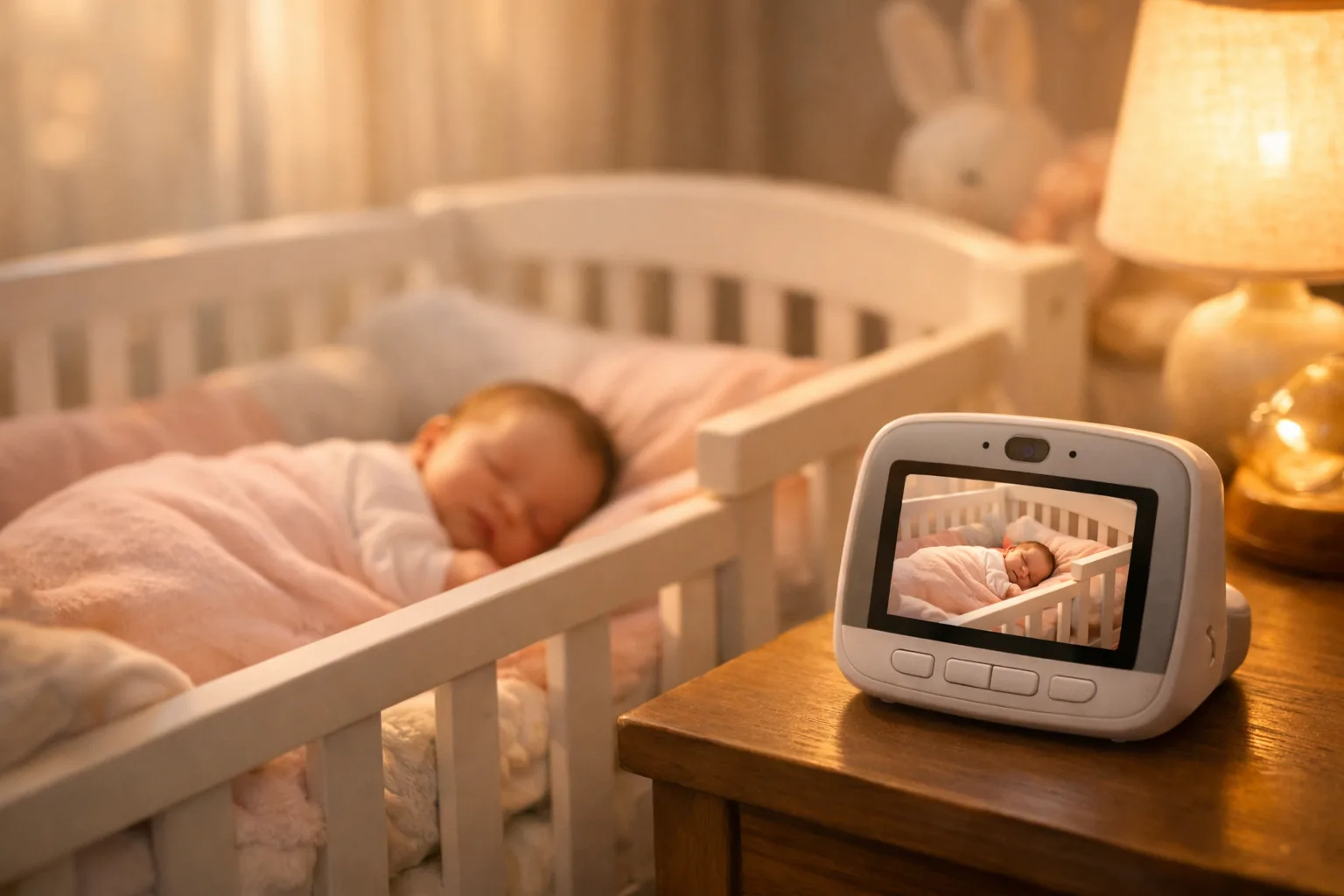
Most parents buy a baby monitor for the wrong reason. They focus on resolution — 1080p versus 720p — and ignore the two things that actually matter at 3 a.m.: the parent unit’s battery should still be alive, and the signal should not drop when you walk to the end of the hallway. Resolution gets you a sharp picture of a baby you can’t see because the signal cut out.
The other quiet mistake is picking a WiFi monitor without thinking through whether your home internet is reliable enough. If the router resets at 2 a.m., a WiFi monitor goes dark; a closed-loop dedicated monitor doesn’t notice. This guide is built around those two priorities — overnight battery, signal reliability — with WiFi access framed as a feature you opt into, not a default.
Who this is for
- First-time parents who want the simplest reliable setup → HelloBaby 5″ No-WiFi. Plug in, pair once, done.
- Parents who keep the monitor on a bedside table all night and want a big readable screen → HelloBaby 6″ IPS.
- Twins, or a baby sharing a room with a sibling → Blemil 6″ dual-camera. Both feeds on one screen.
- One parent often traveling for work and wanting to peek from a hotel → VTech VM901 with the smartphone app.
- You already trust HelloBaby and want a second camera for a second room or angle → HelloBaby Upgrade dual-camera.
The HelloBaby 5″ No-WiFi is the pick for parents who want to plug the monitor in, pair it to the camera once, and not think about it again. It does not connect to the internet. It does not need an account. There is no app to update. The camera talks directly to the parent unit on a closed frequency, which means it cannot be remotely accessed by anyone — full stop.
The parent unit runs roughly a full day on a charge in voice-activated display mode (screen lights up when the baby makes noise). That is far longer than typical 8-12 hour units, and it’s the single feature that comes up most in long-term owner reports. Pan, tilt and zoom are controlled from the parent unit, which is useful when the baby rolls out of frame.
Skip this if you specifically need smartphone access. There is no app — that is the entire point.
HelloBaby 5" No-WiFi
The HelloBaby 6″ IPS upgrade is the same closed-loop system with a noticeably better screen. The bigger IPS panel means you can read the baby’s position from across a bedside table without squinting. Color accuracy on the IPS panel is also better than standard LCD, which sounds minor until you’re trying to tell whether a baby’s face is flushed or just shadowed.
Same long parent-unit battery, same no-WiFi privacy model, same PTZ control. The differentiator is purely the display, but for parents who use the monitor intensively — checking the screen multiple times per night — the upgrade is the practical one.
HelloBaby 6" IPS
The Blemil 6″ comes with two cameras in the box. That’s the pick — not a marketing point. Households with twins, with a baby in a shared room, or with two nurseries don’t need to buy a single-camera unit and figure out compatibility later. The 6″ parent screen runs split-view, showing both feeds at the same time.
Battery runs comfortably overnight in voice-activated mode and a normal sleep cycle’s worth in continuous video. The 1,000-foot line-of-sight range is among the longer claims on this list; in real homes (through walls), expect closer to half that, which is still enough for typical two-story coverage.
Skip this if you only need one camera. You’re paying for a second one you won’t use.
Blemil 6" Dual-Camera
The VTech VM901 is the only pick on this list that monitors over WiFi and the dedicated parent unit at the same time. That dual-mode is the actual reason to choose it — one parent at home with the parent unit, another parent traveling with the app, both seeing the same feed. The 1080p FHD camera produces the sharpest image of any pick here.
The environmental sensors (temperature, humidity, air quality) are a real-feature, not a marketing line — they’re genuinely useful for first-time parents calibrating nursery conditions. Range is effectively unlimited when on the app, which is the whole point of going WiFi.
Skip this if your home internet drops more than occasionally. A WiFi monitor goes dark with the router. Also skip if privacy concerns are your top priority — closed-loop is the safer category for that.
VTech VM901
The HelloBaby Upgrade is the pick for parents who already trust HelloBaby’s closed-loop reliability and want a second camera — either a second nursery, a playroom view, or a second angle on the same room. The parent unit cycles between cameras or shows picture-in-picture. PTZ works on both cameras independently.
It’s the bridge between the simple single-camera HelloBaby and the dedicated dual-camera Blemil, with the advantage of staying inside the HelloBaby ecosystem if you’ve already started there.
HelloBaby Upgrade Dual
The trade-off you're actually making
The interesting decision is between the HelloBaby family and the VTech. They solve different problems with different risk profiles.
HelloBaby is a closed system: nothing connects to the internet, nothing can be remotely accessed, nothing breaks when the router resets. The cost is that you only ever monitor the baby from inside the house, from the parent unit. VTech opens the system to your phone, which is genuinely useful when one parent travels — and it adds the environmental sensors as a bonus. The cost is dependency on a stable home network, plus the broader privacy footprint of any internet-connected camera.
If you fully expect to be in the same house as the baby every night, HelloBaby wins. If “I’m on a work trip and want to peek before bed” is part of your normal use, VTech wins. There is no third answer that splits the difference cleanly — the architecture is the choice.
WiFi vs no-WiFi
The defining decision. Closed-loop monitors are private, simple and immune to internet outages. WiFi monitors give you smartphone access at the cost of network dependency and a broader attack surface. Neither is wrong — both are widely used safely. Pick based on whether remote viewing or privacy carries more weight in your household.
Parent-unit battery
The honest test: can the parent unit run from bedtime through morning without being plugged in? Specs usually list voice-activated mode (longer) and continuous video mode (much shorter). Continuous video is the worst case — plan around it.
Video resolution and screen size
For night vision, confirming position and breathing, 720p with strong infrared is enough. 1080p only pays off when paired with a larger screen and good color reproduction. A bigger screen on a 720p camera is usually more useful than a smaller screen on a 1080p camera.
Range, in real homes
Manufacturer range numbers are line-of-sight outdoors. Through interior walls, real range is typically 40-60% of that. For a standard home where the baby’s room is across the hall, even 300-foot specs are usually fine. For larger homes or basement-to-second-floor monitoring, prefer 800-foot+ specs.
Two-way audio
Standard on all five picks here. Useful for soothing a baby who stirs without entering the room — often enough to return them to sleep without a full wake-up. Audio clarity on the baby-side speaker varies meaningfully between units, and is one of the few specs not always reflected in marketing.
Are WiFi baby monitors safe?
They can be, but the risk profile is real. Use a unique strong password on the monitor account, keep firmware updated, and put the camera on a router with WPA3 if possible. Closed-loop monitors avoid the question entirely — they cannot be accessed remotely because there is no remote access path. Both categories are used safely; the WiFi risk is manageable, not eliminated.
How long should the parent unit run overnight?
Plan for 10-12 hours minimum from bedtime to morning. Units rated “8 hours” usually mean continuous video at full brightness, which is the worst case. Voice-activated display (screen on only when sound is detected) extends battery substantially. Long-battery units like the HelloBaby family give you genuine margin.
Do I really need 1080p video for a baby monitor?
For the actual job — confirming the baby is in position and breathing — 720p with strong infrared night vision is enough. 1080p matters most when paired with a larger screen or smartphone view; on a small parent-unit screen, the extra resolution is not visible. A bigger screen at 720p is usually more useful than a smaller screen at 1080p.
Is two-way audio worth using?
It is, in a specific way. Many babies who stir mid-sleep will resettle to a parent’s voice without needing to be picked up. Two-way audio lets you try the voice fix first, which often returns the baby to sleep faster than walking in. All five picks here include it; clarity on the baby-side speaker varies, with HelloBaby’s reports being among the most consistent.
5" or 6" screen — does it matter?
For parents who glance at the monitor occasionally, 5″ is fine. For parents who keep the monitor on a bedside table and read it through the night, 6″ with an IPS panel is the practical upgrade — easier to read at a glance without leaning in. The HelloBaby 6″ IPS is the cheapest way to get the larger screen on this list.