
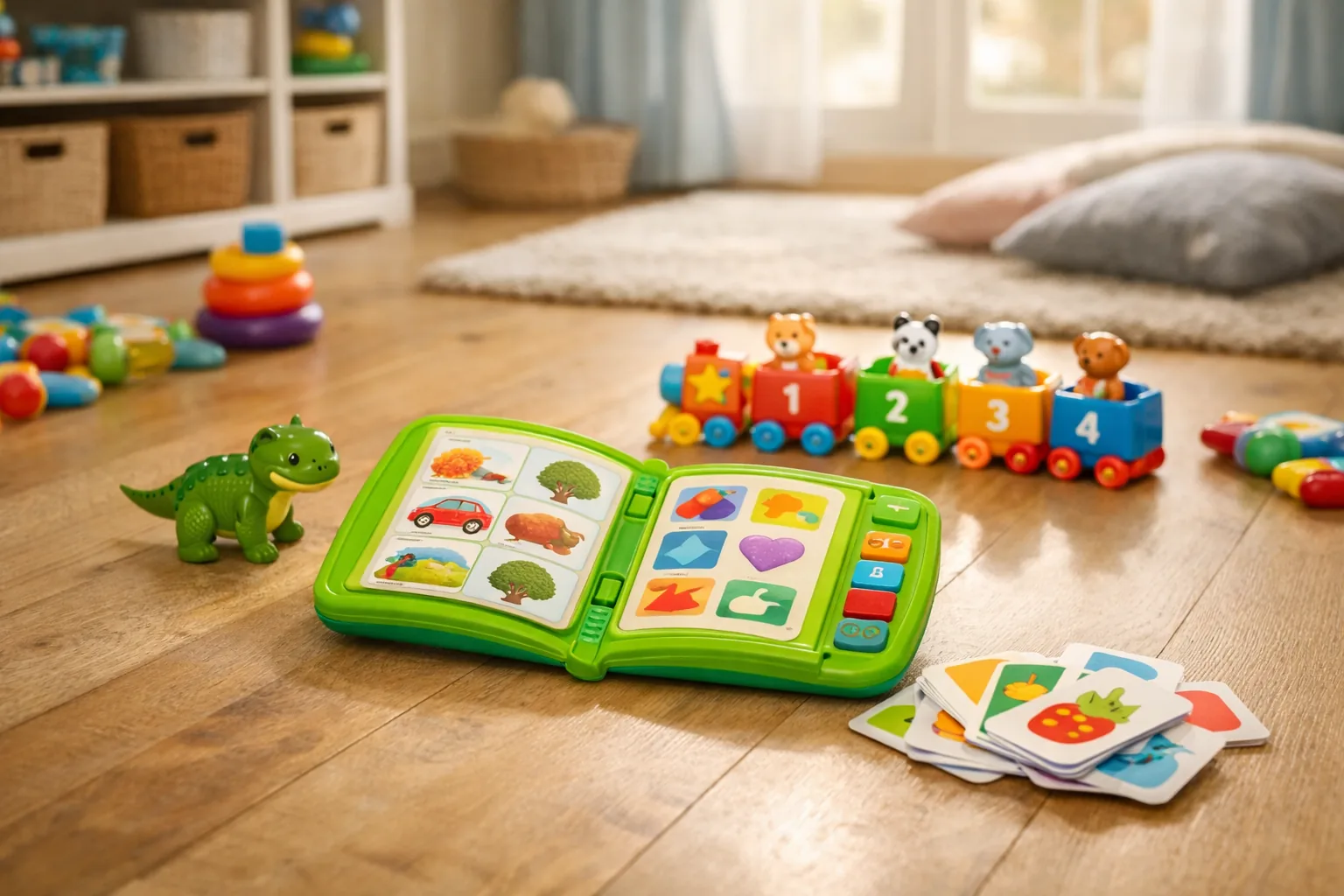
Every parent knows the toy that holds a toddler’s attention for three minutes and then lives at the bottom of the bin. The toys that actually teach are the opposite: the ones a child reaches for day after day, often for the same page or the same little ritual, learning a bit more each time without ever feeling like a lesson. That difference, between a toy that entertains briefly and one that keeps drawing a child back, is the whole game between ages one and five, when language, motor skills, and early problem-solving are developing fast.
The hard part is telling the two apart on a store shelf. Plenty of toys carry an “educational” label that is really just a sticker on an ordinary toy, and the price tag is no guide to which is which. What separates a genuine learning toy is whether it teaches through play a child is naturally pulled toward, and whether it survives the dropping, throwing, and chewing that toddlers do to everything they own.
So this list is sorted by how your child likes to play and roughly how old they are. Some toddlers are drawn to cause and effect, pressing something and getting a response. Others want to pretend and tell little stories. Some homes want screen-free, others are fine with interactive electronics. Find the row that matches your child, and the choice gets simple.
The LeapFrog Learning Friends 100 Words Book is our top pick: simple to use, genuinely durable, and one of the most-reviewed toddler learning toys on Amazon. Toddlers press the touch pages and learn through immediate audio, with no confusing buttons or menus to get in the way.
The LeapFrog Learning Friends 100 Words Book looks simple and is quietly well engineered. It is a sturdy board book with touch-sensitive pages: your toddler presses a picture or word and hears it spoken in a clear, natural voice, with no battery fiddling or menu to navigate. That directness is why it works for very young toddlers, who grasp almost at once that pressing makes something happen.
The bilingual mode is the feature parents single out, with an English and Spanish toggle that introduces a second language without it feeling forced. The content spans colors, foods, animals, body parts, and actions, plus a light-up button with songs and facts, so there is enough variety to keep a child returning. It is also small enough for a diaper bag or car seat, which makes it one of the most genuinely portable learning toys here. It is one of the most-reviewed toddler toys on Amazon, and the rating has stayed high across that huge base.
Skip this if your child is closer to four or five. The vocabulary is pitched at younger toddlers, and older preschoolers will outgrow it.
LeapFrog 100 Words Book
For a two to five-year-old ready for more than a single-purpose book, the LeapFrog 2-in-1 LeapTop Touch is a strong step up. Styled like a small laptop, it appeals to kids who watch a parent work, and it folds open into a tablet mode that feels like a real computer to a preschooler. Five learning modes cover letters and phonics, numbers and counting, music, games, and a playful messaging feature, and you can set it to spell your child’s name, which makes it feel personal.
Durability is the recurring praise in reviews, with parents describing drops that would have ended a flimsier toy and the LeapTop carrying on. The touchscreen responds immediately, giving kids the tactile feedback they like from tablets without the open internet. The battery lasts well between charges. A few parents wish the screen were brighter in direct sun and that there were a mute option, and some want more games, though what is included is solid.
Skip this if you are firmly screen-free. Even as a learning device, this is a screen-style toy, and that may not fit your household’s approach.
LeapFrog 2-in-1 LeapTop Touch
The VTech Chomp and Count Dino turns learning into physical play. Kids feed the dinosaur colored food pieces, and it recognizes each one and teaches colors, foods, shapes, and counting, responding in real time. The feeding action is the hook: insert a piece and the dino chews, names it, plays a short melody, and counts up as more pieces go in, reinforcing number order through play. With a large library of songs and sounds and a pull-along feature, it does not get stale quickly.
What makes it effective is how many things it works at once. Picking up and inserting the pieces builds fine motor skills, the repetition builds listening and comprehension, and color and shape recognition happen with no pressure. Parents report kids feeding the dinosaur for long stretches, which is the rare and valuable thing: quality independent play. There is a volume control and an auto-shutoff, both thoughtful. Some note the voice gets repetitive over long sessions, and very occasionally a food piece sticks in the mechanism.
Skip this if you want a quiet toy. It is talkative and musical by design, and that can wear on a parent over a long afternoon.
VTech Chomp and Count Dino
Not every parent wants electronics, and the Airbition Talking Flash Cards respect that while staying affordable. It is a Montessori-inspired tool, a large set of illustrated cards with spoken words, no screen and nothing complicated. The voice sounds natural rather than robotic, and the premise is as old as it is effective: your toddler pulls a card, hears the word, and naturally repeats it, which is exactly how vocabulary grows. It holds a strong rating, with parents specifically praising the value.
The illustrations look like real objects rather than cartoons, which helps toddlers connect the cards to the world. It recharges over USB, has several volume levels, and shuts off after a stretch of inactivity. The honest limits: younger toddlers under about a year and a half can struggle to insert the thinner cards on their own, it needs recharging a little more often than some expect, and it does one thing, playing words, with no games or modes.
Skip this if you want layered features and play modes. This is deliberately a single, simple learning function.
Airbition Talking Flash Cards
The Play-Act Farm Number Train takes the opposite route from the electronic picks, leaning on hands-on sorting and pretend play. It is a colorful locomotive with numbered, color-coded barns that connect like train cars, plus a set of animal finger puppets. The learning is layered: numbers through the labeled barns, colors through the design, and storytelling through the puppets, which invite kids to make the animals interact and build little farm scenarios. That is learning through creative play rather than rote drilling, which is how young brains develop well.
Parents describe kids playing with it in different ways across a single afternoon, building the train, lining barns up by color, or running stories with the puppets, and that variety is the mark of a well-made open-ended toy. Connecting the pieces builds fine motor skills, and the puppets fit small hands and seem to spark speech and expression. The minor quirks: the barn roofs do not seal tightly, so pieces can scatter if it tips, and the animal colors are whimsical rather than realistic, which may or may not bother you.
Skip this if you specifically want guided, structured learning with feedback. This toy is open-ended on purpose, and it gives back what the child brings to it.
Play-Act Farm Number Train
The trade-off: electronic or screen-free
The choice most parents agonize over is whether to allow electronic toys at all, and the honest answer is that the electronic-versus-screen-free line matters less than the quality of the toy on either side of it. A well-designed electronic toy like the VTech Dino or the LeapTop teaches through active participation, where the child does something and the toy responds. A poorly designed one just makes noise in the background. Likewise a screen-free toy like the flash cards or the farm train is wonderful only if the child actually engages with it.
So judge by participation, not by whether there is a battery inside. Electronics that demand a response and reward effort are fine in balance with physical play, outdoor time, and talking with people. The real failure mode is passive consumption, a toy that entertains while the child just watches. If your household leans screen-free by principle, the Airbition cards and the Play-Act train cover real learning with none of it. If you are comfortable with interactive electronics, the LeapFrog and VTech picks add structured feedback that toddlers respond to. Both paths work when the toy is genuinely good.
Match the toy to the developmental stage
A toy that suits an eighteen-month-old may bore a three-year-old. Read the age range, but also watch your child: are they into cause and effect, pressing things and seeing results, or into pretend and storytelling? That tells you which kind of toy will hold them.
Decide on electronics deliberately, not by default
As above, the question is whether the toy invites active participation. Both electronic and screen-free can teach well; the difference is engagement, not the battery.
Prioritize durability
Toddlers test toys in ways the maker never planned. Look in reviews for whether a toy survives drops and rough handling, since a cheap toy that breaks in two weeks costs more than a sturdy one that lasts through several children.
Favor toys that grow with the child
A toy that a one-year-old bangs on and a three-year-old uses to build or pretend stretches its value across years, and often teaches new things as the child finds new ways to play with it.
What is a sensible price range for these?
Quality toddler learning toys run from budget-friendly to mid-range, and within that span you can get proven durability and real learning value without paying for a brand name. The budget flash cards work well, the LeapFrog book and VTech Dino sit a step up, and more expensive does not automatically mean better for a toddler.
Are bilingual toys worth it?
If you are raising a bilingual household or want to introduce a second language naturally, a bilingual toy like the LeapFrog 100 Words Book is genuinely useful, since the child picks up vocabulary alongside exposure. It is not a substitute for immersion, but it helps. If a second language is not a priority, you do not need to pay extra for it.
Should I avoid electronic toys for toddlers?
Not on principle. A well-designed electronic toy that invites active participation, like the VTech Dino, is fine. The concern is overstimulation and passive watching, not electronics themselves. Keep them in balance with physical play, outdoor time, and conversation.
How do I tell a real learning toy from a gimmick?
Read reviews for mentions of actual learning, comments like “she learned her colors” or “he repeats every word.” Genuine learning toys draw that kind of feedback. Gimmicky toys get reviews about cuteness or brief entertainment with little about skills, and the depth of the reviews tells you a lot.
What age should I start with learning toys?
Around twelve months is reasonable with simple toys like the LeapFrog book; before that, sensory toys suit better. The real sweet spot for the toys on this list is roughly eighteen months through five years. Children develop at their own pace, so a forward twelve-month-old may be ready for toys aimed at eighteen months and up.