
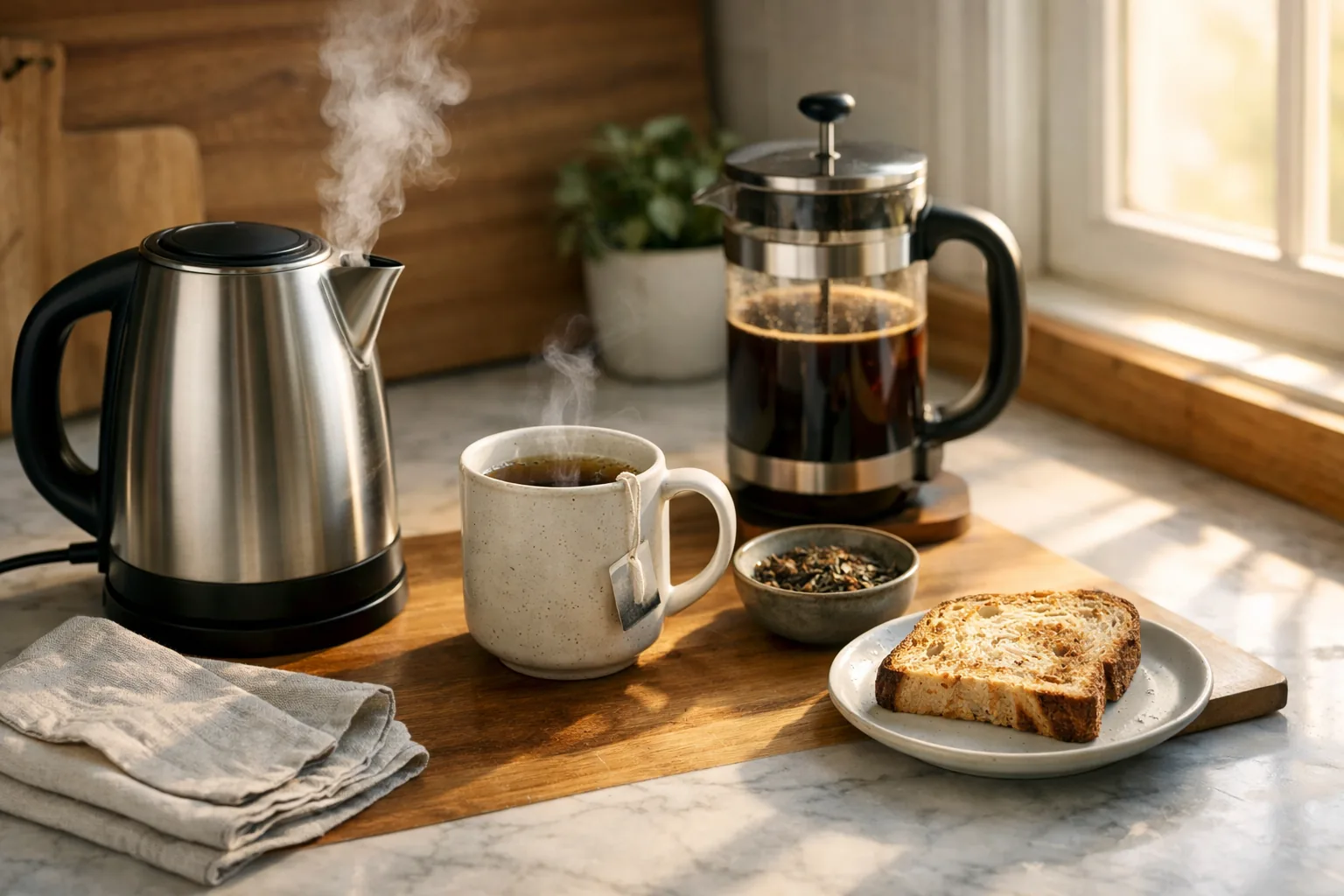
Most electric kettles do exactly one thing: bring water to a boil and switch off. For black tea, instant coffee, oatmeal, or a pot of ramen, that’s all you ever need, and a simple kettle does it faster than a stovetop and safer than a microwave. So before comparing features, it helps to know that for a lot of people the cheapest reliable kettle on this list is genuinely the right answer.
The split happens once your routine asks for more than boiling. Green and white teas turn bitter at a rolling boil and want cooler water, which is where temperature presets stop being a gimmick. Pour-over coffee lives and dies by how slowly and precisely you pour, which is the whole reason gooseneck spouts exist. And a household that fills a French press plus two mugs at once needs more capacity than a single tea drinker. The five kettles here run from a plain glass boiler to a precision gooseneck. Here’s how to find yours.
The OVENTE KG83B Glass Kettle is the best value here and the most-bought kettle of the group. It boils, shuts off on its own, protects itself from running dry, and lets you watch the water level through a glass body. For anyone who just wants fast, safe boiling without paying for presets, this is the easy default.
Why an Electric Kettle Beats the Microwave or Stovetop
A microwave heats water unevenly and can leave it superheated, which is both a minor scald risk and bad for tea. A stovetop kettle works but needs watching and won’t turn itself off. An electric kettle settles both: an enclosed heating element brings water up quickly and cuts out the moment it’s done.
In daily use the payoff is a faster morning and the freedom to walk away while it heats. Tea drinkers tend to notice more consistent results too, since the water hits the same temperature every time. For pour-over coffee the gap is wider, because extraction depends on water temperature and pour rate, and an ordinary spout simply can’t control the pour the way a gooseneck can.
The specs that actually separate these kettles are capacity, whether there’s temperature control, glass versus stainless, and wattage, which sets boiling speed. A higher-wattage kettle clears a liter in roughly a couple of minutes, while a lower-wattage one takes noticeably longer. Every kettle here shuts off automatically and guards against boiling dry.
Match the Kettle to Your Cup
- You just want fast, cheap, see-through boiling: the OVENTE glass kettle.
- One or two people, and you want a fast, dependable little stainless unit: the Amazon Basics 1L.
- A whole household to serve in one fill: the Hamilton Beach 1.7L.
- Pour-over coffee or green and white tea: the COSORI gooseneck with presets.
- A premium kettle you want to keep for many years: the Cuisinart with its long warranty.
The OVENTE is the most-bought kettle here and the cheapest, and it covers the basics cleanly. The glass body lets you see both the water level and the heating, which beats guessing inside an opaque stainless shell, and a ring of light glows while it heats and goes out when it’s done. The heating element is hidden under the base so it doesn’t sit in your water, and a washable filter in the spout catches any scale before it reaches the cup.
It’s the slowest boiler in this group, which is the trade for its low price and its lower wattage, but for everyday tea and a few mugs at a time that’s rarely an issue. A rotating base with cord storage keeps the counter tidy, it comes in several colors, and its warranty runs longer than budget appliances usually offer. Long-term owners tend to praise the two-button simplicity and the reassurance of the auto shut-off.
Skip this if you want the fastest possible boil, where the higher-wattage stainless kettles pull ahead, or you need temperature presets for delicate teas, which this doesn’t have.
OVENTE KG83B
The Amazon Basics kettle wins on doing the simple thing extremely well. It uses a high-grade thermostat, the kind found in commercial kettles, which is the reference standard for shutting off precisely at boil and holding up over years. It boils quickly thanks to a strong element, runs smaller and cheaper than the other stainless models here, and keeps plastic away from the water entirely with a stainless interior.
Its one-liter size is both its strength and its limit. For one or two people making tea or coffee, that’s two full mugs in a single boil with no waiting. For a crowd or a full French press, you’ll be refilling. The wide mouth makes filling and cleaning easy, there’s a level window, and the cordless base spins freely. People who run through a lot of tea tend to single out the speed, the small footprint, and that it doesn’t drip.
Skip this if you regularly make drinks for more than two people at once, where you’ll want the 1.7-liter Hamilton Beach or Cuisinart, or you need temperature presets, since this is boil-only.
Amazon Basics 1L
The Hamilton Beach is the full-capacity workhorse. At 1.7 liters it boils enough for a French press, a pot of oatmeal, and a couple of mugs at once, without the second fill a one-liter kettle forces on a busy household. A strong element keeps it quick despite the larger size, and it has the expected safety basics, plus a level window, a drip-free spout, and a freely spinning cordless base, in a design the brand has refined over many versions.
It sits in the middle on price, between the budget boilers and the specialty kettles. The stainless interior handles anything you’d add hot water to, from tea and instant coffee to ramen and cocoa, without picking up the plastic taste cheaper kettles can develop over time. Households that wanted a no-plastic kettle for entertaining often mention that the rest of the family ends up using it daily for soups and noodles too.
Skip this if you only ever make one or two cups, where the smaller Amazon Basics is tidier and quicker to fill, or you want temperature control for delicate teas or pour-over, which this doesn’t offer.
Hamilton Beach 40880
The COSORI is a different kind of kettle. Its narrow, curved gooseneck spout is built to control how fast and where the water pours, which is the core skill in pour-over coffee and in brewing temperature-sensitive teas. Five presets cover green, white, and oolong teas, coffee, and a full boil, so you stop guessing at the right temperature, and an hour-long hold keeps the water exactly where you set it while you weigh beans and set up the dripper.
The interior, lid, and spout are all stainless, so nothing plastic touches the water, and a high-grade controller keeps the temperature tight. There’s even a way to mute the beep for quiet kitchens. Its smaller capacity is sized for one or two cups, which fits the single-serve pour-over job it’s made for. Coffee people consistently note how much easier the gooseneck makes an even bloom and pour.
Skip this if you mostly need to boil water in volume for a household, where its small size falls short, or you only ever make black tea and instant drinks, where a simpler kettle does the same for less.
COSORI Gooseneck
The Cuisinart is the premium everyday kettle, and it earns that on build and longevity rather than on presets. A strong element boils a full 1.7 liters quickly in a stainless body with a hidden heating element, a backlit water window, a removable scale filter, a drip-free spout with a splash guard, and a stay-cool handle. The cordless base is standard. What sets it apart is an unusually long warranty, the kind of coverage that signals the maker expects it to last.
That longevity is the whole value case. Owners routinely report keeping these running for many years of daily use, and when you spread the price over that lifespan it works out comparable to replacing a cheap kettle every couple of years. People sensitive to taste tend to note there’s no metallic flavor, and long-time owners often replace a worn unit with the exact same model.
Skip this if you replace appliances often anyway, where the premium price is harder to justify, or you want temperature presets and a gooseneck for pour-over, where the COSORI is the right tool.
Cuisinart JK-17P1
How These Five Trade Off
These kettles aren’t ranked on one ladder. They sort along a few honest lines.
Boil-only versus temperature control. Most of these just boil, which is exactly right for black tea, instant coffee, and noodles. Only the COSORI brings presets, and that matters specifically for green and white teas that scorch at a full boil and for the hold function pour-over wants. If delicate tea or pour-over coffee is part of your routine, that control is the whole point. If not, it’s money spent on a feature you won’t touch.
Capacity versus footprint. The one-liter Amazon Basics is quick and compact but asks for a refill when you’re serving a few people, while the 1.7-liter Hamilton Beach and Cuisinart clear a household in one go at the cost of more counter space. The COSORI is smaller still, deliberately, for single-serve brewing. Buy for how many cups you actually pour at once.
Price versus longevity and material. The OVENTE wins outright on value, the Cuisinart on years-of-service and build, and the rest land in between. Glass lets you watch the water but is a touch more delicate, while stainless shrugs off knocks and weighs less. None of the materials change how the water tastes, so this comes down to whether you’re optimizing for upfront cost, lifespan, or just liking to see the boil.
Match capacity to how many cups you pour at once
A one-liter kettle covers two mugs in a cycle, while 1.7 liters handles a family’s morning without a refill. If you routinely serve more than two people at a time, the smaller Amazon Basics will leave you waiting, and the Hamilton Beach or Cuisinart won’t.
Add temperature control only if your drinks need it
Green and white teas turn bitter at a full boil and genuinely want cooler water, which is where the COSORI’s presets stop being optional. For black tea, instant coffee, and ramen, a full boil is correct and any kettle here delivers it.
Treat glass versus stainless as preference, not performance
Glass shows the level and the heating at a glance, while stainless takes knocks better and weighs less. The OVENTE’s tempered glass is sturdy in normal use, but stainless is the safer bet around clumsy hands. Neither changes the taste.
Get a gooseneck only for pour-over
The narrow, curved spout limits flow and lets you steer where the water lands, which matters for saturating coffee grounds evenly. For drip coffee, French press, or instant drinks, the standard spout on every other kettle here is perfectly adequate.
Does water temperature really matter for tea?
For green, white, and oolong teas, yes, quite a lot. A full boil over-extracts them and brings out bitterness, while cooler water keeps them smooth and even slightly sweet. Black teas and herbal blends are far more forgiving and do well with near-boiling or boiling water, so a plain on/off kettle is fine for those. If green or white tea is a regular thing for you, the COSORI’s presets will noticeably improve the cup.
Is a gooseneck kettle only useful for pour-over coffee?
Mostly, yes. The narrow, curved spout restricts the flow so you can saturate coffee grounds slowly and evenly, which is the heart of pour-over. For French press, tea, or instant drinks you don’t need that precision, and a standard spout is quicker and just as suitable.
How long do electric kettles last?
Budget kettles tend to run a few years with daily use, mid-range stainless models with a quality controller a bit longer, and a premium kettle like the Cuisinart can keep going for many years, with some owners reporting well over a decade on older versions of the same model. Scale buildup is the usual cause of fading performance, so descaling every couple of months meaningfully extends a kettle’s life.
What is a high-grade kettle controller and why does it matter?
The controller is the thermostatic part that decides when to switch off. The best ones are the reference standard in the category: they cut out precisely at boil, prevent the element from firing dry, and stay consistent over years. Several kettles here use that caliber of controller, which is a big reason they’re reliable and accurate compared with cheaper generic parts.
How do I descale an electric kettle?
Fill it with equal parts white vinegar and water up to the max line, bring it to a boil, then let it sit for twenty to thirty minutes. Pour it out, rinse well, and boil a full kettle of plain water once before using it again. Repeat for heavy buildup. Doing this monthly keeps the element efficient and stops mineral sediment from reaching your cup, and the hidden or removable elements on these kettles make the job easier.