
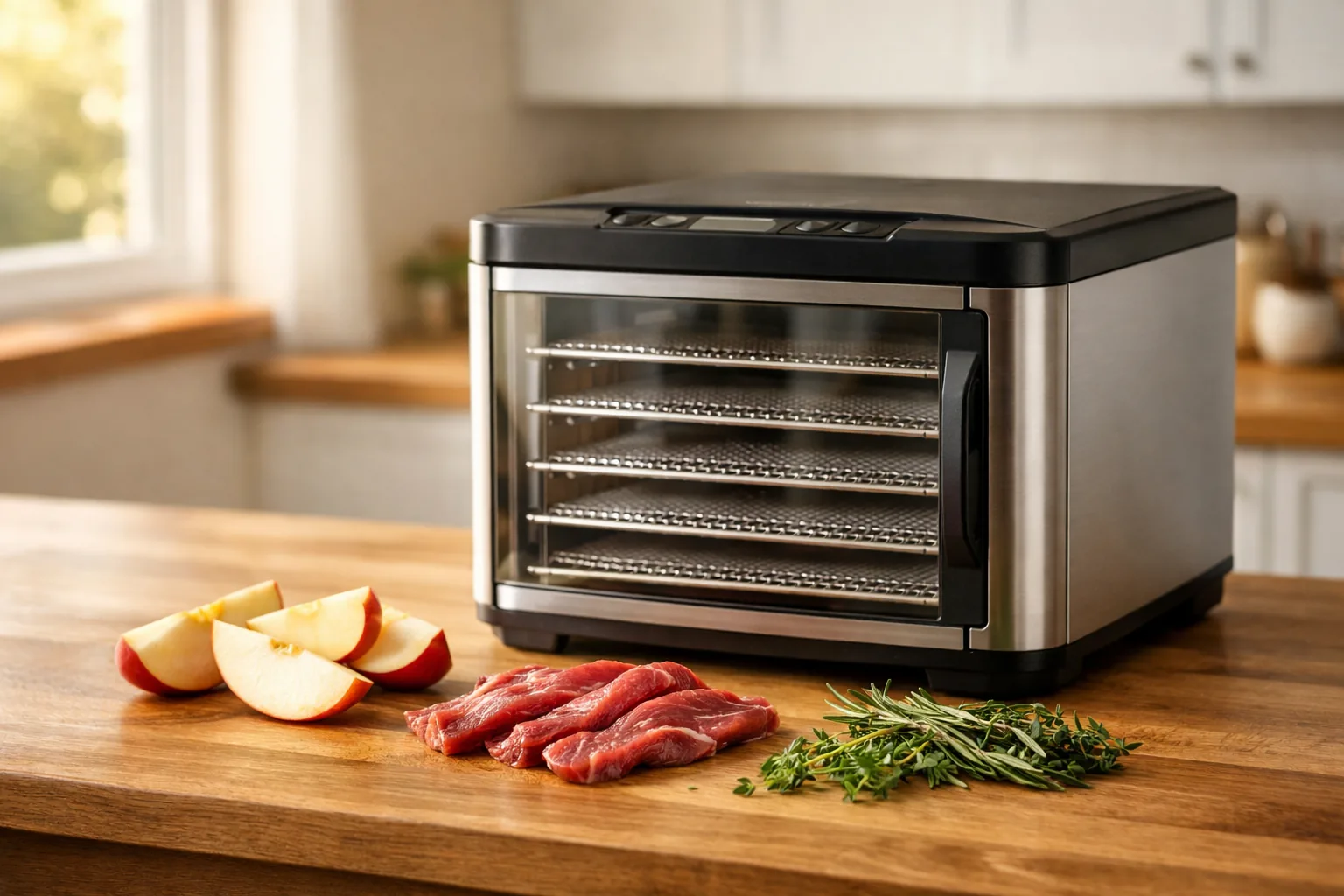
A dehydrator is one of the few kitchen machines that pays for itself. Store jerky is priced like a luxury, and the dried mango and apple chips in the snack aisle cost a fortune for what is, at the end, fruit and patience. Make them at home and you control exactly what goes in: no added sulfites, no preservatives, just the food. The only real decision is which machine actually dries evenly without making you babysit it.
That decision comes down to one honest question: how seriously will you use it? Someone drying garden herbs and the occasional batch of fruit needs a different machine than someone making thick-cut jerky by the kilo every hunting season. Tray material, fan placement, timer, max temperature, and noise all shift in importance depending on which person you are. The five below span that whole range, from a no-frills starter to a precision stainless workhorse. Here’s how to land on yours.
The COSORI 6-Tray is the safe default, and the most-reviewed dehydrator here by a wide margin. All-stainless food surfaces, a brushless motor quieter than conversation, and a rear fan that dries all six trays evenly with no rotating. If you’ll use it often and want one machine to get right, this is it.
Which One Fits You
- Just testing whether dehydrating is your thing: start cheap with the Elite Gourmet.
- You want to load it and walk away overnight: the Hamilton Beach’s auto-shutoff timer.
- You dry many different foods at once, in big batches: the expandable NESCO with flavor separation.
- You’ll use it constantly and want quiet, premium build: the COSORI 6-Tray stainless.
- You make serious thick-cut jerky: the Magic Mill’s higher max temperature and precision.
The Elite Gourmet is the least-commitment way into home dehydrating, and it earns its place not by cutting safety corners (it’s ETL listed) but by stripping out features a casual user genuinely doesn’t need. Its modest heater and simple design handle herbs, fruit chips, and light jerky without fuss.
The five clear trays let you watch the drying without opening the lid and killing the airflow, and the temperature dial spans the full useful range, from delicate herbs at the low end to jerky at the top. The base-mounted fan moves air across every tray without asking you to rotate them, which is a feature you usually pay much more to get. Trays and lid go on the top dishwasher rack, so cleanup after a sticky fruit-leather session is painless.
Skip this if you’ll run it daily and hard, since a minority of owners report the heater giving out under heavy use, or you want a timer, because there isn’t one and you track time yourself. For occasional batches, the value is hard to beat.
Elite Gourmet EFD319
NESCO was making dehydrators before most brands here existed, and the Snackmaster Pro is the model that built its name. It’s a round, stackable design in a market that’s drifted toward rectangular units, and it survives on two genuinely unique strengths.
The first is its Converga-Flow system: a top motor forces air down an outer chamber, then inward across each tray. The practical payoff is that flavors don’t migrate between levels, so you can run jerky on one tray and fruit on another in the same cycle without one tasting of the other. The opaque housing also blocks light during drying, which helps preserve nutrients. The second strength is expandability: it ships with five trays and grows to twelve, the only machine here that scales for big garden hauls or bulk jerky without modification. It’s also the rare unit assembled in the USA.
Skip this if you run full twelve-tray loads and won’t rotate, since the trays nearest the top heater run hotter and need a swap partway, or you want hands-off timing, because it relies on an external lamp timer.
NESCO Snackmaster Pro
The Hamilton Beach fixes the single biggest annoyance with budget dehydrators, the lack of an automatic timer, without climbing into the premium tier. Its base-mounted heater and quiet fan dry all five trays evenly without rotation, and a long digital countdown shuts the machine off on its own when the batch is done.
That auto-shutoff is the whole point. Load a tray before bed or before work and the machine handles the rest. The display is simple, the temperature adjusts cleanly, and the clear vented lid lets you check at a glance. The compact footprint tucks under standard cabinets, which matters for a machine that may run a full day at a time. It comes with a mesh screen for herbs and a solid sheet for fruit leather, so it’s ready for the common tasks out of the box.
Skip this if you want stainless durability, since the trays are plastic, or you need silence, because the fan sits at a noticeable box-fan-on-low hum. For unattended overnight runs at a fair price, it’s the right call.
Hamilton Beach 32100A
The COSORI is the most-reviewed dehydrator here by a wide margin, and the highest-rated, because it gets four things right at once that cheaper machines usually compromise on at least one of: it’s quiet, it dries evenly, every food-contact surface is stainless, and it holds enough for a real batch.
The brushless motor runs quieter than normal conversation, far quieter than any round-stackable unit. The rear fan pushes air across all six stainless trays from one direction, erasing the hot spots that top- and bottom-mounted fans create on their nearest trays. Temperature adjusts in single degrees, and the all-stainless surfaces sidestep the thing that pushes buyers off plastic: over years of heat cycling, stainless doesn’t warp, stain, hold odors, or shed plasticizers. It ships with a herb screen, a fruit-roll sheet, and a recipe book to get going.
Skip this if you make a lot of fruit leather and hate scrubbing, since the stainless mesh holds sticky residue and needs a soak, or your budget is tight, because it’s a real jump from the mid-tier. Otherwise it’s the most reliable pick on the list.
COSORI 6-Tray Stainless
The Magic Mill sits in the same premium tier as the COSORI and matches its top rating, but it’s the better tool for one specific user: the serious jerky maker. Two features set it apart, a higher maximum temperature and single-degree precision across the whole range.
The higher ceiling matters because safe jerky needs the meat’s center to reach at least 160°F to kill pathogens, and the margin gets tight in dense batches. A higher top temperature builds in a real safety buffer for thick cuts without a separate oven step. The fine precision means repeatable results: once you nail the temperature for your favorite batch, you can return to it exactly. The all-stainless build houses a rear fan that drives even airflow across all seven trays, and a keep-warm mode holds a low temperature for a day after the cycle, handy when a batch finishes overnight and you can’t grab it right away.
Skip this if you mostly dry fruit and herbs rather than meat, where the COSORI’s quieter motor and larger tray area serve you better, or you’re bothered by fiddly controls, since the touch start button is easy to brush by accident.
Magic Mill Pro 7-Tray
How These Five Trade Off
The five aren’t really five versions of the same thing. They’re built for different users, and the trade-offs line up cleanly.
Price versus durability. The Elite Gourmet and Hamilton Beach use plastic trays and cost the least, which is fine for fruit and herbs and occasional use. The COSORI and Magic Mill use all-stainless surfaces that survive years of heat without warping or staining, and you pay for that. If the machine will run constantly, stainless is worth the jump. If it’ll come out a few times a season, it isn’t.
Convenience versus capacity. The Hamilton Beach’s auto-shutoff is the most hands-off here, ideal for overnight runs, but it’s a mid-size plastic machine. The NESCO gives up the timer entirely yet scales to twelve trays and separates flavors, which no other model does. Pick based on whether you value walking away or running big mixed loads.
Even drying versus tray rotation. Rear-fan machines (COSORI, Magic Mill) dry every tray the same and never need rotating. The top-fan NESCO runs hotter up high and wants a mid-cycle swap on full loads. For set-and-forget evenness, rear-fan wins. For flavor separation and expandability, the NESCO’s top-fan design is the trade you accept.
Start cheap if you're unsure
The Elite Gourmet handles herbs, fruit, and light jerky and tells you whether dehydrating fits your routine before you spend more. It’s built for occasional sessions, not daily marathons.
Buy the timer if you run overnight
The Hamilton Beach’s automatic shutoff is the feature that lets you load a batch and stop thinking about it. Its plastic trays are fine for fruit and herbs.
Buy the NESCO if you dry many things at once
Nothing else here lets you run citrus and beef jerky on one cycle without cross-flavoring, and the twelve-tray expansion suits bulk processing where stainless isn’t the priority.
Buy the COSORI if it'll run often
Quiet operation, even drying, and stainless surfaces make the most sense for a machine that lives on the counter and works hard, with the biggest track record on the list behind it.
Buy the Magic Mill if jerky is the mission
The higher max temperature and fine precision are the right tools for thick-cut meat at volume, and the keep-warm mode earns its keep on overnight runs.
What is the best food dehydrator for making beef jerky?
The Magic Mill Pro is the strongest jerky pick because of its higher maximum temperature, which gives a safety margin for reaching safe internal temperatures in thick cuts. The COSORI 6-Tray is the close runner-up, with consistent rear-fan drying that handles standard cuts well.
Do I need a dehydrator with stainless steel trays?
Not strictly, but stainless lasts far longer than plastic under repeated heat, resists odors and stains, and avoids any plasticizer concerns over years of use. The COSORI and Magic Mill are all-stainless. The Elite Gourmet, NESCO, and Hamilton Beach use BPA-free plastic, which is safe but degrades and discolors over a longer horizon.
What is the difference between top-mounted and rear-mounted fans in dehydrators?
Top-mounted fans (the NESCO) push air down from the heater and across the trays toward the center. Rear-mounted fans (the COSORI and Magic Mill) push air horizontally from the back across all trays at once. Rear-mounted designs usually dry more evenly because every tray gets the same airflow, while top-mounted units can run hotter on upper trays and may need rotation.
How long does it take to dehydrate food in a home dehydrator?
It depends on the food, thickness, moisture, and temperature. Thin fruit slices run about 4 to 6 hours, standard quarter-inch jerky about 6 to 10 hours, dense root vegetables roughly 8 to 12 hours, and herbs fastest at often 1 to 4 hours. Every machine here includes time and temperature guides for common foods.
Can you dehydrate multiple types of food at the same time?
Yes, with one caveat: strong foods like fish, onions, or garlic can pass odors to milder foods on nearby trays. The NESCO’s Converga-Flow design is built to prevent that flavor transfer, making it the best choice for mixed batches. With the rear-fan rectangular machines, it’s safer to keep strongly aromatic foods on separate loads.
How do I clean food dehydrator trays?
The Hamilton Beach and Elite Gourmet trays are top-rack dishwasher-safe, the simplest cleanup here. The COSORI and Magic Mill stainless trays are hand-washed and resist staining, though sticky fruit leather may need a soak to release from the mesh. The NESCO’s round plastic trays wash with soap and water, but skip high-heat dishwasher cycles that can warp them.