
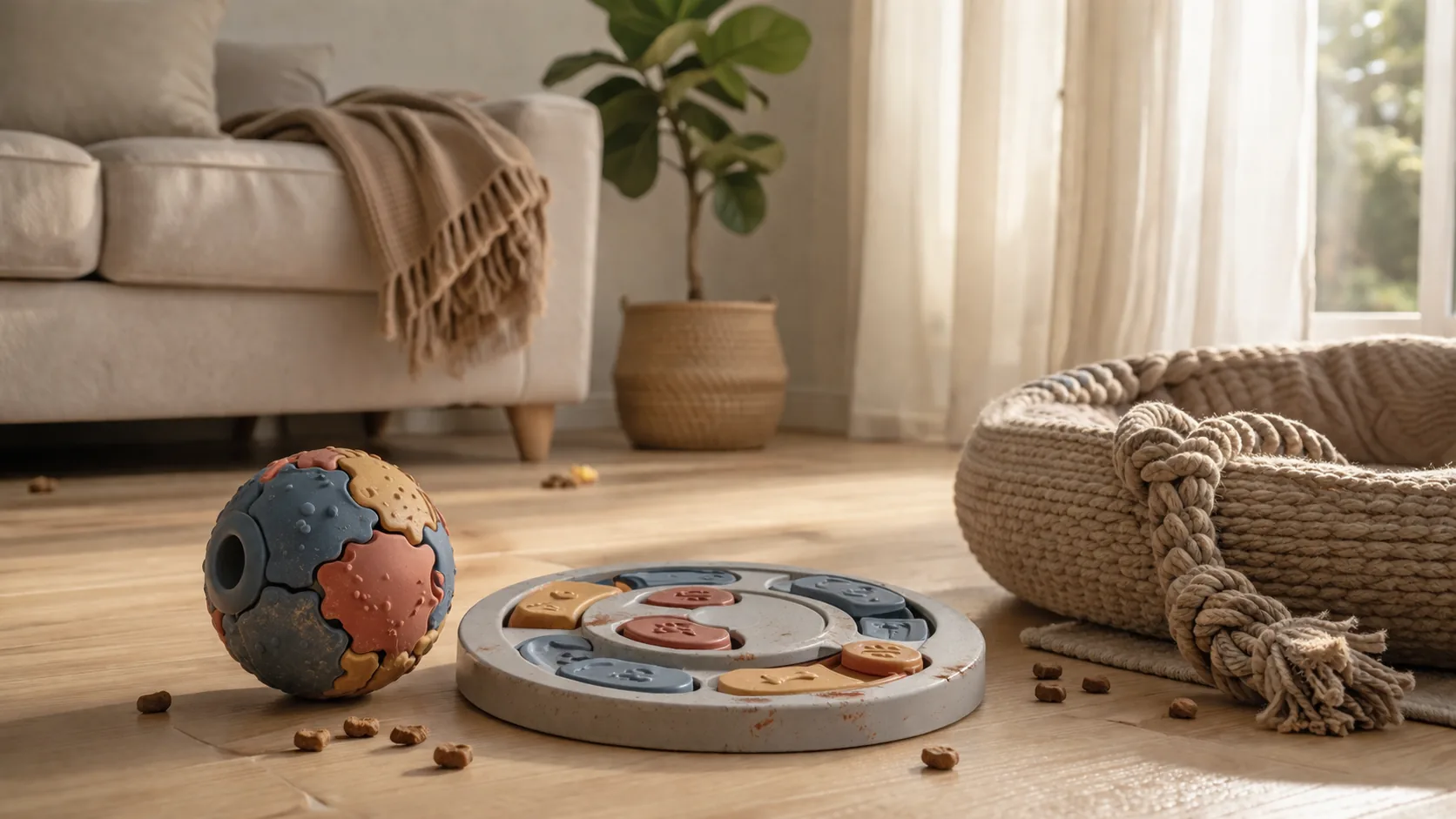
Most of the chewed shoes and shredded cushions people blame on a “bad dog” are really a symptom of a dog with nothing to do. Dogs are wired to work for food, chase moving things, and solve small problems. Take all of that away and the energy comes out sideways, usually on your furniture. Interactive toys give that drive somewhere to go, whether the job is digging treats out of a puzzle or chasing a ball that moves on its own.
The trouble is that “interactive” gets slapped on a lot of things that hold a dog’s interest for about a week before they end up in the toy basket forever. The toys that actually stick share a pattern: they reward effort, they survive the kind of dog you have, and they match how your dog spends its day. A puzzle is useless to a power chewer who cracks it in a minute, and a fetch toy does nothing for a dog stuck home alone.
The five below each do one of those jobs well, and they cover the main reasons a dog gets bored: too much physical energy, not enough mental work, or long stretches with no company. Read the situations, figure out which one your dog is, and pick from there rather than grabbing whatever looks cutest.
If you want one safe starting point, the Chuckit! Ultra Fetch Stick is it. It is the most-owned and highest-rated toy in this group, a tough rubber fetch toy that bounces unpredictably and floats. For a high-energy dog that needs to run, nothing here is easier to recommend.
Which Dog Are You Shopping For?
A quick read on which toy suits which dog before the write-ups:
- A high-energy dog that needs to burn off steam: the Chuckit! Fetch Stick.
- A smart, restless dog that needs a mental challenge: the PETSTA puzzle board.
- A fast eater you want to slow down at mealtime: the FOXMM treat puzzle.
- A strong chewer who destroys anything with parts: the simple HIPPIH treat balls.
- A dog left home alone who needs to entertain itself: the motorized QGI rolling ball.
The Chuckit! Ultra Fetch Stick has anchored the fetch category for years, and it is the most-owned and highest-rated toy in this group. It is built from tough natural rubber with a textured surface that is easy for a dog to grip and carry, and it is the kind of thing that survives a daily routine rather than a single weekend.
What sets it apart from a plain ball is the bounce. The elongated shape sends it skittering in random directions when it hits the ground, so a dog chases it far longer than something that rolls in a straight line. It floats too, which makes it a natural for lake and pool days, and the bright color is easy to spot in tall grass. Owners of strong breeds repeatedly report it holding up to months of hard fetch where softer toys did not last a week.
Skip this if: your dog is mainly a chewer rather than a fetcher. Left alone to gnaw on it, even tough rubber will eventually give up chunks, and this is a fetch toy, not a chew toy.
Chuckit! Ultra Fetch Stick
The PETSTA Dog Puzzle is a flat board with sliding covers and movable pieces that hide treats. A dog has to push, nudge, and paw the right parts to uncover the food, which turns a thirty-second snack into a focused job. It lands at a middle difficulty that challenges most dogs without frustrating them into flipping the whole thing over.
The build is sensible for daily use: food-safe material, no loose small parts to swallow, and a non-slip base so it does not slide around the kitchen while a dog works at it. It comes apart for cleaning, which matters more than people expect once kibble grease builds up. Owners of busy, clever breeds often single it out for buying ten or fifteen minutes of real mental engagement, which is a meaningful dent in a restless dog’s day.
Skip this if: you want a toy that stays hard forever. Most dogs learn the pattern within a couple of weeks, and the challenge fades unless you change up how you hide the food.
PETSTA Dog Puzzle
The FOXMM Interactive Treat Puzzle blends a treat-dispensing puzzle with a built-in squeaker in one unit. A dog presses, slides, and flips compartment covers to reach hidden treats while the squeaker adds a layer of sensory payoff that keeps it coming back. The build is smooth-edged with no sharp parts, and like the PETSTA it sits on a non-slip base.
Where it really earns its place is as a slow feeder. Spread a meal across the compartments and you turn a bowl a dog inhales in seconds into ten or fifteen minutes of work, which owners of gulp-and-go eaters say cuts down on the bloating and begging that follow a rushed meal. The squeaker is a double-edged feature, though. Some dogs fixate on it and ignore the puzzle entirely, chewing the center, which is not built for heavy jaw pressure.
Skip this if: you have a hard chewer who will lock onto the squeaker. The center is not made to take a determined bite.
FOXMM Treat Puzzle
The HIPPIH Dog Puzzle Balls come as a pair of hollow rubber spheres with irregular cutouts that drop treats as a dog rolls, tosses, and chases them. The design is about as simple as it gets, and that is exactly the point: there is nothing mechanical to break, no fabric to shred, and no squeaker to destroy, which makes them the safest pick here for a dog that wrecks everything else.
Fill a ball with kibble and the openings let food fall out unpredictably as it tumbles, sometimes a piece, sometimes a few, sometimes nothing. That on-and-off reward is what keeps a dog working at it. They bounce well enough for indoor or outdoor play and are sized for medium dogs, with small breeds managing them fine. Owners often reach for these as the “leaving the house” toy, loading both and letting a dog stay busy while they are out.
Skip this if: you have a giant, powerful-jawed breed. The strongest dogs can squeeze the rubber to pop treats out without rolling the ball, which skips the whole game.
HIPPIH Puzzle Balls (2-Pack)
The QGI Electric Rolling Ball is the only motorized toy here, and it fills a specific gap: keeping a dog busy when you are not around to play. A built-in motor rolls the ball, changes its direction, and bounces it on its own, and a detachable rope gives a dog something tail-like to grab and tug. A woven cover protects the mechanism from light chewing, and it recharges over USB so there are no disposable batteries to mess with.
A clever touch is the built-in pause: the ball rests for a few seconds before changing direction, which mimics the stop-and-dart movement of prey and keeps a dog guessing. The main audience is dogs home alone during work hours, and owners of high-energy young dogs often report long, self-directed chase sessions that take the edge off. The catches are real, though. The motor hums, wall bounces can be loud in a small apartment, and a serious chewer can get through the rope cover, which is not replaceable.
Skip this if: you live in a small, quiet space or have a heavy chewer. The noise carries, and the rope cover will not survive a determined jaw.
QGI Electric Rolling Ball
The Real Trade-Off
The honest tension in this category is between durability and challenge. The toys that give a dog the most to think about, the puzzle boards and the motorized ball, are also the ones with parts that can wear out, loosen, or get chewed through. The toy that survives anything, the plain HIPPIH balls, asks the least of a dog’s brain. There is no single toy that is both indestructible and endlessly clever, so you are really choosing which side to favor.
The way out is to stop looking for one toy that does everything and instead match the toy to the dog. A power chewer gets simple and solid. A bored genius gets a puzzle you keep changing. A dog with too much energy gets something to chase. A dog left alone gets the self-player. Buy for the dog in front of you, not the dog in the marketing photo.
Start with what kind of energy you are trying to drain
Puzzle feeders work the brain and calm a restless or anxious dog. Fetch toys burn physical energy, which is what a high-drive runner actually needs. The motorized ball sits in between, giving a chase without you having to throw anything. Pick the category that matches your dog’s main problem before you compare individual toys.
Be honest about chew strength
Almost every interactive toy has a weak point for a determined chewer. If your dog destroys things, lean toward the simple solid-rubber options and treat anything with a squeaker, rope, or motor as supervised-only. A toy that becomes a choking hazard the moment you turn your back is not a bargain at any price.
Account for time spent home alone
If the real goal is occupying a dog while you work, prioritize toys that run without you: the self-playing ball and the treat balls both do. Puzzle boards work solo too, but the game ends once the treats are gone, so the window is shorter.
Let size and breed make the final call
Smaller treat balls suit small and medium dogs, puzzle boards work across sizes since dogs use their nose and paws, and a longer fetch toy fits medium-to-large breeds that love to carry things. Matching the toy to your dog’s size is the difference between a toy it engages with and one it ignores.
How long will an interactive toy actually keep my dog busy?
It depends on the type. Puzzle feeders usually buy ten to twenty minutes of focus per session, treat-dispensing balls can stretch to twenty or thirty depending on how much food you load, and a motorized ball can hold a chase-driven dog the longest. None of them replace a walk, but they take the edge off.
Are these safe to leave with a dog unsupervised?
The flat puzzle boards and the solid treat balls are generally fine alone because there are no small parts to swallow. The fetch stick and the motorized ball are better used with you around, since a hard chewer can tear off pieces that become a choking risk.
Won't my dog get bored once it solves the puzzle?
Often, yes, and it is the most common complaint about puzzle toys. Most dogs crack a mid-level puzzle within a couple of weeks. Rotating between two or three different toys keeps things fresh, and you can raise the difficulty by freezing wet food inside the compartments or layering treats under obstacles.
What size dog are these toys built for?
The puzzle boards work for any size since dogs use their paws and nose. The treat balls suit small to medium dogs best, the fetch stick fits medium to large breeds, and the motorized ball works across sizes, though very small dogs may struggle with the rope attachment.
Can interactive toys help with separation anxiety?
They can take the edge off. Many owners report less barking and less destructive chewing when a dog has a focused task during alone time, and puzzle and treat toys are especially good at redirecting nervous energy. They are a helpful supplement, not a substitute for proper training or a vet’s guidance with severe anxiety.