
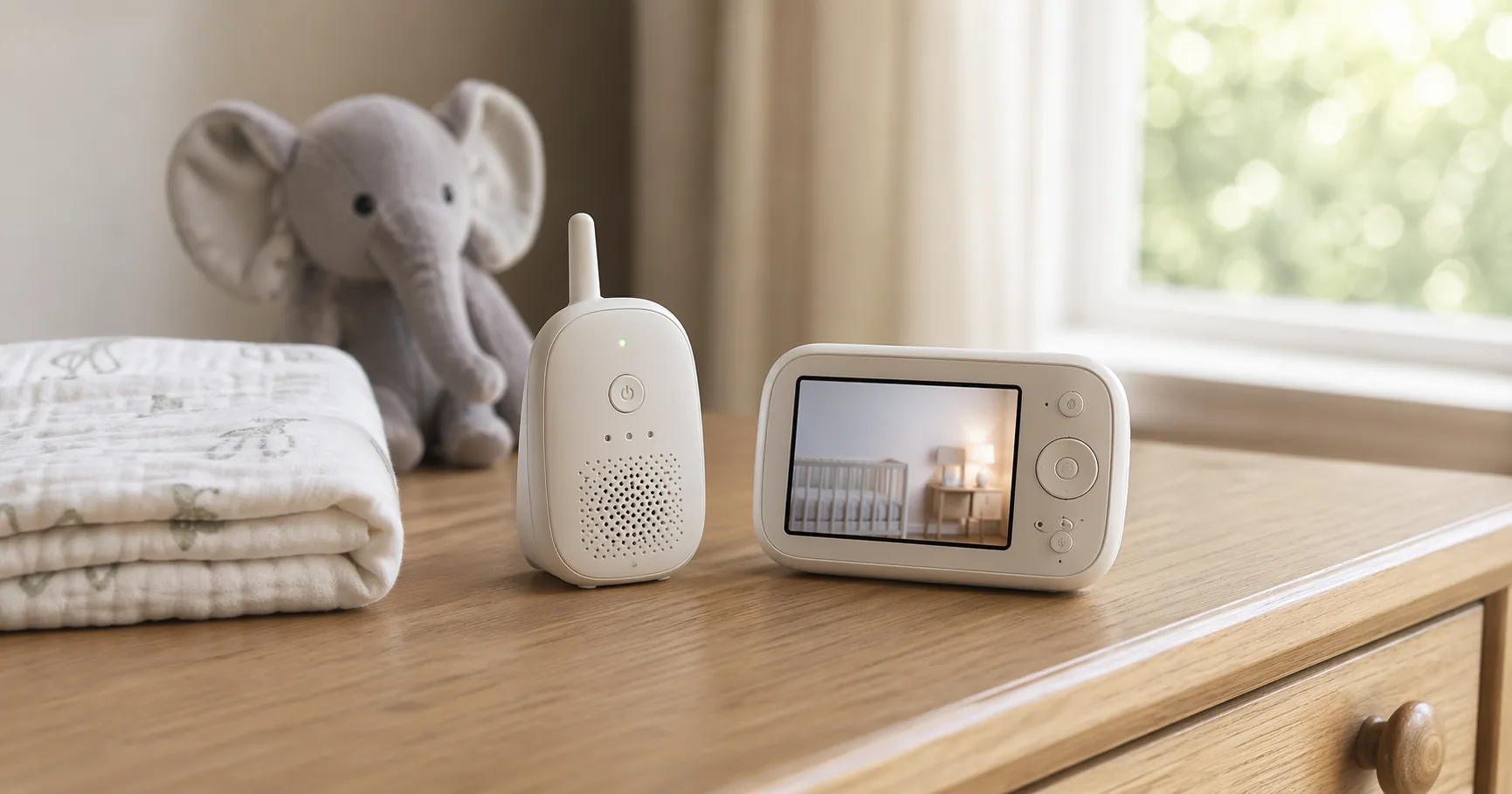
Sometime in the first week home, every new parent runs into the same question at two in the morning: is it enough to hear the baby, or do you need to see them too? It feels like a gear decision, but it is really a decision about you, about how lightly you sleep, how your nursery sits relative to your bedroom, and how your brain behaves when there is a screen you could be checking. Plenty of children have been raised perfectly well on sound alone, and plenty of parents sleep better with a picture. Neither answer is more correct than the other.
To keep this honest, the comparison below uses two monitors from the same brand, so the question stays audio versus video rather than one company versus another. On the audio side is the VTech DM221, which runs on a dedicated cordless-audio signal. On the video side is VTech's no-Wi-Fi VM819, which pairs a small parent screen with a closed-signal camera. Both skip Wi-Fi entirely, both use private signals with no app and no account, and both come from a brand that has been making baby monitors for a long time. That common ground is exactly what lets the real difference show through.
- Products analyzed
- 2
- Average rating
- 4.6
- Price range
- budget audio to mid-range video
- Top rated
- tied at 4.6
- Most reviewed
- VTech DM221 (34K reviews)
Our Top Pick
For most families the VTech DM221 audio monitor covers the real need: knowing the moment your baby wants you. It has the deeper review base of the two, a long battery, a dedicated interference-free signal, and nothing to configure. Choose the video VM819 instead only if seeing the crib is something you specifically need.
The Two at a Glance
| Product | Check |
|---|---|
| VTech Communications DM221 Audio Baby Monitor with up to 1,000 ft of Range, Vibrating Sound-Alert, Talk Back Intercom & Night Light Loop, White/Silver | (opens on Amazon) |
| VTech Baby Monitor No WiFi – 19Hr Video Battery, 1000ft Range, Night Vision, Two-Way Talk, Temperature Sensor, Sound-Activated Screen, Lullabies | VM819 | (opens on Amazon) |
The Two Contenders
VTech Communications DM221 Audio Baby Monitor with up to 1,000 ft of Range, Vibrating Sound-Alert, Talk Back Intercom & Night Light Loop, White/Silver
The VTech DM221 is the monitor that quietly proves a lot of parents never needed video at all. It runs on a dedicated cordless-audio band rather than the crowded space your router and microwave share, which means clean sound with no static, no Wi-Fi, and no monthly fee. It holds the deeper review base of the two units here, the kind of track record that comes from years of households leaning on it.
Its real advantage is that there is nothing to manage. No screen to drain, no app to set up, no network to secure. You switch it on and it works. The parent unit clips to a belt or sits on a nightstand, and a row of indicator lights shows how loud the baby is even with the sound turned down, so you can keep the volume low and still see a wail coming. Battery life is long, two-way talk lets you soothe without walking in, and the range covers a backyard or a two-story house. Parents who have been burned by a Wi-Fi monitor dropping its connection tend to describe this one as the unit they never have to troubleshoot.
Skip this if not being able to see the crib will leave you anxious, because no amount of clear audio replaces a picture for a parent who needs one.
Pros
- Deeper review base of the two, a long proven track record
- Dedicated audio signal gives clean sound with no Wi-Fi or app
- Long battery and long range, with two-way talk
Cons
- Audio only, no way to check the baby visually without going in
- No night vision, zoom, or temperature readout
VTech Baby Monitor No WiFi – 19Hr Video Battery, 1000ft Range, Night Vision, Two-Way Talk, Temperature Sensor, Sound-Activated Screen, Lullabies | VM819
The VTech VM819 is the no-Wi-Fi video monitor for parents who want to see the crib without inviting the security risk of an internet camera. It pairs a small parent screen with a closed-signal camera, so you get the picture with no app, no account, and nothing exposed to the web.
Video adds the things audio simply cannot. Infrared night vision shows the nursery in the dark, the camera pans, tilts, and zooms so you can scan the whole room, and a sound-activated mode keeps the screen off until the baby stirs, then wakes it, which saves both battery and your sleep. Range is long, two-way talk is built in, and a temperature readout tells you whether the room is too warm or too cold. Parents who use it consistently mention the relief of confirming the baby is fine without easing the door open.
Skip this if you know yourself to be the kind of person who will lie awake staring at the feed, because for some parents the screen creates more worry than it removes. Skip it too if battery life is your top priority, since running the screen continuously drains it faster, which is exactly why the sound-activated mode exists.
Pros
- No-Wi-Fi video, a real picture with no hacking risk and no account
- Night vision, motorized pan, tilt, and zoom, and a sound-activated screen
- Temperature readout and two-way talk, on a long-range closed signal
Cons
- Costs more than the audio model and the screen is small
- Battery drains faster with the screen on continuously
When Each One Wins
Sleep style decides this for a lot of people. If you wake at the smallest noise, an audio monitor with adjustable sensitivity can genuinely help you rest, because you hear a real cry without a glowing screen lighting up the room. If you sleep heavily, or if silence makes you uneasy, video gives you a way to reassure yourself with a glance instead of getting out of bed to peek.
Your home layout pushes the choice next. In a small apartment or a single-floor place where the nursery sits close to where you sleep, audio is usually all you need, because you will hear everything anyway. In a larger or multi-story house where the nursery is far off, video adds the confidence that you are not missing something happening in a room you cannot hear well from your own.
Be honest about your own anxiety, because it matters more than any feature. Some parents feel calmer the instant they can see the baby breathing. Others find themselves checking the feed compulsively and sleeping worse for it. If you suspect you are the second kind, audio may be the healthier tool, and if not seeing the baby would keep you on edge, video is worth the extra cost.
Budget is the last lever. Both are one-time purchases with no subscription attached, and the audio model is the cheaper of the two. If money is tight, audio covers the essential job, knowing when your baby needs you, at the lowest price, and you can always add a video unit later if you decide you want one.
Tie-Breakers
If you are still genuinely torn, a few smaller things usually settle it.
Stage of babyhood is one. For a newborn whose movements you could not interpret from a screen anyway, audio is plenty, and many parents only start wanting video once the baby is old enough to roll, stand, or climb, when seeing what is happening in the crib actually tells you something.
Distraction is another. If you want the monitor to fade into the background of your night, audio does that better, because there is nothing to look at. If you want a quick visual check to be possible without leaving bed, that is the whole point of video.
Battery expectations are a third. Audio units tend to run longer between charges, which matters if you forget to dock the parent unit overnight. Video asks a little more discipline, though the sound-activated screen closes much of that gap.
Whatever you choose, both of these stay off the internet, which means neither carries the remote-hacking risk that occasionally makes the news with Wi-Fi cameras. That shared trait takes security off the table as a deciding factor and lets you choose purely on what fits your nights.
How to Choose Between Audio and Video
Start with the core question and answer it honestly: do you need to see the baby to feel calm, or is hearing them enough? For most parents that single answer settles it before any spec enters the picture.
Then layer your home on top. A small place where every room is close leans audio. A sprawling or multi-floor house leans video, because the picture earns its price when the nursery is far from where you sleep.
Finally, weigh budget and habits together. Both options here stay off Wi-Fi and use private signals, so they are equally secure, and the choice really comes down to cost and temperament. Audio handles the essential need for less, video adds a visual reassurance some parents genuinely sleep better with, and there is no wrong answer, only the one that fits how you actually live at three in the morning.
Is an audio or video baby monitor better?
Neither is better for everyone. Audio monitors are simpler, cheaper, and tend to last longer on a charge. Video monitors let you see the baby without entering the room. Light sleepers and small homes often do fine with audio, while larger homes and anxious parents tend to value video.
Do I really need a video baby monitor?
Not necessarily. Many families raise children with audio only. Video becomes worthwhile if you have a larger home, want to confirm the baby is fine without opening the door, or simply feel calmer seeing them. For plenty of households, audio covers the core need.
Are no-Wi-Fi baby monitors more secure?
Yes. Both models here use closed signals that cannot be reached over the internet, which removes the hacking risk tied to Wi-Fi cameras. There is no app, no account, and nothing sent to the cloud.
What is a dedicated audio signal and why does it matter?
It is a frequency band reserved for cordless audio, separate from Wi-Fi and Bluetooth traffic. For a baby monitor that means clear sound with no static or dropouts and a private connection that the internet cannot touch.
Can video baby monitors be hacked like Wi-Fi cameras?
A no-Wi-Fi video monitor like the VM819 cannot be reached over the internet because it never connects to it, using a closed radio link between the camera and the parent unit instead. Only Wi-Fi-enabled smart monitors carry the remote-hacking risk that occasionally makes headlines.
As an Amazon Associate I earn from qualifying purchases. Prices and availability change frequently — use the Amazon button to check current pricing.