
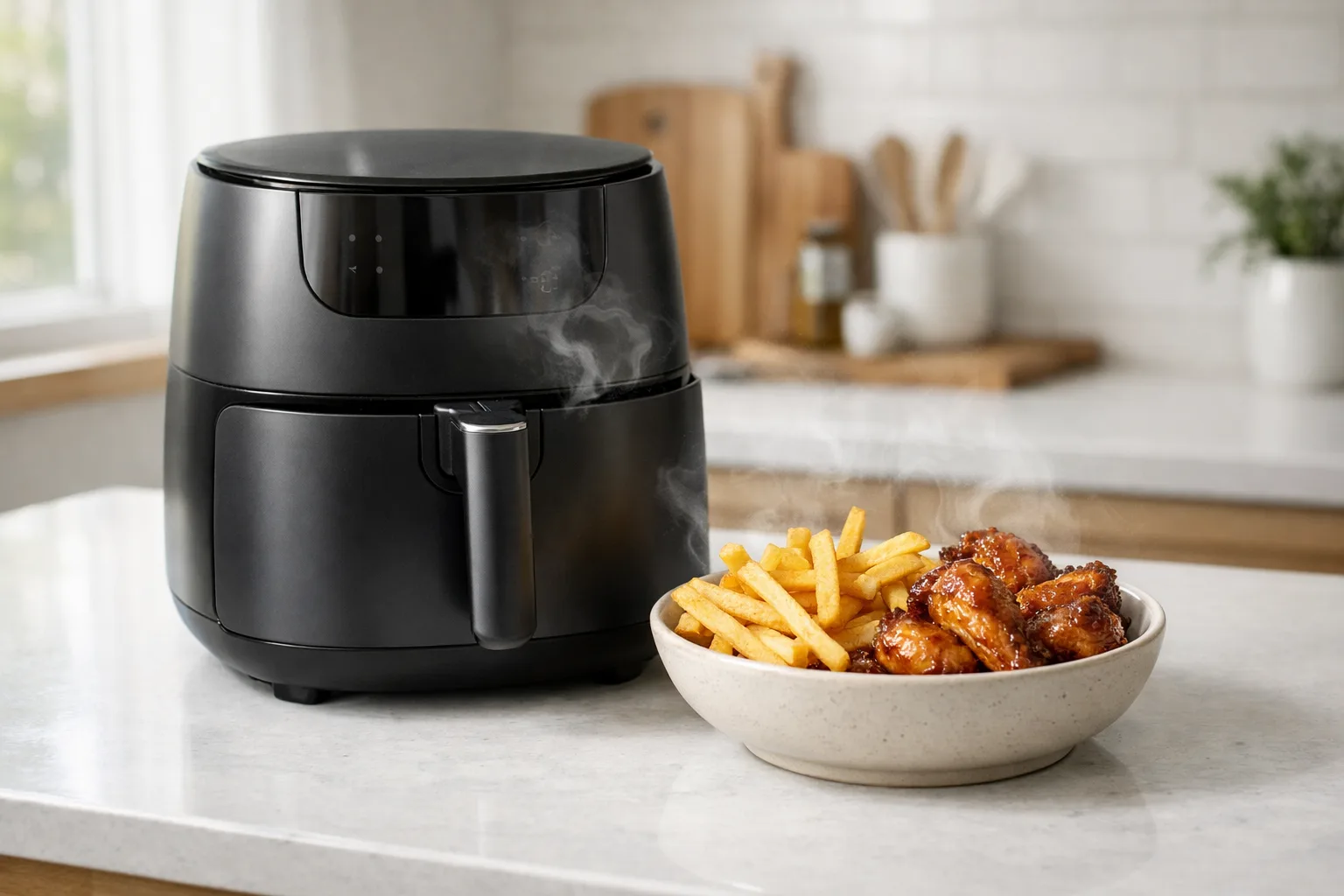
Most people buy the wrong-size air fryer. They see a 4-quart unit on sale, picture crispy fries, and discover six months later that one batch barely covers dinner for two. Capacity drives more returns in this category than any other spec — more than wattage, more than presets, more than brand. This guide is built around that: each pick is matched to a household size and a counter situation, not to a generic "Best Overall" slot.
A second mistake worth naming up front: buying dual-basket because the spec sheet sounds versatile, then using only one basket for months. Dual-basket pays for itself when you regularly cook two foods at different temperatures. If you don't, you're paying for hardware that sits idle.
Top 5 Picks at a Glance
| Product | Check |
|---|---|
| Cosori 9-in-1 TurboBlaze Air Fryer 6 Qt, PFAS-Free Ceramic Coating, 90°–450°F, Precise Heating for Even Results, Air Fry, Roast, Bake, Broil, Dry, Frozen, Proof, Reheat, Keep Warm, 120V, Dark Gray | (opens on Amazon) |
| Ninja Air Fryer with Air Crisp | 5 QT Capacity fits up to 4lbs of Fries | 4-in-1 Pro Air Fry, Roast, Reheat, Dehydrate | 400°F Max Temp | 1750 Watts | W/Nonstick Basket & Crisper Plate | Grey | AF141 | (opens on Amazon) |
| Ninja DZ201 Foodi 8 Quart 6-in-1 DualZone 2-Basket Air Fryer with 2 Independent Frying Baskets, Match Cook & Smart Finish to Roast, Broil, Dehydrate & More for Quick, Easy Meals, Grey | (opens on Amazon) |
| Instant Pot 10QT Air Fryer, 7-in-1 Functions with EvenCrisp Technology that Crisps, Broils, Bakes, Roasts, Dehydrates, Reheats & Rotisseries, Includes over 100 In-App Recipes, Stainless Steel | (opens on Amazon) |
| Ninja XL Air Fryer with MaxCrisp | 6.5 QT Capacity | 6-in-1 Max Crisp, Air Fry, Roast, Bake, Reheat & Dehydrate | 450°F Temp | 1750 Watts | Nonstick Basket, Crisper Plate & Recipe Guide | Grey | AF181 | (opens on Amazon) |
Who this is for
- Cooking for 1-2 people in a small kitchen → start at the 4-quart Ninja Pro or the 6-quart Cosori. Anything bigger eats counter space you'll resent.
- Family of 3-4 → 6 quarts is the floor. The Cosori TurboBlaze handles this without going dual-basket.
- Family of 4+, two foods at once → dual-basket Ninja DZ201 is the only pick on this list that finishes protein and a side at the same minute.
- Batch-cooking weekends or hosting → the Instant 10-quart fits a 5-lb chicken or a full rack of ribs in one go.
- Apartment with under 18" counter depth → skip the Instant 10-qt and the Ninja Pro XL entirely. They physically dominate the corner they sit in.
Reviews
Cosori 9-in-1 TurboBlaze Air Fryer 6 Qt, PFAS-Free Ceramic Coating, 90°–450°F, Precise Heating for Even Results, Air Fry, Roast, Bake, Broil, Dry, Frozen, Proof, Reheat, Keep Warm, 120V, Dark Gray
The Cosori TurboBlaze is the pick if you want one machine to handle everything from fries to a small whole chicken without committing to a dual-basket setup. The ceramic coating is the differentiator here — most air fryers at this tier use standard PTFE non-stick, which is fine but raises questions for buyers who'd rather not deal with it. Ceramic also wipes clean faster, which matters more than people expect after the third week of ownership.
The 6-quart basket is the sweet spot for households of 2-4. It fits a 4-lb rotisserie chicken, or roughly 2 lbs of wings, or a half-sheet's worth of fries. Temperature range goes from 170°F (proofing dough, gentle reheats) up to 450°F. Fan speed is noticeably higher than the budget Ninja models, which is why crisping is faster.
Skip this if you cook wet-battered foods often. The higher fan speed makes thin batters drip before they set.
Pros
- Ceramic basket — PFOA-free, easier daily cleaning
- 6 qt fits a whole 4-lb chicken without splitting it
- Touchscreen with 9 presets including dehydrate and proof
- High fan speed — crisps frozen foods noticeably faster than entry-level models
Cons
- Touchscreen mis-reads with wet fingers
- Wet batter coatings (tempura, beer-batter) shed in the airflow
Ninja Air Fryer with Air Crisp | 5 QT Capacity fits up to 4lbs of Fries | 4-in-1 Pro Air Fry, Roast, Reheat, Dehydrate | 400°F Max Temp | 1750 Watts | W/Nonstick Basket & Crisper Plate | Grey | AF141
The Ninja 4-in-1 Pro is the pick when 4 quarts is genuinely enough — meaning one or two people, no large-batch ambitions. Owner reports cluster around the same point: it's the unit that quietly does what it's supposed to for years, with a manual knob that doesn't develop touchscreen glitches.
The 4-quart basket fits about 1.5 lbs of food at once. That's a single chicken breast plus a side of fries, or two salmon fillets, or a generous batch of Brussels sprouts. DualZone heating circulates from the top and bottom, so mid-cook shaking is less critical than on older single-fan models. Four functions — air fry, roast, reheat, dehydrate — is honest coverage for what most people actually cook.
Skip this if you cook for 3+ people regularly. You'll be running two batches per meal within a month and the time savings disappear.
Pros
- 4 qt is right-sized for 1-2 people and frees up counter space
- Manual knob — no touchscreen failures over time
- DualZone heating reduces mid-cook shaking
- Among the most consistently rated units on Amazon
Cons
- 4 qt is genuinely tight for families
- No proofing or low-temperature dehydrate
Ninja DZ201 Foodi 8 Quart 6-in-1 DualZone 2-Basket Air Fryer with 2 Independent Frying Baskets, Match Cook & Smart Finish to Roast, Broil, Dehydrate & More for Quick, Easy Meals, Grey
The Ninja DZ201 is built for one specific household pattern: salmon at 400°F next to broccoli at 390°F, both finishing at the same minute. Two independent 4-quart baskets, two independent temperature dials, and a sync feature that staggers start times automatically. If you don't cook this way, the extra footprint isn't worth it. If you do, this is the only pick on the list that solves the cold-side problem.
Total capacity is 8 quarts split between two zones — useful for a family of 4 plating two different foods, less useful if you'd rather cook a single 8-quart batch (the Instant 10-qt is better for that). The unit is wider than it looks on screen; measure your counter before buying.
Pros
- Two zones, two temperatures, synced finish
- 8 qt total — feeds 4 with two food types in one cook
- Sync Finish is genuinely accurate, not a marketing checkbox
- 6 cooking functions per basket
Cons
- Wider footprint than a standard microwave
- Two smaller baskets, not one big one — bad fit for whole-bird cooking
Instant Pot 10QT Air Fryer, 7-in-1 Functions with EvenCrisp Technology that Crisps, Broils, Bakes, Roasts, Dehydrates, Reheats & Rotisseries, Includes over 100 In-App Recipes, Stainless Steel
The Instant 10 QT Air Fryer 7-in-1 is the pick when capacity is the whole point — meal prep on Sunday, a tray of wings for game day, a 5-lb whole chicken on a Tuesday without splitting it. Seven functions extend beyond air frying into broil, bake and toast, which matters in a small kitchen where this might replace a toaster oven outright.
EvenCrisp keeps airflow consistent even when the basket is packed close to capacity — a real weakness in cheaper large units, where the bottom layer comes out soggy. The trade is footprint: this unit owns the corner of the counter it lives in. If your kitchen has under 18 inches of clear depth, look elsewhere.
Skip this if you cook for 1-2 people only. You'll preheat 10 quarts to cook a half-pound of food and resent the energy bill.
Pros
- 10 qt fits a 5-lb whole chicken or full rack of ribs
- 7 functions — credible toaster-oven replacement
- Even cooking even when loaded near capacity
- Broiler function is genuinely useful, not gimmick
Cons
- Footprint demands real counter commitment
- Single basket — no two-temperature cooking
Ninja XL Air Fryer with MaxCrisp | 6.5 QT Capacity | 6-in-1 Max Crisp, Air Fry, Roast, Bake, Reheat & Dehydrate | 450°F Temp | 1750 Watts | Nonstick Basket, Crisper Plate & Recipe Guide | Grey | AF181
The Ninja Pro XL 6.5 Qt sits in the awkward middle between the 4-qt Pro and the dual-basket DZ201. Pick it when you want one big basket — say, 9 lbs of wings or two whole chickens — and you're confident you don't need two temperatures at once. If you'd ever want two zones, the small step up to the DZ201 makes more sense.
Six functions, large digital display, dishwasher-safe basket. Build quality is the same Ninja tier that runs reliably for years, which is the main reason it's on this list at all.
Pros
- 6.5 qt — fits ~9 lbs of wings in one batch
- Dishwasher-safe basket, fast post-cook cleanup
- 6 functions including dehydrate
- Same long-running Ninja chassis as the DZ201
Cons
- Priced close enough to the dual-basket DZ201 that the choice gets hard
- Single basket — same limitation as any non-dual unit
The trade-off you're actually making
The interesting decision on this list is not which model is "best" — it's between the Ninja Pro XL and the dual-basket DZ201. They cost within a small range of each other. The Pro XL gives you one bigger basket; the DZ201 gives you two independent ones at half the size each.
The honest test is: in a normal week, how often do you cook two foods at different temperatures? If the answer is "more than once," the DZ201 wins by a wide margin — sync-finish saves enough plating chaos that the wider footprint pays for itself. If the answer is "rarely," the Pro XL wins because you get one usable 6.5-qt basket instead of two cramped 4-qt ones.
There is no "best for everyone" pick in air fryers. There is a best pick for your counter, your household and your week.
How to Choose an Air Fryer
Capacity, matched to household size
The 1-quart-per-pound rule is roughly accurate. A 4-qt basket comfortably feeds 1-2 people; a 6-qt basket comfortably feeds 3-4; anything above 8 qt is for batch cooking or households of 5+. Most buyer disappointment in this category traces back to undersizing — almost never to oversizing within the 4-6 qt range.
Single vs dual basket
Single is simpler and cheaper to maintain. Dual is only worth it if you'll regularly run two foods at different temperatures or times. The honest test: count last month's dinners and see how many would have benefited.
Coating
Standard non-stick is PTFE-based and safe at normal cooking temperatures (under ~500°F). Ceramic coatings sidestep PFOA concerns and tend to clean faster but are more sensitive to metal utensils. If you're using silicone tongs anyway, ceramic is the better long-run choice.
Wattage
Anything below 1,400W struggles with frozen foods and large batches. The picks on this list all run at 1,500W or above. Higher wattage matters most for preheat time and for keeping temperature steady when the basket is loaded near capacity.
Counter footprint
Measure before you buy. Manufacturer dimensions usually exclude the rear venting clearance (typically 3-5 inches). A 10-qt unit needs a 16-18" deep clear zone to operate safely.
Will a 4-quart air fryer fit a whole chicken?
No. A 4-qt basket holds roughly 1.5 lbs of food. Whole chickens are 4-5 lbs, so you'd need to spatchcock and split it across two cooks. For one-batch whole chicken, start at 6 quarts; for chicken plus sides in one go, you need 8 quarts or more.
Do I really need to preheat an air fryer?
For best crisp on frozen or breaded foods, yes — 2-3 minutes makes a visible difference. For fresh vegetables or already-cooked reheats, you can skip it without much loss. Several Ninja models preheat automatically when you set a cycle.
What can you NOT cook well in an air fryer?
Wet batters (beer-battered fish, tempura) shed in the airflow before they set. Large bone-in roasts that benefit from slow even heat do better in a regular oven. Loose grated cheese will fall through the basket. Very leafy greens cook unevenly because the fan blows them around.
How long should a quality air fryer last?
With normal use of 3-5 times per week, three to five years is realistic before the basket coating starts to wear or the fan motor weakens. Coating life is the dominant failure mode — handwashing extends it noticeably even on dishwasher-safe baskets.
Is dual-basket really worth the extra money?
Only if you regularly cook two foods that need different temperatures or times. If your normal cook is one protein and one side that go in together anyway, a single 6-qt basket gives you more usable space for less money. Dual-basket earns its keep when sync-finish replaces juggling two cooks back-to-back.
As an Amazon Associate I earn from qualifying purchases. Prices and availability change frequently — use the Amazon button to check current pricing.