
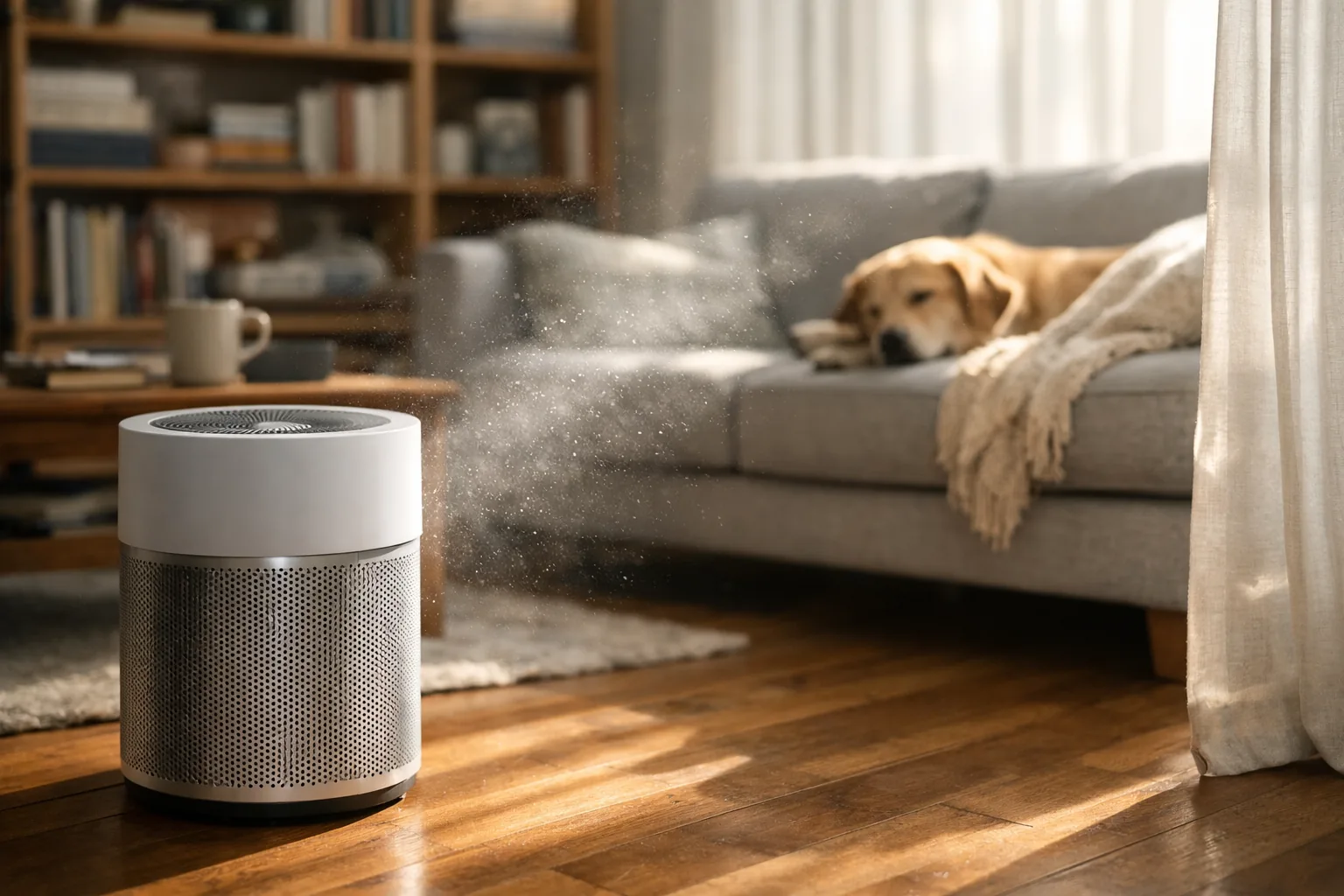
The problem with indoor air is that you can't see it. You notice the dust on a shelf a week after cleaning, or the morning congestion that clears by noon, or the way a pet's smell lingers no matter how often you vacuum. None of that looks like an air problem until you run a purifier for a few nights and the symptoms quietly stop. That's the honest pitch for these machines: they fix something you were only half aware of.
What makes the choice tricky is that "air purifier" covers a small bedroom unit and a machine built to clean an open-plan main floor, and the wrong size simply won't keep up. So the real decision isn't which one is best in the abstract. It's how big your room is, whether pets are in the picture, and how quiet the thing has to be while you sleep next to it. The five below cover that whole spread, from a cheap smart compact to a large-room workhorse. Here's how to land on the one that fits your home.
- Products analyzed
- 5
- Average rating
- 4.6
- Price range
- budget to premium
- Top rated
- LEVOIT Core 300-P (4.7)
- Most reviewed
- LEVOIT Core 200S-P
Our Top Pick
The LEVOIT Core 300-P is the safe default for most bedrooms and living spaces. It carries AHAM-verified airflow numbers, runs near-silent on sleep mode, and is one of the most-bought HEPA purifiers on Amazon for years running. If you want one machine to get right without overthinking it, start here.
All Five at a Glance
| Product | Check |
|---|---|
| LEVOIT Air Purifier for Home Allergies Pet Hair in Bedroom, Covers Up to 1073 ft² by 56W High Torque Motor, AHAM VERIFIDE, 3-in-1 Filter with HEPA Sleep Mode, Remove Dust Smoke Odor, Core300-P, White | (opens on Amazon) |
| GermGuardian 4-in-1 HEPA Air Purifier for Home, Large Rooms Up to 743 Sq. Ft. with HEPA Air Filter, UV-C Light & Odor Reduction, AC4825E, 22 Tower Gray" | (opens on Amazon) |
| LEVOIT Air Purifier for Home Bedroom Dorm Room, Smart & Voice Control, AHAM VERIFIDE, 3-in-1 Filter With HEPA Sleep Mode, for Pollen, Pollutants, Smoke, Dander, Dust, Core 200S-P, White | (opens on Amazon) |
| PuroAir 240 HEPA Air Purifiers for Home Large Rooms - Covers Up to 1,000 Sq Ft - Filters Up to 99.9% of Pollutants, Smoke, Pollen, Dust - Quiet HEPA Air Filter - Air Purifiers for Bedroom | (opens on Amazon) |
| LEVOIT Air Purifiers for Home Large Room Up to 1875 Ft² with Washable Pre-Filter, AHAM VERIFIDE, Air Quality Monitor, HEPA Sleep Mode for Allergies, Pet Hair in Bedroom, Vital 200S-P, White | (opens on Amazon) |
Which One Fits You
- You want one solid unit for a bedroom or office and no fuss: the LEVOIT Core 300-P.
- You worry about mold, bacteria, or a musty room, not just dust: the GermGuardian with its optional UV-C light.
- You're on a tight budget but still want app control and quiet: the LEVOIT Core 200S-P.
- You need to clean a big open room and want it to manage itself: the PuroAir 240 with auto mode.
- You have shedding pets and a large space: the LEVOIT Vital 200S-P with its pet-hair inlet.
The Reviews
LEVOIT Air Purifier for Home Allergies Pet Hair in Bedroom, Covers Up to 1073 ft² by 56W High Torque Motor, AHAM VERIFIDE, 3-in-1 Filter with HEPA Sleep Mode, Remove Dust Smoke Odor, Core300-P, White
The Core 300-P is the model that turned LEVOIT into a default name, and it earns the spot by doing the basics right rather than chasing features. Its clean-air numbers are AHAM-verified, which matters more than it sounds: it means the coverage on the box was checked by an independent body, not just claimed by the brand. In practice it suits a bedroom or a mid-size living space, refreshing the air several times an hour.
The reason it lives in so many bedrooms is the sleep mode. It drops to a level quieter than a whisper while still pulling air through the full filter stack, a pre-filter for hair and large debris, a HEPA layer for fine particles, and activated carbon for odors. The display shuts off so there's no glow, and a filter indicator takes the guesswork out of maintenance. Owners with allergies often mention waking up less congested within the first week, which is the only test most people actually care about.
Skip this if your main floor is one big open space, where a single Core 300-P will struggle and you'd want one of the large-room units below, or you specifically want app and voice control, which lives on the smart variants instead.
Pros
- AHAM-verified coverage, independently checked
- Genuinely quiet sleep mode with display-off
- Three-stage filter handles particles and odors
- Filter-change indicator, low running cost
- One of the longest track records in the category
Cons
- Built for one room, not open-plan floors
- No app or voice control on this version
GermGuardian 4-in-1 HEPA Air Purifier for Home, Large Rooms Up to 743 Sq. Ft. with HEPA Air Filter, UV-C Light & Odor Reduction, AC4825E, 22 Tower Gray"
The GermGuardian offers something none of the others here do: an optional UV-C light that targets airborne bacteria and mold spores instead of only trapping them. It's optional on purpose. You can run the tower in plain HEPA mode and switch the UV light on when a room feels musty or someone's sick. It's certified to add no ozone in the process, which is the usual worry with UV purifiers.
The tall, narrow tower moves air through a pre-filter, a true HEPA layer, and activated carbon, and it suits medium rooms well. Owners reach for it most in basements, around litter boxes, or in rooms that hold a damp smell, and they tend to report the odor easing within the first day. It's backed by a long warranty, and replacement filters are easy to find and not expensive, which keeps it cheap to live with.
Skip this if you're a light sleeper, since it runs louder than the LEVOIT units at the same fan speed, or you don't actually need the UV feature, in which case a plain HEPA unit gives you the same particle cleaning for less hassle.
Pros
- Optional UV-C light for bacteria and mold
- Certified to produce no ozone
- True HEPA plus carbon for odors
- Long warranty, cheap and easy filters
Cons
- Noticeably louder at higher speeds
- UV bulb is a separate consumable to replace
LEVOIT Air Purifier for Home Bedroom Dorm Room, Smart & Voice Control, AHAM VERIFIDE, 3-in-1 Filter With HEPA Sleep Mode, for Pollen, Pollutants, Smoke, Dander, Dust, Core 200S-P, White
The Core 200S-P is the cheapest machine here and also the most-bought of the group by a wide margin, which tells you it's solving a real problem for a lot of people: clean air in a small room without spending much. It pulls in air from all sides, runs the same kind of three-stage filter as its pricier siblings, and still gives you app scheduling and voice control, features that usually cost more.
It's sized for compact spaces, a dorm, a nursery, a small bedroom, or a desk-side office. Its sleep mode is quiet enough that parents often describe it as a bonus white-noise source in a nursery rather than a disturbance. For a first purifier, or a second unit for a room the main machine doesn't reach, it's the easiest one to justify.
Skip this if you're trying to cover a living room or open area, where its small coverage will fall short, or you'd rather press a button than set up Wi-Fi, in which case the simpler Core 300-P fits better.
Pros
- Lowest cost here, app and voice control
- 360-degree air intake for small rooms
- Quiet sleep mode, doubles as soft white noise
- Same filtration approach as the larger LEVOITs
Cons
- Coverage limited to small rooms
- Needs Wi-Fi setup for the smart features
PuroAir 240 HEPA Air Purifiers for Home Large Rooms - Covers Up to 1,000 Sq Ft - Filters Up to 99.9% of Pollutants, Smoke, Pollen, Dust - Quiet HEPA Air Filter - Air Purifiers for Bedroom
The PuroAir is the coverage specialist, built to clean a large room or an open living-and-dining area that would overwhelm a bedroom unit. It runs a pre-filter, an H13 HEPA layer, and carbon, and its standout trick is a built-in particle sensor tied to an auto mode. Instead of you managing fan speed, it reads the air and ramps up on its own when something changes.
That auto behavior is the whole appeal for everyday use. Light a candle, start cooking, or walk in with pollen on your clothes, and the machine catches the spike and responds before you'd notice the air getting worse. People who work from home and want a set-and-forget unit tend to single this out as the feature that makes it disappear into the background. Owners in heavy allergy regions often say a difficult season passed with far fewer symptoms than usual.
Skip this if you only need to cover a bedroom, where you'd pay for capacity you won't use, or you keep a unit right beside the bed, since at full speed it's louder than the LEVOITs and you'll want to lean on the auto threshold.
Pros
- Largest practical coverage in this group
- Particle sensor with hands-off auto mode
- H13 HEPA plus carbon, built for constant running
- Reasonably priced replacement filters
Cons
- Overkill and pricey for a small bedroom
- Loud at top speed near a sleeper
LEVOIT Air Purifiers for Home Large Room Up to 1875 Ft² with Washable Pre-Filter, AHAM VERIFIDE, Air Quality Monitor, HEPA Sleep Mode for Allergies, Pet Hair in Bedroom, Vital 200S-P, White
The Vital 200S-P is the one to buy if you have shedding pets and a large space to clean. Its airflow numbers are among the highest here, enough for a sizable open room, and it's engineered around the problem pets create: hair clogging the filter early. A U-shaped inlet catches pet hair and large debris before it reaches the HEPA layer, and a washable pre-filter cuts down how often you're buying replacements.
It rounds that out with a color ring that shows air quality at a glance and an app for scheduling and remote control. Pet owners using it in big open plans often note that hair stops collecting on furniture as fast as it used to, and households with both pets and an asthmatic kid tend to report fewer flare-ups. For a large, hairy home, the extra cost mostly pays itself back in filter life.
Skip this if you don't have pets and your rooms are smaller, where the Core 300-P or PuroAir gives better value, or you want the simplest possible machine, since this one leans on its app and sensors.
Pros
- High airflow for large open rooms
- U-shaped inlet keeps pet hair off the HEPA filter
- Washable pre-filter lowers running cost
- Air-quality ring plus app scheduling
Cons
- Highest price here, wasted on small rooms
- More features to manage than a basic unit
How These Five Trade Off
These aren't five versions of one machine. They split along a few clear lines, and knowing which line matters to you settles the choice.
Room size versus everything else. This is the first filter, literally and figuratively. The Core 200S-P and Core 300-P are room machines, ideal for bedrooms and offices and wasted on a great room. The PuroAir and Vital 200S-P are built for open floors and will idle through a small room while a compact unit there saves you money. Buy for the actual square footage, and lean a size up rather than down, because a purifier only helps when it can keep pace with the room.
Smart features versus simplicity. The Core 200S-P, PuroAir, and Vital 200S-P bring sensors, apps, or auto modes that genuinely reduce fiddling once set up. The Core 300-P and GermGuardian are button-and-dial machines you set and forget in a different way. If Wi-Fi setup sounds like a chore, that's a real reason to pick the simpler pair.
Pets and filters versus upfront cost. Pet dander is among the harshest things you can ask a purifier to handle, and pet hair shortens filter life fast. The Vital 200S-P's hair-catching inlet and washable pre-filter cost more at the register but stretch the gaps between filter purchases in a shedding home. Without pets, that engineering is money you don't need to spend.
How to Pick the Right Air Purifier
Match coverage to your real room, then size up. A rated square footage assumes one clean pass, not the constant filtering you actually want. For real allergen control, pick a machine rated well above your room's size. A bedroom does better with a unit rated for a space half again as large.
Trust AHAM-verified airflow over marketing numbers. Clean-air airflow is the number that decides how fast a purifier clears a room. AHAM verification means it was tested independently rather than claimed by the brand. All five here carry it, which is part of why they made the list.
Treat UV-C as a specific tool, not a default. The GermGuardian's UV light earns its place against mold, dampness, or microbial worries. For ordinary dust, pollen, and dander, a good HEPA filter alone does the job without the extra bulb.
Plan for pets before you buy. Dander and hair are the fastest way to clog a filter. In a shedding home, a unit with a hair-catching inlet and a washable pre-filter pays for itself in fewer replacements. Cheaper units in a high-dander room will eat filters far quicker than the box suggests.
Take sleep-mode noise seriously. A purifier only works if it's running, and a unit that's too loud at night gets switched off, which defeats the point. The LEVOIT machines here are quiet enough to vanish in a bedroom on sleep mode, which is exactly when you most want them on.
Do air purifiers actually help with allergies?
Yes, with one limit worth understanding. A HEPA purifier pulls airborne pollen, dust-mite allergens, and pet dander out of the room it's running in, and the most useful place to put one is the bedroom, on continuously. What it can't do is remove the source, so it manages what's already in the air rather than ending the problem. Run it around the clock where you sleep and that's where you'll feel the difference most.
What is CADR and why does it matter?
CADR, or clean air delivery rate, is a standardized measure of how fast a purifier cleans air, tested and certified by AHAM. A higher number means faster cleaning, and there are separate figures for smoke, dust, and pollen. As a rough guide, a bedroom is fine with a modest rating while a large room wants a much higher one. Every unit in this roundup carries an AHAM-verified rating, meaning the figures were checked independently rather than self-reported.
How often do I need to replace the filter?
Most HEPA filters here are rated for roughly six to eight months of continuous use. In a tough environment, a home with shedding pets, a heavy allergy season, or high outdoor pollution, plan closer to the six-month end. The LEVOIT units include a change indicator, and the GermGuardian's replacement filters are widely available and inexpensive. A washable pre-filter, like the one on the Vital 200S-P, stretches the main filter's life.
Should I run my air purifier all day or only when I'm home?
Continuous running is the most effective approach. Particles settle and lift again with every movement, door, and open window, so a purifier that only runs while you're awake leaves the air unfiltered through the night, which is the window that matters most for sleep and allergies. All five here are designed for around-the-clock use at low wattage, so the electricity cost stays small.
Are LEVOIT purifiers worth it compared with premium brands like Dyson or Blueair?
For most homes, yes. The LEVOIT units deliver AHAM-verified airflow at a fraction of the premium price, and for a given room size you're not getting dramatically better filtration by spending three or four times as much. The step up at the premium tier usually buys nicer materials, fancier smart features, or quieter operation at the same airflow, not cleaner air. For a typical bedroom or living room, the value here is hard to beat.
Where should I place an air purifier in a room?
Put it where air can move freely around it, not jammed into a corner or tucked under furniture, and ideally a few feet from a wall with nothing blocking the intake or outlet. In a bedroom, a spot near the bed but not pointed straight at your face works well. Keeping doors and windows closed while it runs lets it clean the room's air instead of constantly fighting fresh outdoor particles.
As an Amazon Associate I earn from qualifying purchases. Prices and availability change frequently — use the Amazon button to check current pricing.