
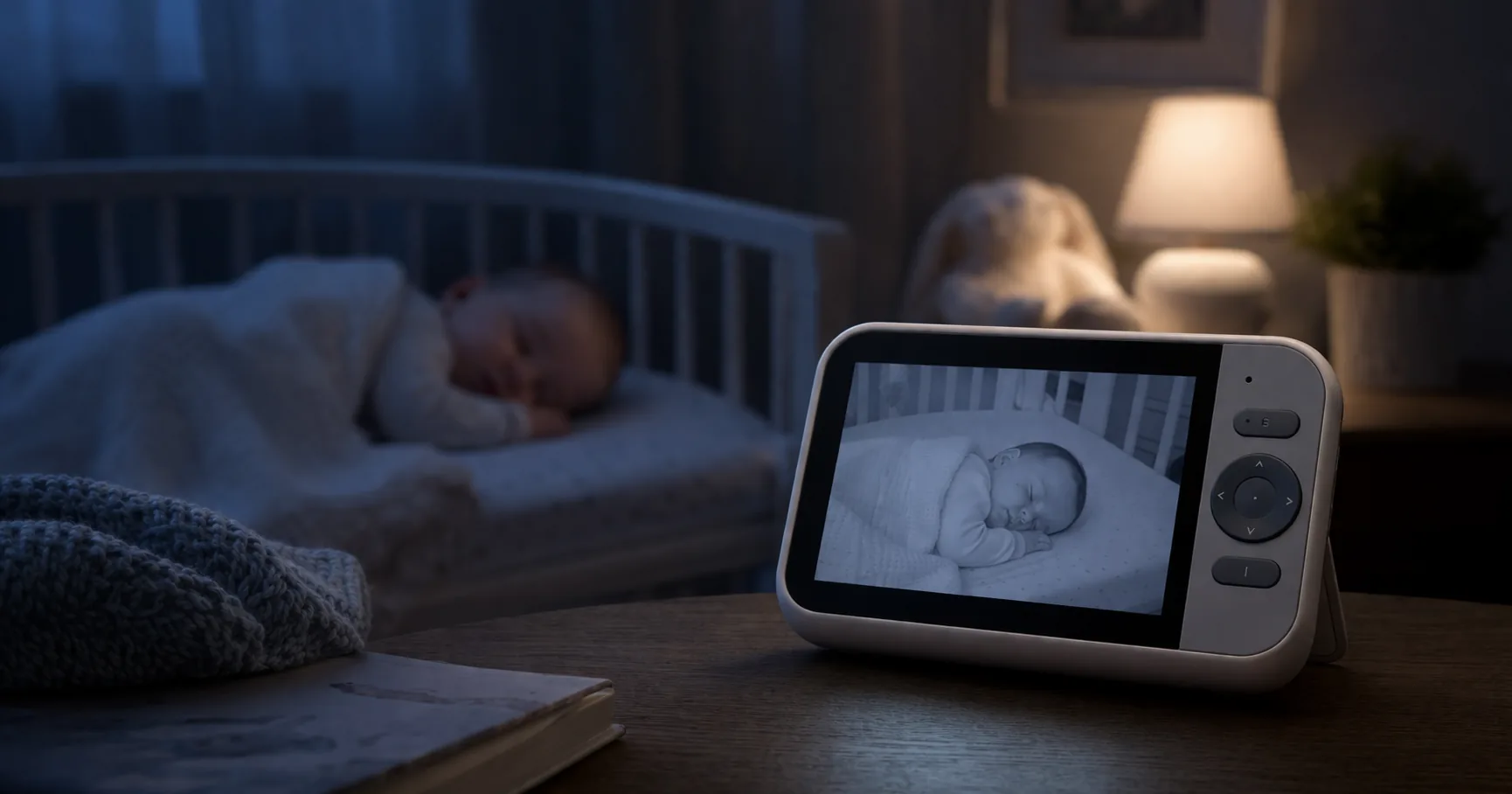
The reason to buy a non-WiFi baby monitor is simple. A WiFi monitor is a small computer on your home network, with a camera pointed at the most private room in your house, and every few years a news cycle reminds parents what happens when one of them gets breached. A monitor that uses FHSS radio instead of WiFi removes the entire category of router-side risk. There is no app, no cloud account, no recovered password, no firmware update that opens a new hole.
What you give up is checking the camera while you are at the office. If that is a dealbreaker, this list is the wrong list. If it is not, the seven monitors below cover the segment from a small travel-friendly 2.8-inch unit at the budget end to a 5-inch HD monitor with active noise cancellation at the top.
- Products analyzed
- 7
- Average rating
- 4.5
- Price range
- budget to premium
- Top rated
- Infant Optics DXR-8 PRO (4.6)
- Most reviewed
- Infant Optics DXR-8
Our Top Pick
Best non-WiFi baby monitor overall: the Infant Optics DXR-8. The deepest crowd of long-term owner feedback in the category, an interchangeable lens system nobody else offers, and an instant lag-free feed that comes from never loading an app in the first place.
Pick by the screen you want at 3 a.m.
The real decision inside this segment is not brand or feature count. It is what you want to be holding when the baby cries at three in the morning. A small 2.8-inch unit clips onto a belt or fits in a partner's hand without thinking about it, and runs longer between charges because the screen draws less. A 5-inch screen makes it possible to actually see whether the baby's eyes are open or just shadow, and it makes night vision useful past a glance.
Battery numbers in this category come in two flavors. Screen-on hours are what you get if you watch it the way most parents do for the first month, with the display lit through the whole nap. VOX hours are what you get when the screen sleeps until the camera hears sound, which works once you trust the sensor. Most picks here run eight to twelve hours screen-on and thirty to forty-eight in VOX. The one outlier is the VTech VM819, which holds nineteen hours of continuous screen-on video and is the right buy for households that want the display always lit.
At a Glance
| Product | Check |
|---|---|
| Infant Optics DXR-8 480p Video Baby Monitor, Non-WiFi Hack-Proof FHSS Connection, Interchangeable Lenses, Pan Tilt Zoom, LED Sound Bar, Night Vision, and Two-Way Talk. | (opens on Amazon) |
| GoodBaby 5" Baby Monitor with Camera and Audio, No WiFi Secure Camera, 30-Hour Battery, Remote PTZ, Auto Night Vision, Room Temperature, Two-Way Audio,Lullabies,960 ft Range | (opens on Amazon) |
| HelloBaby No WiFi Baby Monitor 5" Screen 30-Hour Battery Pan-Tilt-Zoom Video Upgrade with Camera and Audio, Night Vision, VOX, 2-Way Talk, 8 Lullabies and 1000ft Range, HB6550 | (opens on Amazon) |
| VTech Baby Monitor No WiFi – 19Hr Video Battery, 1000ft Range, Night Vision, Two-Way Talk, Temperature Sensor, Sound-Activated Screen, Lullabies | VM819 | (opens on Amazon) |
| Infant Optics DXR-8 PRO - Patented Active Noise Reduction (ANR), 5” HD Video Baby Monitor with 1 Camera, No WiFi, Hack-Proof,Pan Tilt Zoom, Interchangeable Lens | (opens on Amazon) |
| Kidsneed Baby Monitor with Camera and Audio - 5 inch 720P Video Baby Monitor, No WiFi, 48H Battery Life, Night Vision, Two Way Talk, Remote Pan Tilt Zoom, Thermal Monitor,1000 ft Range (530) | (opens on Amazon) |
| ANMEATE 5" HD Video Baby Monitor with Camera and Audio - No WiFi, 48H Battery Life,720P Remote Pan Tilt Zoom, Two-Way Talk, Night Vision, Thermal Room Monitor, Lullabies & White Noise, 1000ft Range | (opens on Amazon) |
Who each monitor is for
- First-time parents who want the safest brand bet: the Infant Optics DXR-8 has the deepest pool of long-term owners in the category and the longest unchanged design.
- Tight budget, want a full-size screen: the GoodBaby 5-inch and the Kidsneed cover the entry-level price with a real 5-inch display.
- Apartment with a fan, white noise machine, or HVAC humming: the Infant Optics DXR-8 PRO has active noise reduction that filters constant background sound from what you hear.
- Carrying the parent unit around the house all day: the VTech VM819 has a small belt-friendly screen and the longest screen-on battery.
- Travel and weekends without a charger nearby: the ANMEATE 5-inch has a 5,000 mAh battery and the longest VOX runtime.
The Picks
Infant Optics DXR-8 480p Video Baby Monitor, Non-WiFi Hack-Proof FHSS Connection, Interchangeable Lenses, Pan Tilt Zoom, LED Sound Bar, Night Vision, and Two-Way Talk.
The Infant Optics DXR-8 has been the reference point in this category for so long that it shows up by name in pediatrician recommendations and parent forums alike. The interchangeable lens system is the feature nobody else has matched. The included standard lens covers a normal nursery viewing distance, and the optional zoom and wide-angle lenses adapt the same camera to an oddly shaped room or an unusually big one. Pan, tilt and zoom run from the parent unit. The 480p resolution looks low on paper but renders crisply in practice because it is paired with strong infrared night vision and a feed with zero loading time. Nothing buffers because nothing is going through a server.
The honest limit is the resolution number itself. If you are buying in 2026 expecting 720p HD on every product, the DXR-8 will feel like a generation behind. For most parents, in a normal nursery, it is genuinely all the resolution you need. The instant-on, lag-free feed is the part that matters more day to day.
Skip this if you want to watch your baby on the parent unit for sustained stretches in a noisy apartment. The DXR-8 PRO further down this list is the right answer in that case.
Pros
- The deepest pool of long-term owner feedback in the non-WiFi category
- Interchangeable lens system that no competing brand offers
- Instant, lag-free feed with no app to load
- Strong infrared night vision
Cons
- 480p resolution feels dated next to HD picks
- Zoom and wide-angle lenses are sold separately
GoodBaby 5" Baby Monitor with Camera and Audio, No WiFi Secure Camera, 30-Hour Battery, Remote PTZ, Auto Night Vision, Room Temperature, Two-Way Audio,Lullabies,960 ft Range
The GoodBaby 5-inch is the budget answer that does not feel like a budget answer once you pick it up. The display is a full 5-inch panel, the parent unit pans and tilts the camera from across the house, and the rated 30-hour VOX battery covers a full sleep night without thinking about it. The two-way audio works the way owner reviews describe, which is to say it is loud enough to be useful and clear enough that the baby can recognize a parent's voice through it.
The small things matter on a monitor you reach for half-asleep. The thermometer reading in the corner is the right kind of glanceable. The four programmable feeding alarms are the touch that suggests someone designed this with a real newborn in the house. The shorter zoom range and the less-established brand are real limits, but the value-per-dollar at this price is hard to ignore.
Pros
- A real 5-inch screen at the lowest pricing tier
- 30-hour VOX battery covers a full night easily
- Four programmable feeding alarms
- Thermometer reading visible at a glance
Cons
- 2x zoom is on the shorter end of this list
- Less long-term track record than the established brands
HelloBaby No WiFi Baby Monitor 5" Screen 30-Hour Battery Pan-Tilt-Zoom Video Upgrade with Camera and Audio, Night Vision, VOX, 2-Way Talk, 8 Lullabies and 1000ft Range, HB6550
The HelloBaby HB6550 sits between the budget GoodBaby and the premium Infant Optics, and the trade is mostly build quality and brand continuity. HelloBaby has been refining the same monitor shape long enough that the listing notes specific iterations made in response to owner feedback, which is exactly the kind of thing that does not show up in a spec sheet but does show up in three-year reliability. A 5-inch screen, full pan and tilt, a 30-hour VOX battery, room temperature display with an alarm, and a 1,000 ft rated range all land in line with the rest of the segment.
The single specific reason to choose this one over the GoodBaby is the brand's track record of responding to long-term owner reports. The single specific reason to choose the GoodBaby instead is that the price gap pays for noticeable accessories or for a backup battery you actually use.
Pros
- Refined build that reflects iteration on owner feedback
- 5-inch screen, full PTZ, 30-hour VOX battery
- Room temperature alarm in addition to display
- Established brand presence in the segment
Cons
- Premium pricing over the budget picks for similar core specs
- Camera is not backward-compatible with earlier HB6550 hardware revisions
VTech Baby Monitor No WiFi – 19Hr Video Battery, 1000ft Range, Night Vision, Two-Way Talk, Temperature Sensor, Sound-Activated Screen, Lullabies | VM819
The VTech VM819 is the pick for the parent unit you wear on a belt clip during the day. The 2.8-inch display sounds small until you remember that the alternative is carrying a 5-inch tablet-like screen around for ten hours. The form factor disappears into a pocket. The trade is a screen-on battery that runs nineteen hours of continuous video on a single charge, which is the longest screen-on figure in this category by a wide margin.
The auto-on screen is the practical detail. Set the VOX threshold to a sensitivity that matches your baby's sleep, and the display goes dark between cries and snaps awake the second something matters. Three decades of VTech in this category shows up in the small things, like the way the belt clip is positioned and the way the talk button does not require looking at the unit. The lullaby selection is limited, which is true, and not particularly important.
Pros
- 19-hour screen-on battery is the longest in this segment
- Compact 2.8-inch unit fits in a pocket or on a belt clip
- Auto-on screen with adjustable VOX threshold
- VTech's long category presence shows in build details
Cons
- 2.8-inch screen is a real downgrade from the 5-inch picks
- Lullaby selection is limited
Infant Optics DXR-8 PRO - Patented Active Noise Reduction (ANR), 5” HD Video Baby Monitor with 1 Camera, No WiFi, Hack-Proof,Pan Tilt Zoom, Interchangeable Lens
The Infant Optics DXR-8 PRO is the same trusted brand family as the standard DXR-8, with 720p HD on a 5-inch screen and a single feature that justifies its premium price for a specific kind of buyer. Active Noise Reduction is patented audio filtering on the parent unit that removes constant background sound, the hum of a city fan or an air purifier or HVAC, from what you actually hear. In a quiet suburban nursery this is a nice-to-have. In a city apartment with traffic outside or a fan running across the room, it is the difference between hearing the baby cry and not.
Pan, tilt and zoom run from the unit with up to 6x optical zoom using the included lens system, and each camera pairs to one and only one monitor as a safety feature. The price is roughly double the standard DXR-8. The right reason to spend it is the noise filtering. If your nursery is genuinely quiet, the standard DXR-8 covers the same ground for half the money.
Skip this if your nursery is in a quiet bedroom with the fan off, since the standard DXR-8 gives you the same feed and the same brand reliability at half the price.
Pros
- 720p HD resolution on a 5-inch screen
- Active Noise Reduction filters out fan and HVAC hum
- 6x optical zoom with interchangeable lenses
- One-camera pairing as a hardware safety measure
Cons
- Roughly twice the price of the standard DXR-8
- Wide-angle lens is still sold separately
Kidsneed Baby Monitor with Camera and Audio - 5 inch 720P Video Baby Monitor, No WiFi, 48H Battery Life, Night Vision, Two Way Talk, Remote Pan Tilt Zoom, Thermal Monitor,1000 ft Range (530)
The Kidsneed 5-inch is the entry-level pick if you specifically want the 720p picture quality and do not want to spend premium money to get it. The resolution and screen size are the same numbers as the Infant Optics DXR-8 PRO, on paper. What is different is the absence of noise reduction, the absence of an interchangeable lens system, and the smaller pool of long-term owner reports behind it. A 5-inch HD picture, full pan, tilt and zoom, automatic infrared night vision, two-way audio, a thermometer, and FHSS encryption is the spec sheet.
This is a pick for parents who want the sharper image and accept a less-established brand to get it. The depth of owner reviews is meaningful for this category, since the failure modes of cheap monitors are real and tend to surface six months in. The Kidsneed has enough reviews to be a credible buy, and not so many that there is no risk in it.
Pros
- 720p HD resolution at the budget pricing tier
- Full 5-inch screen with PTZ
- Two-way audio and a glanceable thermometer
- FHSS encryption with no internet exposure
Cons
- Less established brand than Infant Optics or VTech
- No interchangeable lens option
ANMEATE 5" HD Video Baby Monitor with Camera and Audio - No WiFi, 48H Battery Life,720P Remote Pan Tilt Zoom, Two-Way Talk, Night Vision, Thermal Room Monitor, Lullabies & White Noise, 1000ft Range
The ANMEATE 5-inch is the answer for households that want to leave the monitor unplugged for whole weekends. The 5,000 mAh battery in the parent unit is the largest in this segment, and it translates to a 48-hour VOX runtime that no other pick on this list matches. A 5-inch HD display, pan, tilt and zoom, automatic night vision, two-way audio and a temperature sensor round out the specs. FHSS encryption keeps the signal off the internet completely.
The right time to choose this over the other 5-inch picks is when you actually travel with the monitor often, or when the nursery is far enough from an outlet that the unit lives on its battery most of the time. If you charge it on a nightstand next to the bed every night, the bigger battery is a feature you paid for and will never notice.
Pros
- 48-hour VOX battery is the longest in this list
- 5-inch HD display with full PTZ
- Large 5,000 mAh parent-unit battery
- FHSS encryption
Cons
- Less name recognition than VTech or Infant Optics
- The bigger battery only matters off the charger
Also worth considering
These models also stood out in our research. They didn't make the main list above, but each one fits a specific need better than the core picks.
HelloBaby Baby Monitor 6" World First IPS Screen 30H Battery, Secure No WiFi, Pan Tilt Video Camera with Night Vision, VOX, 2-Way Talk, 1000ft, Portable Video Audio Monitor Ideal for Mom, Elderly, Pet
The HelloBaby 6-inch IPS model is worth a look because its upgrade is one you notice the moment you pick it up. The larger IPS display is the whole story. If you find small parent units hard to read in the dark, or awkward for grandparents, the bigger, sharper screen isn't a minor perk, it's the reason to buy this one.
The rest stays true to the privacy-first brief: no WiFi, no app, no account, just a private closed connection. It adds the features you'd expect at this tier, including remote pan and tilt, infrared night vision, and a long battery that stretches depending on how you use it, without moving into a premium tier. Its buyer base is smaller than the HB6550 but still workable, with owners reporting they still feel good about it after years of use, which is reassuring for a baby product where trust beats novelty. The main cautions are a thinner review history and a few notes about weaker talk-back audio.
Skip this if you want the most proven track record, where the HB6550 leads, or you need a compact unit for travel, where the small VTech is better suited.
Pros
- Large, sharp IPS screen, easy to read at a glance
- Simple non-WiFi setup, no app or account
- Remote pan-tilt and night vision, not just a bigger screen
- Screen upgrade without a premium-tier jump
Cons
- Thinner buyer history than the top picks
- Some reports of weaker talk-back audio
The trade-off worth knowing
The temptation in this category is to read the spec sheet and pick the one with the biggest screen and the longest battery and the highest resolution. That logic produces a 5-inch HD monitor that runs 48 hours in VOX and costs about as much as the premium Infant Optics, with a brand you have not heard of. The trade you make for that combination is a smaller pool of long-term owner feedback, which matters in a category where failures tend to show up at the six-month mark rather than out of the box.
The other temptation is to spend up to the trusted premium brand and end up with a 480p picture in 2026. That is fine if you watch the screen mostly to confirm the baby is still in the crib. It is less fine if you actually study the feed during long naps trying to decide whether to go in. The honest answer is that brand reliability and resolution rarely live in the same monitor inside this segment, and the right choice depends on which trade you would rather make.
A few habits that help every pick
Three small habits push any of these monitors further than the box suggests. Mount the camera on a wall bracket rather than balancing it on a shelf above the crib, since a falling camera is the single most-reported failure mode across all brands and FHSS or not has nothing to do with it. Charge the parent unit to full overnight only once or twice a week instead of leaving it plugged in continuously, since lithium batteries hold capacity better with shallower regular cycles. And keep the parent unit out of the same room as a microwave oven, which sits on the same 2.4 GHz band that FHSS uses and will introduce static during the sixty seconds it runs.
Why pick a non-WiFi baby monitor over a WiFi one?
A non-WiFi monitor never sends video or audio through any server, which removes the category of risk that comes with home network breaches. It also keeps working when your router restarts or hits a dead zone, which a WiFi-based system will not.
How long does a non-WiFi baby monitor's battery actually last?
Most parent units here run eight to twelve hours screen-on and thirty to forty-eight hours in VOX mode. The VTech VM819 is the screen-on outlier at nineteen hours, and the ANMEATE is the VOX outlier at forty-eight, with the rest sitting in between.
Is 480p good enough, or should I get 720p?
480p is enough to confirm the baby is fine in the crib. 720p is sharper for catching detail, like whether the eyes are open or just shadow. If you mainly glance at the screen, 480p covers it; if you study the feed during long naps, the HD picks pay back the difference.
How far does the signal really reach inside a house?
Manufacturer ratings around 1,000 feet are open-air. Through walls and standard interior framing, expect roughly 500 to 600 usable feet, which covers a two-story home including a basement and a yard. Brick walls and metal framing shorten that further.
Are interchangeable lenses worth it on the Infant Optics models?
For a typical nursery with the camera mounted across the room, the standard lens is the right lens and the optional ones are not needed. The zoom lens earns its keep in a particularly small nursery, and the wide-angle in an unusually big one. For most rooms, neither lens is worth buying.