
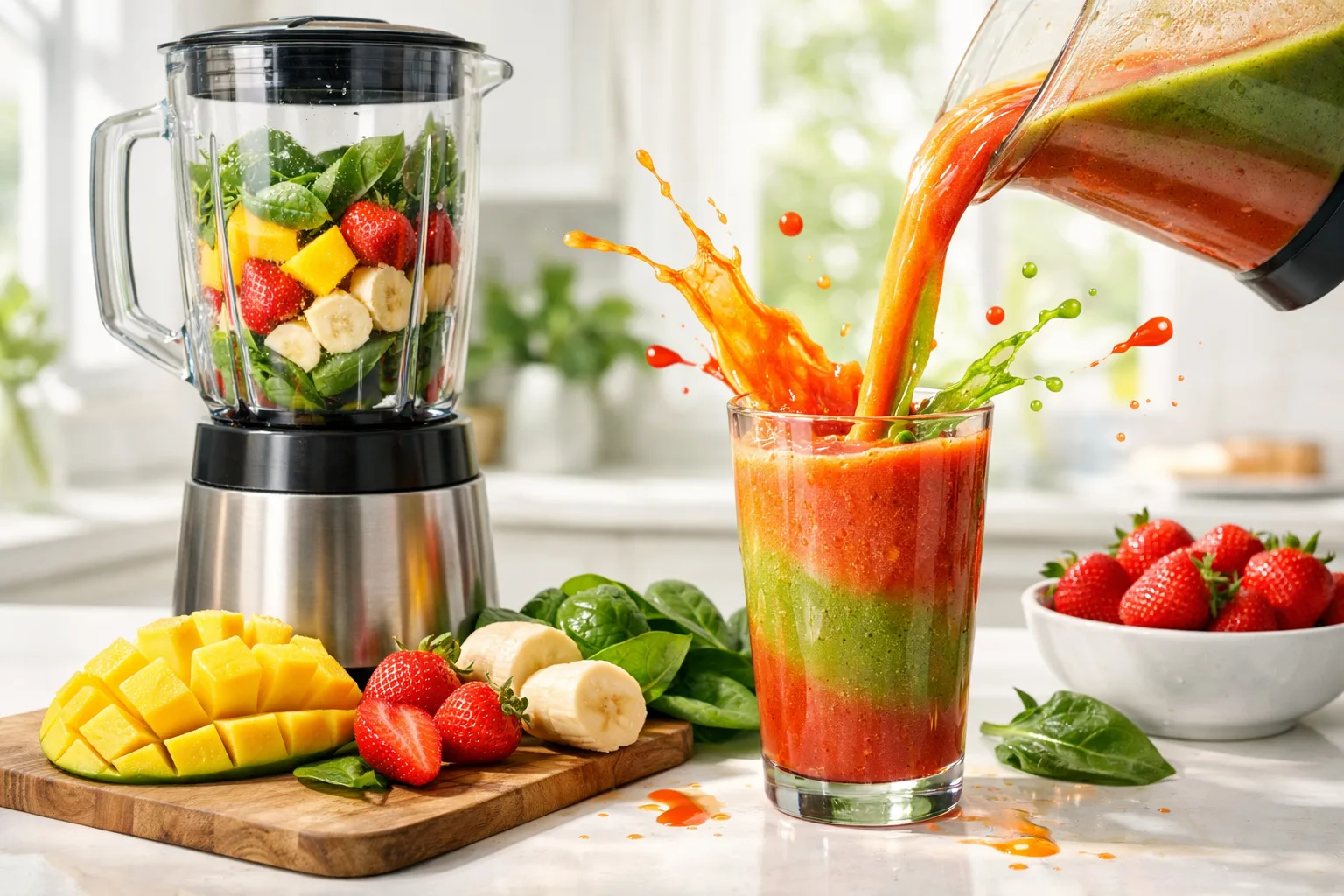
The blender that disappoints you is almost never underpowered — it's mismatched to how you actually blend. Buyers overspend on 1500-watt full-size machines and then make exactly one single-cup smoothie a day from them, hating the cleanup. Other buyers go cheap on a personal blender and try to crush solid ice cubes dry, stalling the motor in the first week. Either way the unit ends up at the back of the cabinet.
Power and blade design matter, but they matter less than the format question: are you blending in a cup you'll drink from, or in a pitcher you'll pour from? That decision steers the rest. This list is sorted around that, with capacity and ingredient stiffness as the secondary filters.
Top 5 Picks at a Glance
| Product | Check |
|---|---|
| Ninja Kitchen System | All-in-One Food Processor & Blender for Smoothies | Includes Pitcher, (2) 16 oz. To-Go Cups & 8-Cup Bowl | Makes Salsa, Dough, Shakes, & Frozen Drinks | 1500W | Black | BL770 | (opens on Amazon) |
| Ninja Nutri-Plus Personal Blender | Compact Push to Blend | Make Frozen Drinks, Smoothies, Sauces & More | With (3) 20 oz. To-Go Cups, (2) Spout-Lids & (1) Storage-Lid | 900 Peak Watt | Silver | BN301 | (opens on Amazon) |
| Ninja Professional Blender | Smoothie Blending, Drink Mixer, Grinder, Ice Crusher, Frozen Fruit Blending | 1000W Power, Total Crushing Technology, XL 72-oz. Pitcher | Black & Grey | BL610 | (opens on Amazon) |
| Nutribullet Personal Blender, Shakes, Smoothies, Food Prep, and Frozen Blending, 24 Ounces, 600 Watt, Dark Gray, NBR-0601WM | (opens on Amazon) |
| Ninja Professional Plus Blender with Auto-iQ | Smoothie and Ice Cream Maker, Frozen Drink Mixer, Margarita Machine | 3 Auto-iQ Presets, 1400W, 72-oz. Total Crushing Pitcher | Dark Grey | BN701 | (opens on Amazon) |
Who this is for
- Daily single-cup smoothie, grab-and-go → NutriBullet Personal Blender. Cup is also the cup you drink from. Zero transfer step.
- Single user but blends frozen-solid fruit or seeds → NutriBullet BN301 Plus. Same format, real torque.
- Households making 2-3 smoothies per morning → Ninja Professional 72-oz pitcher.
- Frequently blends ice into snow texture (smoothie bowls, frozen drinks) → Ninja Kitchen System or the Ninja Professional.
- Wants one machine that does smoothies, sauces, dips, dough → Ninja Kitchen System. Pitcher + food processor in one.
- Wants pitcher AND single-cup flexibility from one unit → NutriBullet Professional Plus.
Reviews
Ninja Kitchen System | All-in-One Food Processor & Blender for Smoothies | Includes Pitcher, (2) 16 oz. To-Go Cups & 8-Cup Bowl | Makes Salsa, Dough, Shakes, & Frozen Drinks | 1500W | Black | BL770
The Ninja Kitchen System is the pick when you want a single appliance to cover smoothies, dips, sauces, dough and chopped vegetables. The pitcher handles batch smoothies for a household; the food processor bowl handles everything that isn't smoothie; the single-serve cups handle the morning grab-and-go. It is the most versatile option on this list by a wide margin.
The 1500-watt motor is overkill for most smoothies, which is the point — it doesn't stall on frozen-solid ingredients or dense smoothie-bowl mixes, and the headroom keeps the motor cool enough that it lasts longer under heavy use. Reports from long-term owners on consistency over years are among the strongest on Amazon.
Skip this if you only ever make one single-cup smoothie per day. You're paying for a food processor and a pitcher you'll rarely touch.
Pros
- All-in-one: pitcher + food processor + single-serve cups
- 1500W — frozen-solid ingredients and dense blends without stalling
- Among the most consistently rated blenders on Amazon
- Long-term motor reliability under daily heavy use
Cons
- Premium tier — most expensive on this list
- Footprint demands counter commitment
Ninja Nutri-Plus Personal Blender | Compact Push to Blend | Make Frozen Drinks, Smoothies, Sauces & More | With (3) 20 oz. To-Go Cups, (2) Spout-Lids & (1) Storage-Lid | 900 Peak Watt | Silver | BN301
The NutriBullet BN301 Nutri-Blender Plus is the pick when you want personal-blender simplicity but routinely blend things that lower-wattage cup blenders struggle with — frozen fruit straight from the freezer, leafy greens with thick stems, chia or flax seeds, nut butters. The extractor blade design is what does the work here: it pulls ingredients down into the blade rather than spinning them away, which is why these units handle leafy greens better than wattage alone would suggest.
The format is the same blend-and-go cup as the standard NutriBullet. Cleanup is rinse-the-cup-and-blade — a real-world 30 seconds, not a marketing claim. Dishwasher safe for the cup.
Pros
- Extractor blade — handles greens and frozen fruit better than wattage implies
- Blend-and-go cup format — no transfer step
- Cleanup measured in seconds
- Strong long-term reliability reports from daily users
Cons
- Single-cup capacity — not for households blending for multiple people
- Lower headroom than full-size units for very thick blends
Ninja Professional Blender | Smoothie Blending, Drink Mixer, Grinder, Ice Crusher, Frozen Fruit Blending | 1000W Power, Total Crushing Technology, XL 72-oz. Pitcher | Black & Grey | BL610
The Ninja Professional is the pick when you want a true batch blender — multiple smoothies in one go, a frozen drink batch for friends, a smoothie bowl thick enough to eat with a spoon — without going up to the Kitchen System tier. The 1000-watt motor with Total Crushing Technology breaks ice into snow consistency, which is genuinely the differentiator: dry ice blending is where most mid-range pitchers fail.
72-oz pitcher, three speeds and a pulse. No single-serve cups in the box, so the blend-then-pour workflow applies — you will dirty a glass after. That's the trade for the much larger usable capacity.
Skip this if your normal use is one smoothie per morning. You'll resent the pitcher cleanup within a month.
Pros
- Total Crushing — ice into snow without added liquid
- 72-oz pitcher fits a family batch
- Three speeds plus pulse for control
- Extensively validated at this tier
Cons
- No single-serve cups — extra cleanup vs personal blender
- Lid noise is noticeable at maximum speed
Nutribullet Personal Blender, Shakes, Smoothies, Food Prep, and Frozen Blending, 24 Ounces, 600 Watt, Dark Gray, NBR-0601WM
The NutriBullet Personal Blender is the pick when you want the minimum-friction daily smoothie routine and you blend mostly normal ingredients — fresh fruit, yogurt, lightly frozen berries, leafy greens with liquid. Fill the cup, twist the blade on, press down, done. The 24-oz cup is sized to fit standard cup holders for the commute.
It is honest about what it isn't. Try to dry-blend solid ice cubes and the motor will labor; load a cup with thick frozen mass and no liquid and it will struggle. With even a small splash of liquid, it handles frozen fruit fine. For the price tier this is among the most validated kitchen appliances on Amazon.
Skip this if your morning smoothie is always frozen-solid ingredients with no liquid added. The next-step-up BN301 is the right pick instead.
Pros
- Entry-tier pricing with strong long-term reliability
- One-button operation, no settings to learn
- Cup fits standard cup holders for grab-and-go
- Among the most consistently rated personal blenders on Amazon
Cons
- Struggles with dry ice or very thick frozen loads
- Single-cup only — no batch option
Ninja Professional Plus Blender with Auto-iQ | Smoothie and Ice Cream Maker, Frozen Drink Mixer, Margarita Machine | 3 Auto-iQ Presets, 1400W, 72-oz. Total Crushing Pitcher | Dark Grey | BN701
The NutriBullet Professional Plus is the pick when you want both a full pitcher (for batch smoothies, soup, sauce) and the single-serve cup format (for the morning grab-and-go) from one machine, without going up to the Ninja Kitchen System price. You get the NutriBullet extractor blade engineering at full-pitcher size, which is the main reason to choose this over the Ninja Professional — it blends leafy greens noticeably smoother at the same speed.
The pitcher is smaller than the Ninja Professional's 72-oz, which is the trade-off. For most households making 2 smoothies at a time, the capacity is enough; for batch-cooking a large dinner soup, the Ninja pitcher wins on volume.
Pros
- Pitcher and single-serve cup formats in one machine
- Extractor blade at full-size for smoother greens
- Strong owner reports for long-term durability
- Reasonable price for the dual-format flexibility
Cons
- Lower wattage than Ninja at the same tier
- Pitcher capacity smaller than the Ninja Professional's
The trade-off you're actually making
The interesting choice on this list is between the Ninja Professional pitcher and the NutriBullet Professional Plus. They cost in the same range, and they solve the mid-range full-size question two different ways.
The Ninja gives you a bigger pitcher and a higher-torque motor optimized for crushing ice into snow. If you make smoothie bowls, frozen cocktails or anything where dry ice has to disintegrate, the Ninja wins outright. The NutriBullet gives you the extractor blade design plus the single-serve cup format alongside the pitcher. If your smoothies always include liquid and the green smoothness matters more than ice texture, the NutriBullet wins — and you also get the grab-and-go cup without buying a second device.
The Kitchen System sits above both as the "I want it to do food-processor work too" pick. The two personal blenders sit below as the "I only make one cup a day" picks. That's the actual fork.
How to Choose a Blender for Smoothies
Format: cup or pitcher
The decision that drives the rest. Cup blenders are faster to use, faster to clean and have a permanent home in your morning. Pitcher blenders win on capacity and on dense, ice-heavy blends, at the cost of an extra cleanup step every time.
Wattage, matched to ingredient stiffness
For fresh or lightly frozen fruit with liquid, 600-900W is enough. For frozen-solid ingredients, smoothie bowls, dry ice or nut butters, 1000W or above. Above 1500W matters mostly for headroom — it keeps the motor cool under repeated heavy loads, which extends the unit's working life rather than the per-smoothie performance.
Blade design
Underrated. NutriBullet's extractor blade pulls ingredients down toward the cutting edge, which is why these units beat higher-wattage competitors on leafy greens. Ninja's Total Crushing blade is optimized for ice. Match the blade to your dominant use.
Cleanup
The blender you use is the one that's easy to clean. Cup formats clean in under a minute. Pitcher formats need disassembly, rinsing the blade base separately, and drying. If past blenders ended up shelved because of cleanup, the cup format wins regardless of capacity arguments.
Longevity
Daily-use units last 3-5 years before motor wear becomes noticeable. The two failure modes are running dry without liquid and consistently overloading on too-thick blends. Either is avoidable. Both NutriBullet and Ninja sell replacement parts, which extends usable life past the first wear cycle.
Is a 1000W blender meaningfully better than a 600W?
For normal smoothies with liquid, no — both produce a smooth result. The difference shows up with frozen-solid ingredients, dry ice, smoothie bowls and nut butters, where the lower wattage motor labors or stalls. If your smoothies always include enough liquid to keep the blade circulating freely, 600-900W is enough. If they don't, step up to 1000W.
Can a personal blender crush ice?
Some can, with conditions — small amounts of crushed or shaved ice combined with liquid blend fine. Dry-blending solid ice cubes is where personal blenders struggle and where motors burn out. If ice-crushing performance matters, a full-size Ninja with Total Crushing is the safer pick than any personal cup.
How long do these blenders last under daily use?
With normal daily use, three to five years is realistic before motor wear. Personal blenders fail most often from dry-running (no liquid) or repeated thick-blend overloads. Full-size units last longer because they have larger motors with more thermal headroom. Replacement blades and cups are sold for both NutriBullet and Ninja, which extends usable life.
Blender or food processor — which one do I need?
A blender is built for liquid-based work: smoothies, soups, sauces. Its tall narrow vessel pulls liquid into the blade. A food processor is built for dry or semi-solid work: chopping, slicing, dough. Its wide shallow bowl is the wrong shape for liquids. The Ninja Kitchen System is the only pick here that does both well, because it includes a separate food-processor bowl.
Why do my smoothies still come out chunky?
Almost always one of two reasons. Either the blade design isn't pulling ingredients down toward the cutting edge (try blending in shorter pulses with stops to shake the cup), or there isn't enough liquid in the mix to circulate solids through the blade. Adding a small amount of liquid or layering ingredients with liquid at the bottom usually solves it without buying a more powerful unit.
As an Amazon Associate I earn from qualifying purchases. Prices and availability change frequently — use the Amazon button to check current pricing.