
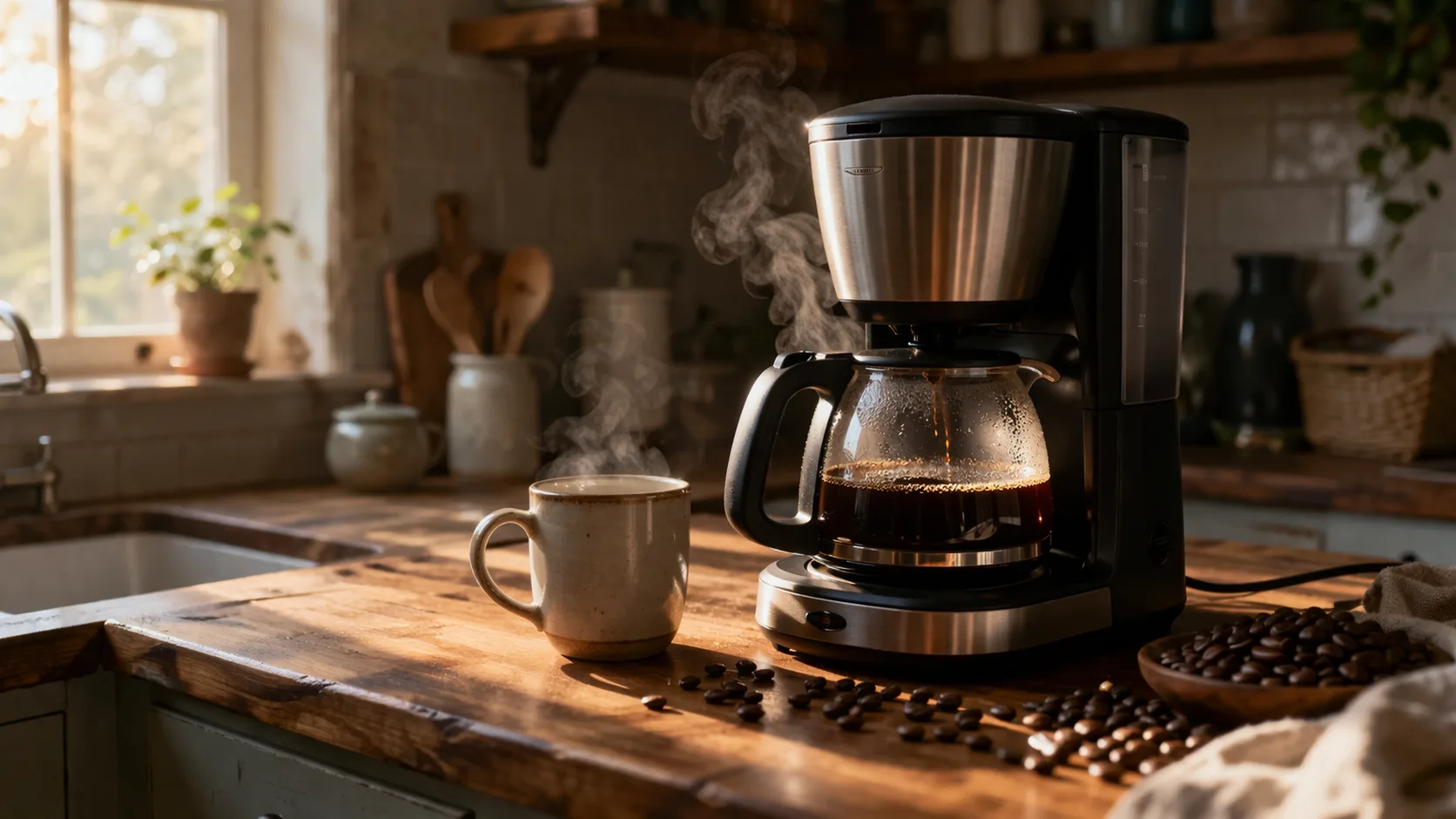
The reason most people are unhappy with their drip coffee maker has nothing to do with the brand. It's that the water temperature never reaches the range coffee actually extracts at — somewhere between 195°F and 205°F. Cheaper machines undershoot, often by 20°F or more, and the result is the flat, slightly sour cup that buyers blame on their beans. Beans are usually not the problem.
The second mistake is leaving a glass-carafe machine on its warming plate for an hour. The coffee that comes out of the pot at 8 a.m. is fine; what you pour at 9:15 has been stewed on a hot plate and tastes like it. This guide is sorted around those two facts: brew temperature first, carafe type second, capacity third. Everything else is preference.
Top 5 Picks at a Glance
| Product | Check |
|---|---|
| Hamilton Beach 2-Way Programmable Coffee Maker, 12 Cup Glass Carafe And Single Serve Coffee Maker, Black with Stainless Steel Accents, 49980RG | (opens on Amazon) |
| Cuisinart 14-Cup Coffee Maker, Programmable PerfecTemp Glass Carafe Coffee Machine with 1-4 Cup Setting, Brew Strength Control and Pause, Stainless Steel, DCC-3200NAS | (opens on Amazon) |
| Ninja 12-Cup Programmable Coffee Brewer, 2 Brew Styles, Adjustable Warm Plate, 60oz Water Reservoir, Delay Brew - Black/Stainless Steel | (opens on Amazon) |
| Cuisinart DCC-1200P1 Brew Central 12-Cup Programmable Coffeemaker Coffee Maker, Carafe, Brushed Chrome | (opens on Amazon) |
| BLACK+DECKER 12-Cup Digital Coffee Maker, Programmable, Washable Basket Filter, Sneak-A-Cup, Auto Brew, Water Window, Keep Hot Plate, Black | (opens on Amazon) |
Who this is for
- Mixed household where one person leaves at 6 a.m. with a travel mug and the rest brew later → Hamilton Beach 2-Way. Two separate brewing systems in one machine.
- Family of 4+ who brews a full pot daily → Cuisinart 14-Cup PerfecTemp. Largest capacity, real temperature control.
- Wants meaningful strength control and a brew that doesn't taste burnt after 90 minutes on the plate → Ninja 12-Cup.
- Daily driver, set-and-forget, premium tier without going specialty → Cuisinart DCC-1200P1 Brew Central.
- First coffee maker, secondary kitchen or office → BLACK+DECKER 12-Cup Digital.
Reviews
Hamilton Beach 2-Way Programmable Coffee Maker, 12 Cup Glass Carafe And Single Serve Coffee Maker, Black with Stainless Steel Accents, 49980RG
The Hamilton Beach 2-Way is the pick for the specific household that wastes coffee every morning — one person leaves early with a travel mug while the rest brew a full pot two hours later. It has two independent brewing systems sharing one footprint: a 12-cup carafe side and a single travel-mug side, each with its own water reservoir and its own brew button.
The travel-mug side fits up to a 14-oz tumbler and brews directly into it. No transfer, no waste from brewing a half-pot for one cup. Programmable 24-hour timer on both sides. The brew quality is consistently strong for the tier — among the most consistently rated drip makers on Amazon.
Skip this if you only ever brew the full pot. You're paying for a single-cup side that won't get used.
Pros
- Two independent brewing systems in one unit
- Brews into a travel mug — no pouring step before commute
- 24-hour programmable timer on both sides
- Strong long-term reliability reports
Cons
- Glass carafe — loses heat without the warming plate
- Travel-mug side caps at 14 oz
Cuisinart 14-Cup Coffee Maker, Programmable PerfecTemp Glass Carafe Coffee Machine with 1-4 Cup Setting, Brew Strength Control and Pause, Stainless Steel, DCC-3200NAS
The Cuisinart 14-Cup PerfecTemp is the pick when you regularly brew for 3-4 people or more, and you want the brew to actually taste like good coffee rather than flat coffee. The PerfecTemp control keeps water in the 195-205°F window through the entire cycle — the cheaper machines that miss this window produce the under-extracted cup that beans alone can't fix.
14-cup capacity is the largest on this list; the 1-4 cup setting slows the brew cycle for small batches so you don't get weak coffee at low volumes. 24-hour timer, auto-pause for mid-brew pours, simple controls. This is the pick that pays off most clearly in the cup quality compared to the budget tier.
Pros
- 14-cup capacity — comfortably feeds 3-4+ daily coffee drinkers
- Brew temperature held in the extraction window
- 1-4 cup setting for small batches without weak result
- 24-hour programmable timer with auto-pause
Cons
- Glass carafe only at this tier
- Larger footprint than 12-cup units
Ninja 12-Cup Programmable Coffee Brewer, 2 Brew Styles, Adjustable Warm Plate, 60oz Water Reservoir, Delay Brew - Black/Stainless Steel
The Ninja 12-Cup is the pick when you want to actually change how the coffee tastes from cup to cup, not just brew the same drip every morning. The Classic and Rich settings produce genuinely different extractions — Rich is for the stronger cup that holds up under milk, Classic is the standard daily brew. Most "strength" settings on competing machines just slow the flow; Ninja's adjusts extraction more meaningfully.
The adjustable warming plate temperature is the underrated feature. Standard warming plates run hot enough to start cooking the coffee within 60-90 minutes, which is where the bitter taste comes from. Ninja lets you dial that down so the second cup tastes like the first.
Pros
- Two real brew styles, not just a strength slider
- Adjustable warming plate prevents stewed-coffee taste
- 24-hour delay brew with simple programming
- Wide spare parts availability
Cons
- Build feel is mid-tier vs Cuisinart at similar prices
- Some owners find the carafe handle awkward
Cuisinart DCC-1200P1 Brew Central 12-Cup Programmable Coffeemaker Coffee Maker, Carafe, Brushed Chrome
The Cuisinart Brew Central is the pick when you want one machine that just works for years. It's been the consistent recommendation in the drip category for over a decade, and the reason is unromantic: it brews in the right temperature window every time, the auto-pause works without leaks, and the auto-clean function makes the descaling routine simple enough that people actually do it.
The 60-second mid-brew pause is the most-used feature owners cite — pour a cup before the pot is finished, slide the carafe back, no spill. Build is the heavier Cuisinart chassis that handles being moved around the kitchen daily without rattling apart over time.
Skip this if budget is the dominant constraint. The temperature gain over the BLACK+DECKER is real, but for an office secondary machine it's not worth the difference.
Pros
- 60-second auto-pause for mid-brew pours
- Auto-clean function — makes descaling routine actually happen
- Decade-plus track record of consistent results
- Brew temperature held in the extraction window
Cons
- Higher tier than the Hamilton Beach for the same 12-cup capacity
- Glass carafe — no thermal option in this model
BLACK+DECKER 12-Cup Digital Coffee Maker, Programmable, Washable Basket Filter, Sneak-A-Cup, Auto Brew, Water Window, Keep Hot Plate, Black
The BLACK+DECKER 12-Cup Digital is the pick when the job is "have hot coffee ready at 7 a.m. every morning" and the budget is the dominant constraint. It brews a full 12 cups, programs 24 hours ahead, and keeps the pot warm. It is one of the most consistently rated entry-tier drip makers on Amazon, which is honest about what it is and isn't.
What it isn't: a machine that holds water in the 195-205°F extraction window. The cup tastes thinner than what you'd get from a Cuisinart, and that's not adjustable. For a first coffee maker, a college kitchen or an office secondary, it's the right pick. For a daily-driver where the cup quality matters, the Hamilton Beach or Cuisinart pay back the small price gap.
Pros
- Entry-tier pricing with strong reliability reports
- 24-hour programmable timer
- Reusable basket filter included
- Compact footprint for small kitchens
Cons
- Brew temperature undershoots the extraction window
- Plastic construction feels less durable over years of use
The trade-off you're actually making
The interesting decision on this list is not between price tiers — it's between the Hamilton Beach 2-Way and the Cuisinart Brew Central at roughly the same price.
Hamilton Beach gives you flexibility: full pot and single travel-mug from one machine, which is the right answer if your household has staggered morning schedules. The carafe brew quality is fine but not exceptional. The Cuisinart gives you a single, better-tasting pot — the temperature window is held more precisely, and the auto-pause + auto-clean are noticeably better-engineered. The cost is that you only ever brew into the carafe; the travel-mug-direct convenience is gone.
If the household brews into mugs at the same time every morning, the Cuisinart wins on cup quality. If at least one person leaves with a travel mug while the pot is still brewing for the others, the Hamilton Beach saves the wasted half-pot every day, and that adds up faster than the modest cup-quality difference.
How to Choose a Coffee Maker
Brew temperature
The single most important spec, and the one buyers ignore most often. Specialty coffee organizations recommend 195-205°F for proper extraction. Machines that undershoot this produce the flat, sour cup that no amount of bean-changing fixes. Cuisinart's PerfecTemp control is explicit about this; cheaper machines often run 175-185°F.
Glass vs thermal carafe
Glass shows you how much coffee is left and costs less, but loses heat fast — and the warming plate that keeps it hot is also what cooks the coffee into bitterness after an hour. Thermal carafes hold heat for 2-3 hours without any heating element. If you typically finish the pot within 30 minutes, glass is fine; if it sits on the counter for an hour or more, thermal is worth the upgrade.
Programmable timer
Standard on all five picks. Set it the night before, brew starts on its own. This is the feature that turns "I sometimes make coffee" into "the machine is part of my morning routine," and is the single most-cited reason owners stick with one machine over years.
Capacity, in real cups
12-cup carafes hold about 60 oz, which is roughly 5-6 standard travel mugs or 8-9 small cups. 14-cup holds about 70 oz. For 1-2 people, 12-cup is more than enough; for 4+ or for someone who batch-brews for the whole day, 14-cup makes a real difference.
Long-term maintenance
Descaling every 3-6 months is the single most important habit for coffee maker longevity. Mineral buildup is the dominant failure mode after the heating element. Auto-clean functions (Cuisinart) make this less likely to get skipped; manual descaling on cheaper machines is the same procedure with extra friction.
Is a more expensive coffee maker actually worth it?
Up to a point, yes. The jump from the entry-tier to the mid-range is the largest single quality gain in this category because it buys you proper brew temperature. The cup tastes noticeably stronger and rounder. Going above the premium tier into specialty machines (pour-over, espresso) is a different category — for drip coffee, the law of diminishing returns kicks in past the Cuisinart tier.
Glass or thermal carafe?
Thermal if you drink the pot slowly over an hour or more — it preserves cup quality without the warming-plate stewing effect. Glass if you finish the pot quickly, or if seeing how much is left matters to you. The Ninja's adjustable warming plate is a middle-ground option that mitigates the glass-carafe bitterness without going thermal.
How long should a drip coffee maker last?
Five to ten years with regular descaling. The two failure modes are scale buildup in the tubing and heating element wear. Descaling every 3-6 months covers the first; the second is mostly chance. Cuisinart and Hamilton Beach have the most consistent long-term reliability reports from owners running daily use over years.
What does the 1-4 cup setting actually do?
It slows the brew cycle when you're making a small batch, so the water spends enough time in contact with the grounds to extract properly. Without it, a 2-cup brew on a 12-cup machine often tastes weak and thin because the water rushes through too fast. The Cuisinart 14-Cup and Brew Central both have this setting, which is the difference between a good small batch and a flat one.
Why does my coffee taste burnt by mid-morning?
Almost always the warming plate. Standard warming plates run hot enough to keep cooking the coffee long after brewing finishes, and the longer it sits, the more bitter it gets. Either move to a thermal carafe (no heating plate), use a machine with adjustable warming plate temperature like the Ninja, or transfer the pot to an insulated container after brewing.
As an Amazon Associate I earn from qualifying purchases. Prices and availability change frequently — use the Amazon button to check current pricing.