
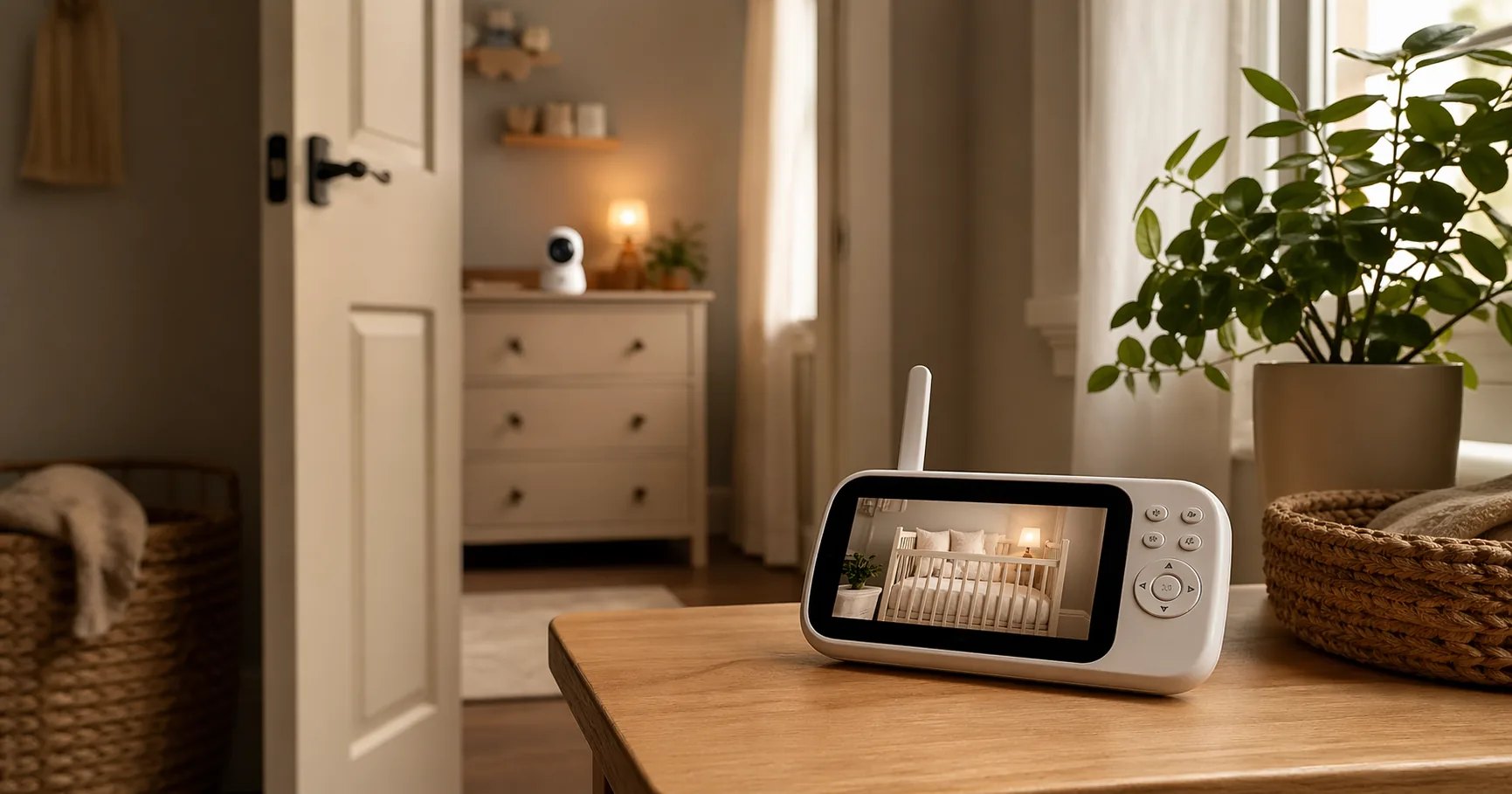
There is a particular kind of frustration that only owners of big houses know: the baby monitor that works perfectly in the next room and goes dead the moment you step into the garage or out onto the deck. Wi-Fi monitors are built for a phone that stays near a router, not for a parent walking the far end of a two-story house. Long range monitors solve a different problem. They use a closed signal that needs no internet, pushes through stucco and brick, and holds steady across distances that quietly defeat a home network.
The catch is that almost every monitor claims a long range on the box, and plenty of them lose the connection well short of it once real walls get involved. The five below are the ones that keep the feed alive where it counts, spread across price tiers and including an audio-only option for parents who never needed video to begin with. Pick by your house and your habits, not by the biggest number on the listing.
The Infant Optics DXR-8 is the long range video monitor most parents should start with. It has the deepest review base of any monitor in its class, the only interchangeable-lens camera here, and a closed signal with no Wi-Fi, no app, and no account. It is the safe default if you want video and reliability over smart-home extras.
Who Each Monitor Is For
A long range monitor is not one product for one buyer. Before the picks, find yourself here:
- You have a tall or wide house and the parent unit travels between floors or out to the far rooms. You need a video monitor whose signal genuinely holds between levels.
- You never wanted video, just a clear sound of your baby while you move around the house. An audio-only unit costs a fraction of the rest and avoids screen distraction entirely.
- You have two kids in two rooms, or one child who roams between a nursery and a play space. A dual-camera setup on a single screen saves you buying two systems.
- You want to glance, not pick up. If you keep the monitor on a side table and check it across the room, screen size matters more than any other spec.
- You are on a tight budget or need a second unit for a grandparent’s house or a vacation rental. A starter video monitor covers the first year without overspending.
The Infant Optics DXR-8 is the long range monitor that every other long range monitor gets measured against. It carries the deepest review base of any model in its category, the kind of staying power most baby tech never earns, and it does it without touching the internet.
Its signature feature is the interchangeable lens system. Optional zoom, wide, and normal lenses thread onto the front of the camera, so you can change the viewing angle as your child grows or as you move the camera between rooms, without buying a new unit. Parents repeatedly name this as the reason they chose it over a fixed-lens rival. Pan, tilt, and zoom run from the parent unit, and the whole thing works on a closed signal between two paired devices, with no app, no account, and nothing exposed to the web. Range holds well through standard interior walls.
The screen is the obvious compromise. It is lower resolution than newer HD competitors, so you will not read fine detail across a room, but for the real job of seeing whether your baby is asleep, breathing, or climbing the crib rail, it is plenty sharp.
Skip this if remote viewing from outside the house is a must-have, because the closed signal does not leave the home by design. For parents who specifically want to avoid Wi-Fi, that limitation is the entire point.
Infant Optics DXR-8
The HelloBaby HB6550-2 is the dual-camera version of HelloBaby’s flagship, built for parents with two kids in separate rooms or one child who moves between a nursery and a play area. Both cameras pair to a single parent screen, and you can switch between them or set the display to rotate automatically, so two rooms get covered without you tapping anything.
The advertised range is among the longest here, and owners in two-story homes consistently confirm the signal stays stable between floors. Battery life on the parent unit is a genuine standout, comfortably covering an overnight with room left for the next day’s naps. The camera handles remote pan, tilt, and zoom, and adds a temperature readout and a set of lullabies for nighttime soothing. The picture is sharp enough for crib detail.
Skip this if you only have one child and one nursery, since you would pay for a second camera you will not use, and the single-camera models here suit you better. The other thing to watch is the parent screen, which a few long-term owners report dimming after about a year, so a protection plan is sensible if you plan to run it across several years.
HelloBaby HB6550-2 Dual-Camera
For parents who never needed video, the VTech DM221 is the long range monitor to buy, and it holds the highest rating in this roundup. The reason it punches above its price is the signal type: it runs on a dedicated cordless-audio band rather than the crowded 2.4GHz space shared by your router and microwave. Owners in dense apartment buildings and Wi-Fi-saturated neighborhoods single this out, because the audio stays clear where other monitors crackle or drop.
A long advertised range and a signal-strength meter on the parent unit let you know exactly how far you can wander before it cuts out. Two-way talk lets you soothe from the kitchen without climbing the stairs, the camera unit doubles as a soft night light, and the parent unit lasts a long stretch per charge. For a newborn whose movements you cannot see anyway, or an older child whose room you check rather than watch, audio is what most parents actually use, at a fraction of a video monitor’s cost.
Skip this if you want to confirm what your baby is doing with your eyes, because there is no video at all. The parent unit is also small and easy to misplace around the house.
VTech DM221 Audio Monitor
The Firskids 1000ft is the entry point into long range video. It is the cheapest video monitor here by a clear margin, and it does not give up the core feature, the long, Wi-Fi-free range, to hit that price. The hardware covers the essentials: an IPS parent screen, a closed signal, two-way talk, infrared night vision, and a temperature readout. Battery life is competitive with monitors costing two or three times as much, with an eco mode that stretches it further.
Where it slips is build quality and brand support. The plastic feels lighter than the established names, a few owners report the camera mount loosening over months of use, and customer service is more hit-or-miss because Firskids is a smaller brand. As a first-year monitor or a backup for a second home, the value is hard to argue with.
Skip this if you need the monitor to last through several children or many years, because the pricier picks are built to go the distance and this one is built to the price.
Firskids 1000ft Video Monitor
The HelloBaby HB6560 is the large-screen option, the one to choose if you want to actually read your baby’s face from across the room rather than walk over to the unit. The display is noticeably bigger than the others here, and for parents who keep the monitor on a side table and glance at it, that extra screen real estate is a real usability gain.
The camera handles remote pan, tilt, and zoom, runs on the same closed, long-range signal as the rest, and the parent unit lasts a long time in audio mode with a solid stretch of video streaming. This is a single-camera unit, so it suits one child or one nursery. Owners consistently praise the picture clarity and the smooth pan-and-tilt, which does not grind or stall the way some cheaper motorized cameras do.
Skip this if you need to cover two rooms out of the box, since it ships with one camera, and the dual-camera HB6550-2 is the better starting point there. Against the Infant Optics, the trade-off is track record: HelloBaby is newer, so if resale or handing the unit down matters, the longer-established option holds value better.
HelloBaby HB6560 6-Inch
The Trade-Off Nobody Mentions
The honest tension in this category is between reach and everything else. The monitors that brag loudest about range are not automatically the ones you will enjoy using, because in a real house full of walls and appliances, advertised range gets cut roughly in half anyway, and what you feel every single day is the screen, the battery, and the signal type, not the last hundred feet of theoretical distance.
That is why the picks here split the way they do. The audio VTech wins on signal cleanliness and price but asks you to give up video entirely. The large-screen HelloBaby wins on daily usability but covers one room. The dual-camera HelloBaby covers more rooms but is wasted on one child. The Infant Optics wins on proven longevity but runs a plainer screen. The budget Firskids wins on price but not on lifespan. None of them wins on all four at once, and any listing that implies it does is selling you the number on the box rather than the experience of owning it.
How to Choose a Long Range Baby Monitor
First, be sure you actually need long range. If the nursery shares a floor with your living room and there is no basement or detached garage in the picture, a standard monitor is fine. Long range earns its keep in three cases: tall houses where the parent unit moves between floors, large homes, and outdoor use like watching a napping baby from the yard or deck. Outside those, you are paying for reach you will not touch.
Second, settle the signal question. A closed, Wi-Fi-free monitor gives you a private connection between two devices, keeps working during an internet outage, and carries no monthly fee, which is why every pick here uses one. If viewing from outside the house matters more to you than privacy and reliability, that is a Wi-Fi monitor, a different category with different trade-offs.
Third, weigh battery and screen over range numbers, because those are what you live with daily. A parent unit that lasts a nap, a night, or a full day of on-and-off checking is the difference you will feel, and a screen sized for how you glance at it beats a spec you will never measure.
Finally, match the monitor’s lifespan to your timeline. The Infant Optics has been around the longest and still turns up working in years-old households, which suits a multi-child plan. The cheaper picks make sense for short horizons or backup duty. Buy for how long you genuinely need it to last.
How far does a long range baby monitor actually reach in a real house?
Advertised ranges are measured outdoors with no obstructions. Inside a typical home with drywall, appliances, and other wireless devices, expect roughly half of that, which still comfortably covers most multi-story houses and yards.
Are non-Wi-Fi baby monitors more secure than Wi-Fi ones?
Yes, in the most concrete way: there is no internet feed for an outsider to reach. Closed monitors pair two devices directly with no cloud, app, or account. The trade-off is you lose viewing from outside the house and features like phone alerts, but for privacy-minded parents the security gain is real.
What is the difference between a 2.4GHz monitor and a dedicated-band audio one?
A 2.4GHz monitor shares the band with your router and microwave, so it can hit interference in crowded environments, which it manages by hopping between sub-frequencies. A dedicated cordless-audio band is reserved for that use and stays effectively interference-free, but it is audio only. The 2.4GHz approach is what supports video.
Will a long range monitor work between floors of a two-story house?
Yes. Every monitor here is rated for multi-story use, and owners consistently confirm stable signals between floors. The exception is older homes with plaster-and-lath walls or stucco exteriors, where any wireless signal fades faster. In those, the dedicated-band VTech audio unit is the most reliable.
Do I need a video monitor or is audio enough?
Audio is enough for newborns whose movements you cannot see anyway and for older toddlers whose rooms you check rather than watch. Video matters when you want to confirm your baby is asleep without opening the door, or during sleep training when you want to see the crib without being seen. If you are unsure, the audio VTech is a low-risk place to start.
How long should a baby monitor last?
A well-built monitor lasts roughly five to seven years with normal use, enough to cover one child from birth to age four or to span two siblings. Battery degradation is the usual failure point, with the parent unit’s runtime dropping after a few years. A protection plan is worth it on the pricier monitors.