
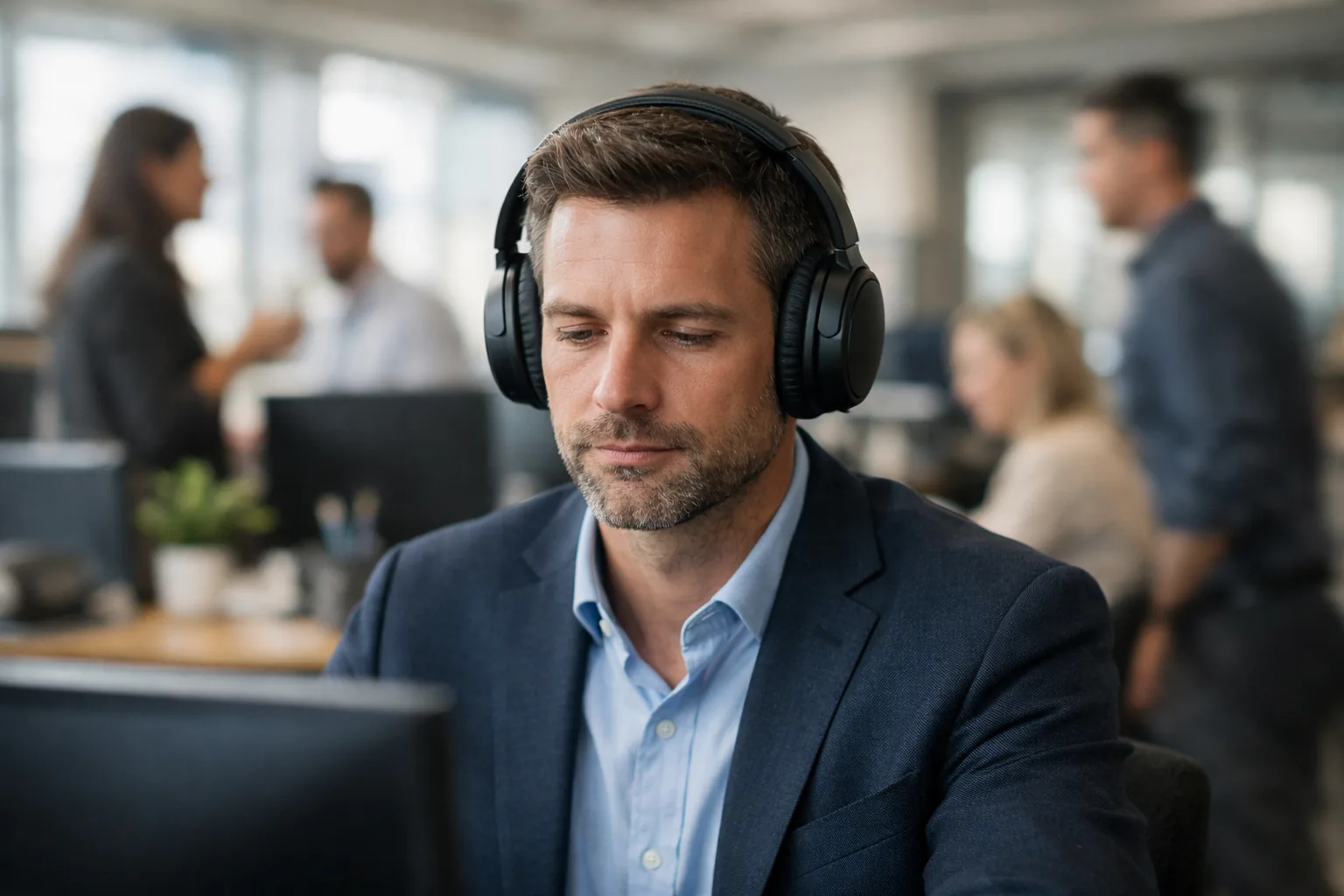
There's a number most people chase when they shop for noise cancelling headphones, and it's usually the wrong one. They compare how much sound each pair can block at its absolute best, then buy more cancelling than their daily life ever calls for. The more useful question is smaller and more personal. How loud does your normal day actually get?
That's the lens for this whole list. The cheapest picks here quiet a room, a commute, or an open office without complaint. The premium pick earns its price on a plane, on a subway, or anywhere the noise is loud and constantly shifting. So the real decision isn't which pair is best in a lab. It's how much cancelling your week demands before you stop paying for headroom you won't use.
Five Picks at a Glance
| Product | Check |
|---|---|
| Bose QuietComfort Headphones - Wireless Bluetooth Headphones, Active Over Ear Noise Cancelling and Mic, USB-C Charging, Deep Bass, Up to 24 Hours of Playtime, Black | (opens on Amazon) |
| JBL Tune 770NC - Adaptive Noise Cancelling with Smart Ambient Wireless Over-Ear Headphones, Bluetooth 5.3, Up to 70H Battery Life with Speed Charge, Lightweight, Comfortable & Foldable Design (Black) | (opens on Amazon) |
| Sony WH-CH720N Noise Canceling Wireless Headphones Bluetooth Over The Ear Headset with Microphone and Alexa Built-in, Black New | (opens on Amazon) |
| Soundcore by Anker Q20i Hybrid Active Noise Cancelling Headphones, Wireless Over-Ear Bluetooth, 40H Long ANC Playtime, Hi-Res Audio, Big Bass, Customize via an App, Transparency Mode (Black) | (opens on Amazon) |
| Soundcore Life Q20 Hybrid Active Noise Cancelling Headphones, Wireless Over Ear Bluetooth Headphones, 60H Playtime, Hi-Res Audio, Deep Bass, Memory Foam Ear Cups, for Travel, Home Office (Renewed) | (opens on Amazon) |
How much cancelling do you actually need?
- A quiet home or a calm office. The budget Soundcore pairs already cover everything you need.
- A regular commute on bus or light rail. Step up to the JBL or the Sony for stronger, adaptive cancelling.
- Frequent flights or a genuinely loud workplace. This is where the Bose pulls clearly ahead and the price makes sense.
- All-day wear above all. Weight and comfort beat raw cancelling, and the lightweight Sony wins long sessions.
- On a tight budget. Don't overthink it. The Soundcore Q20i delivers most of the experience for the least money.
Reviews
Bose QuietComfort Headphones - Wireless Bluetooth Headphones, Active Over Ear Noise Cancelling and Mic, USB-C Charging, Deep Bass, Up to 24 Hours of Playtime, Black
The Bose QuietComfort is the pair to buy when cancelling is the whole point, whether that's frequent flights, a loud commute, or a workplace you need to tune out for hours. Bose's signature is a deep, natural quiet rather than the faint pressure some systems create, and at its price that calm is the best you'll find.
It pairs that with the plushest cushions here and enough battery for a full work day or a long-haul flight on one charge. Two-device Bluetooth lets it follow you from laptop to phone without re-pairing. You're paying a real premium, and the place you feel it is exactly where cheaper pairs fall short: the loud, chaotic environments where good cancelling matters most.
Skip this if your noise is mostly a quiet office. You'd be paying for cancelling power you'll rarely call on.
Pros
- The deepest, most natural quiet on this list
- The most comfortable cushions for long wear
- Two-device Bluetooth and an all-day battery
- The clear choice for planes and loud commutes
Cons
- A real premium over everything else here
- No automatic pause when you take them off
JBL Tune 770NC - Adaptive Noise Cancelling with Smart Ambient Wireless Over-Ear Headphones, Bluetooth 5.3, Up to 70H Battery Life with Speed Charge, Lightweight, Comfortable & Foldable Design (Black)
The JBL Tune 770NC lands where a lot of buyers actually live: strong cancelling, very good call quality, and a marathon battery without premium pricing. Its adaptive mode reads the room and adjusts on its own, easing off when it's quiet and leaning in on a noisy platform, which saves battery and keeps the isolation where you need it.
The battery is the headline, comfortably the longest here, so it suits travel or anyone who'd rather not charge often. The sound is classic JBL, punchy and energetic, well-matched to music. It won't match the premium pick in the loudest places, but at well under half the price, that's a fair trade.
Pros
- The longest battery life on this list
- Adaptive cancelling that adjusts to the environment
- Excellent call quality from its microphone array
- Energetic, bass-forward sound for music
Cons
- Cancelling trails the premium pick in the loudest settings
- The build feels a touch plasticky next to pricier models
Sony WH-CH720N Noise Canceling Wireless Headphones Bluetooth Over The Ear Headset with Microphone and Alexa Built-in, Black New
Sony's WH-CH720N is the mid-range entry in Sony's noise-cancelling line, carrying the core engineering at a far friendlier price than the flagship. Its defining trait is weight, or the lack of it. This is the lightest over-ear here, which makes it the one you forget you're wearing through a full work day.
It upscales compressed audio toward better quality on playback, and an ambient mode kicks in when it hears you start talking, so you can hold a quick conversation without taking them off. The battery is shorter than the JBL's and it pairs to one device at a time, but for comfort-first listeners it's the standout.
Pros
- The lightest pair here, best for all-day wear
- An automatic talk-through ambient mode
- Audio upscaling for compressed files
- Sony's cancelling at a non-flagship price
Cons
- Shorter battery than the JBL
- Connects to only one device at a time
Soundcore by Anker Q20i Hybrid Active Noise Cancelling Headphones, Wireless Over-Ear Bluetooth, 40H Long ANC Playtime, Hi-Res Audio, Big Bass, Customize via an App, Transparency Mode (Black)
The Soundcore Q20i is the easiest recommendation on this list. It's the most-bought and best-liked pair here, and it costs a fraction of the premium pick. That bears repeating: a well-rated, dual-microphone ANC headphone for budget-tier money.
The cancelling uses microphones outside and inside the cup, the more capable approach rather than the cut-rate single-mic method, and the battery runs for days. It won't silence a plane the way the Bose does, but for commuting, an office, or study, the reduction is real and genuinely useful. For most people shopping by value, this is where to start and often where to stop.
Pros
- The best-validated pick here, by a wide margin
- Dual-microphone cancelling, not the budget single-mic kind
- Days of battery on a charge
- Remarkable performance for the money
Cons
- Cancelling trails premium models in loud places
- Bass-leaning tuning won't suit every listener
Soundcore Life Q20 Hybrid Active Noise Cancelling Headphones, Wireless Over Ear Bluetooth Headphones, 60H Playtime, Hi-Res Audio, Deep Bass, Memory Foam Ear Cups, for Travel, Home Office (Renewed)
The Soundcore Life Q20 is for the buyer who wants real cancelling at the smallest possible spend. It delivers the core promise of meaningful quiet for focus, commuting, or study, and its battery outlasts plenty of pricier competitors.
The cancelling is functional rather than commanding. It handles steady noise like AC hum, office chatter, and road drone well, and gives up ground when the noise turns loud or erratic. If your aim is to block predictable background sound at a desk without spending much, it does that job and makes itself an easy recommendation.
Pros
- The lowest price on this list
- Battery that outlasts many mid-range pairs
- Solid cancelling for steady background noise
- A genuinely low-risk way to try ANC
Cons
- Struggles with loud or variable noise
- Single-device pairing only
Where the money stops paying off
Climb this list and three things improve together: how much noise gets cancelled, how well the cancelling adapts, and the finer audio qualities like detail and separation. They don't improve evenly against price, though. The jump from the budget Soundcore pairs to the mid-range JBL and Sony buys a clear step up in cancelling and adaptiveness. The jump from there to the premium Bose buys mostly the loud-environment ceiling: the plane, the subway, the noisy floor.
So spend to your environment. If your days run quiet to moderate, the mid-range tier is the practical stopping point and the premium pick is headroom you won't use. If you're regularly somewhere loud and unpredictable, that's the one place the premium price returns itself, and the budget pairs will leave you wanting.
How to Choose Noise Cancelling Headphones
Sort by your loudest regular environment. Quiet to moderate noise is well handled even at the budget end. Public transit and planes are where stronger, adaptive, and premium cancelling separates from the pack. Buy for where you spend the most time, not the average.
Dual-microphone cancelling is the baseline to want. The better systems sense noise both outside and inside the ear cup and adapt to it, where cheaper single-mic designs only listen outside. Every pick here uses the dual-microphone approach, which is part of why even the budget ones hold up.
Battery life maps to a charging habit. Across this list, it ranges from solid to exceptional, which in practice means weekly versus less-than-weekly charging. For travel, favor the longer-lasting picks so a multi-day trip doesn't need a cable.
Match the format and call quality to your use. These are all over-ear, which seals better and stays comfortable longer than on-ear designs. If you take a lot of calls, weight the picks with the strongest microphone arrays, which are the JBL and the Sony.
What are the best noise cancelling headphones in 2026?
It depends on your noise. The Bose QuietComfort is the strongest canceller here and the right pick for frequent flyers or loud workplaces. For most people in quieter settings, the Soundcore Q20i delivers the best cancelling per dollar and is where many buyers should start.
Is cheap noise cancelling actually worth anything?
Yes. Budget pairs like the Soundcore Q20i meaningfully reduce steady background noise such as AC hum, office chatter, and coffee-shop buzz. They won't match premium models on a plane, but for everyday environments the reduction is real, and the technology has come a long way.
How long do noise cancelling headphones last?
Battery runs from solid to exceptional across this list, and with cancelling on you'll see most of the rated figure. Physically, three to five years of daily use is reasonable. Battery wear and cushion wear are the usual first failure points.
Do these work for sleeping?
Over-ear models are bulky for side-sleeping, so in-ear ANC suits bed use better. They do work well for sleeping upright on a flight, which is a common reason people reach for the Bose specifically.
What's the difference between noise cancelling and noise isolating?
Cancelling is active, with the headphones generating anti-noise to counter ambient sound electronically. Isolating is passive, where the cushions physically block sound. The better pairs do both at once, and every pick here combines a physical seal with active cancelling.
As an Amazon Associate I earn from qualifying purchases. Prices and availability change frequently — use the Amazon button to check current pricing.