
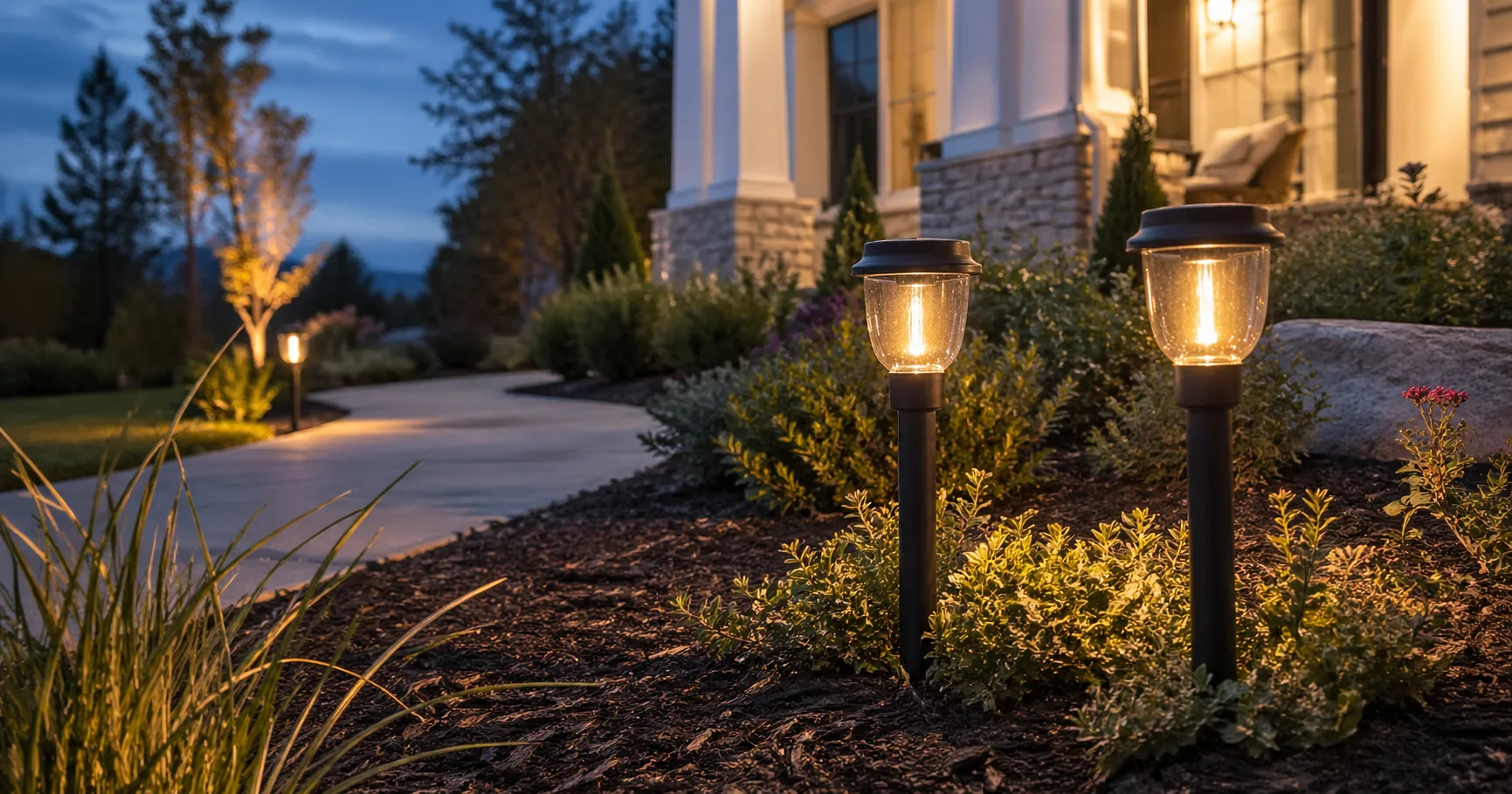
Solar pathway lights are the rare home upgrade that takes ten minutes and no tools. There's no wiring, no electrician, and nothing added to the power bill. You stake them in a sunny spot and the sun handles the rest. The problem is that the category is swamped with look-alike sets that quit by the end of the first season, so the real skill isn't finding solar lights, it's finding ones that survive a year of weather and still come on at dusk.
Here's the thing most buyers learn the hard way: brightness is not the number to chase. Pathway lights are accent lighting. They trace the edge of a walk or driveway so you don't step off it in the dark; they do not floodlight the ground. Some of the best-loved sets are deliberately soft and pretty, and some of the brightest are the first to crack a stake or cloud over. So the picks below are sorted by what actually decides happiness with solar lights: how much sun your spot gets, the look you want, and how long the set holds up.
Two broad styles cover most yards. The compact stake-and-shade lights throw a decorative glow and suit garden borders close to the house. The taller filament-bulb lights mimic vintage Edison bulbs and read better along a driveway. The five here span both, plus the budget-to-premium range, so there's a sensible match for most setups.
- Products analyzed
- 5
- Average rating
- 4.4
- Price range
- budget to premium
- Top rated
- DenicMic Pathway (4.5)
- Most reviewed
- GIGALUMI Pathway
Our Top Pick
The best all-rounder is the DenicMic set. It pairs a stainless pole with a faceted acrylic shade that casts a pretty patterned glow, holds up across seasons, and earns one of the highest ratings in the category at a friendly price. A safe default for garden borders and walkways near the house.
The Five at a Glance
| Product | Check |
|---|---|
| DenicMic Solar Lights Outdoor 10 Pack Waterproof 6000K Cold White LED Stainless Steel Stake Outside Lights for Yard Pathway Garden Driveway Walkway Landscape Path Lighting | (opens on Amazon) |
| DERAYSION 12 Pack Solar Lights Outdoor, Solar Pathway Lights Auto On/Off Waterproof Garden Landscape Lighting for Path, Yard, Walkway, Driveway Decor | (opens on Amazon) |
| GIGALUMI Solar Outdoor Lights,12 Pack LED Solar Lights Outdoor Waterproof, Solar Walkway Lights Maintain 10 Hours of Lighting for Your Garden, Landscape, Path, Yard, Patio, Driveway | (opens on Amazon) |
| LETMY Solar Pathway Lights Outdoor, 8 Pack Bright IP65 Waterproof Auto On/Off Garden Powered Landscape Lighting for Yard Patio Walkway Driveway | (opens on Amazon) |
| BITPOTT Bright Solar Pathway Lights Outdoor, 8 Pack Solar Powered Garden Lights Waterproof IP65, Auto On/Off Outdoor Light for Lawn Patio Walkway Driveway Decor Landscape Lighting | (opens on Amazon) |
Reviews
DenicMic Solar Lights Outdoor 10 Pack Waterproof 6000K Cold White LED Stainless Steel Stake Outside Lights for Yard Pathway Garden Driveway Walkway Landscape Path Lighting
The DenicMic set earns the top spot on the strength of its rating-to-price balance, holding one of the highest scores in the category across a deep review base. What sets it apart at this level is the build. The shade is faceted acrylic that scatters a snowflake-like pattern on the ground around each stake, and that little decorative touch is the single most common reason owners say they came back for a second or third set. The pole is stainless steel, and the battery sits in a box you can unscrew and swap by hand without tools.
In real yards, owners describe these surviving snow, ice, heavy rain, and strong wind across multiple seasons, which is the durability story that matters with solar lights. The glow is on the soft side, which is exactly right for borders and walkways close to the house but worth knowing if you expected something punchy. The handful of complaints center on the plastic battery box cracking if you're rough swapping batteries, and on dimming when a light gets parked somewhere it can't catch real sun.
Skip this if you're lighting a long driveway or want a tall, statement fixture; these are low, decorative, and best near the house.
Pros
- One of the highest ratings in the category, on a deep review base
- Faceted shade casts a pretty patterned glow
- Stainless pole and a tool-free, replaceable battery
- Comes in several color options
- Easy on the budget for the number of lights
Cons
- Soft, accent-level glow rather than bright path lighting
- The plastic battery box can crack if handled roughly
DERAYSION 12 Pack Solar Lights Outdoor, Solar Pathway Lights Auto On/Off Waterproof Garden Landscape Lighting for Path, Yard, Walkway, Driveway Decor
The DERAYSION set is the budget pick that doesn't feel cheap. It's the classic stake-and-shade pathway shape in a warm white tone, weather-sealed, with a built-in dusk-to-dawn sensor that switches the lights on at sunset and off at sunrise on their own. There's no app, no remote, and no setup beyond pulling the activation tab and pushing them into a sunny patch of ground. Owners consistently mention how painless assembly is and how the set tends to light up uniformly out of the box.
The recurring theme in the reviews is simple value: a generous number of lights that hold up through rain, snow, and wind for what you pay. As with any set at this price, a light or two can fail in the first few months, but a warranty and the return window cover that, and the overall consistency wins people over. The glow is enough to mark a path edge, not to flood it, and some owners note the lights fade in the second half of the night rather than burning full-bright until dawn.
Skip this if your install spot is shady; budget lights have the least energy headroom and struggle most without good sun.
Pros
- Strong value for the number of lights you get
- Automatic dusk-to-dawn operation with no setup
- Backed by a manufacturer warranty
- Pack-size options for different yard sizes
- A proven, widely bought seller
Cons
- Accent-level brightness, enough to mark an edge, not light a walkway
- Some owners see noticeable dimming toward dawn
GIGALUMI Solar Outdoor Lights,12 Pack LED Solar Lights Outdoor Waterproof, Solar Walkway Lights Maintain 10 Hours of Lighting for Your Garden, Landscape, Path, Yard, Patio, Driveway
The GIGALUMI set has the deepest review history in this whole category by a wide margin, which is the main reason it's here. Its rating sits a touch below the others, so this is the one pick I'm including on the weight of its long-term evidence rather than its score. When tens of thousands of buyers have used something over years, the durability picture gets very clear, and here it's mostly positive.
The hardware is mid-tier and the spec sheet won't wow anyone. What stands out is how many owners report sets still working years later, including after hail and hard winters, often on a repeat purchase. The honest caveats are equally consistent: the plastic stakes are on the brittle side and can snap after a season, and the included batteries are low-capacity, so many owners get noticeably longer runtime after swapping in higher-capacity rechargeables. The brand also has a reputation for sending replacements when a light fails, which softens those issues.
Skip this if you want the highest-rated set on day one rather than the most proven one; a couple of picks here rate higher.
Pros
- The deepest long-term review history in the category
- Many owners report multiple years of use, even after rough weather
- Easy, affordable way to cover a long path
- Batteries are replaceable and easy to upgrade
- A responsive track record on replacing failed units
Cons
- Rated slightly lower than the others here
- Brittle stakes and low-capacity stock batteries that benefit from an upgrade
LETMY Solar Pathway Lights Outdoor, 8 Pack Bright IP65 Waterproof Auto On/Off Garden Powered Landscape Lighting for Yard Patio Walkway Driveway
The LETMY set steps into the more decorative tier with vintage filament-style bulbs in clear teardrop housings. They stand taller than the compact stake lights, so they read well from a distance and look the part along a driveway or in a rustic garden. The battery is larger than the entry-level sets, which helps them stay lit longer, and they carry a step-up weather rating that adds resistance to stronger water than ordinary rain.
The most useful framing comes from long-term owners who treat these as a few-years product rather than a forever fixture: the bulbs work reliably for a good stretch, but the plastic frame gradually fades and the shade clouds with sun exposure, so eventually you replace the set. Within that window they perform well, and the brand earns repeated praise for cheerfully replacing units that fail early. Buy them for the look and the better-than-budget runtime, with realistic expectations about lifespan.
Skip this if you want something you'll never think about again; plan on replacing these after a few years rather than keeping them indefinitely.
Pros
- Warm, retro filament-bulb look
- Taller fixtures that show up well along a driveway
- Step-up weather resistance for harsher rain
- Larger battery for longer nightly runtime
- Strong reputation for free replacements on failures
Cons
- Frame fades and shade clouds over a few years
- A replace-the-set product, not a lifetime fixture
BITPOTT Bright Solar Pathway Lights Outdoor, 8 Pack Solar Powered Garden Lights Waterproof IP65, Auto On/Off Outdoor Light for Lawn Patio Walkway Driveway Decor Landscape Lighting
The BITPOTT set is the priciest and best-equipped pick here, and it's what you buy when you like the tall filament look but want sturdier hardware behind it. It uses a more efficient solar panel and a larger battery than the rest, which is the combination that actually keeps lights glowing from dusk to dawn even on shorter winter days when charging time is limited. The shade is thicker and clearer, and the whole fixture feels a cut above.
Owners who've cycled through cheaper sets tend to describe these as the ones that finally satisfied them, calling out both the cleaner look on a driveway and the multi-year durability that justifies the higher price. The fair warning, which applies to every solar light but bites hardest here because expectations are higher, is that runtime depends on real sun. Give them a genuinely sunny spot and they go the distance; tuck them under trees or a north-facing wall and they'll fade early like anything else.
Skip this if your budget is tight or your install spot is shaded; you'd be paying premium money for performance the sun won't let these deliver.
Pros
- More efficient panel and larger battery, the longest runtime here
- Reliably lights through the night in good sun, even in winter
- Tall filament look with a thick, durable shade
- Backed by a manufacturer warranty
- The most "finished" look of the group on a driveway
Cons
- The highest price in this guide
- Runtime drops sharply without several hours of direct daily sun
The Trade-Off Worth Naming
Everything in this category is, at heart, plastic and an LED. Genuinely metal-and-glass solar pathway lights barely exist at these prices; they come from premium brands at several times the cost. So the honest framing for any set here is that you're buying a multi-year product, not a lifetime one. The LED can last a very long time, but the rechargeable battery loses capacity over a couple of years, stakes get brittle, and panel covers cloud in the sun. Plan on a replacement cycle rather than expecting these to outlast the house.
That reframes the spend. The budget sets are the right call when you accept that and just want easy, attractive light now. The premium set earns its price only if your conditions let it perform and you value the look and the slightly longer durability. Paying up does not buy you immortality here; it buys you better sun-to-runtime and a nicer fixture.
How to Choose
Three questions settle it.
How much sun does the spot get? If it's open and south-facing with all-day sun, almost anything works, and the budget sets are the smart buy. If it's partly shaded or only gets sun for part of the day, spend up for the premium or filament sets, which bank more energy and cope better with weak charging.
How bright do you actually need it? These are edge-markers, not floodlights. If you want to genuinely light the surface of a path, you need solar floodlights or wired fixtures instead. Going in expecting a gentle glow rather than illumination is the single biggest fix for disappointment in this category.
What look fits the space? Compact stake-and-shade lights suit garden borders and walks near the house and throw decorative patterns. Tall filament bulbs suit driveways and rustic settings and read from farther away. Pick the shape for the setting first, then choose within it by budget and sun.
How bright should outdoor solar pathway lights be?
For marking the edges of a walk, driveway, or garden bed, a soft accent glow is all you need, and that's what every pick here delivers. If you actually want to light up the surface of the path, that's a different product: solar floodlights or wired path lights. The most common mistake is buying stake lights expecting illumination, then being let down by what is, by design, gentle ambient light.
How long do solar pathway lights stay lit at night?
It depends far more on the day's sun than on the light itself. In good summer sun, most will glow for the bulk of the night, with the larger-battery sets lasting longest. In partial shade or short winter days, expect them to fade in the back half of the night. The realistic expectation is bright early and dimmer later, with runtime tracking how much charge they actually banked that day.
What weatherproof rating do I need?
For nearly everyone, the standard rating these sets carry is plenty: dust-tight and resistant to rain from any direction. The step-up rating on the filament pick simply adds resistance to stronger, higher-pressure water, which only matters in very wet climates or if they'll catch a pressure washer. Don't overthink it; the common rating handles normal weather without trouble.
How long will they last before they break?
Plan on a few years of useful life at this price tier. The LED itself can last far longer, but the real wear points are the rechargeable battery, which loses capacity over a couple of seasons, the plastic stakes, which can get brittle, and the panel cover, which clouds in the sun. The most-proven set here has the most owners reporting multiple years of service, but treat all of them as replaceable rather than permanent.
Can I leave them out in winter?
In most climates, yes. The lights themselves shrug off snow, ice, and freezing temperatures. The catch is the battery: hard cold plus short winter days means less charge, so they'll run fewer hours per night in deep winter. Some people store them through the coldest months, but that's a preference, not a requirement, and most owners simply accept shorter winter runtime.
Should I upgrade the included batteries?
For the budget sets with low-capacity stock batteries, yes, swapping in higher-capacity rechargeables noticeably improves runtime, and owners regularly recommend it. For the premium and filament picks, the included batteries are already decent, so an upgrade only helps once the originals start fading after a season or two. On some sealed budget sets the batteries aren't easily user-replaceable, so check before buying if that flexibility matters to you.