
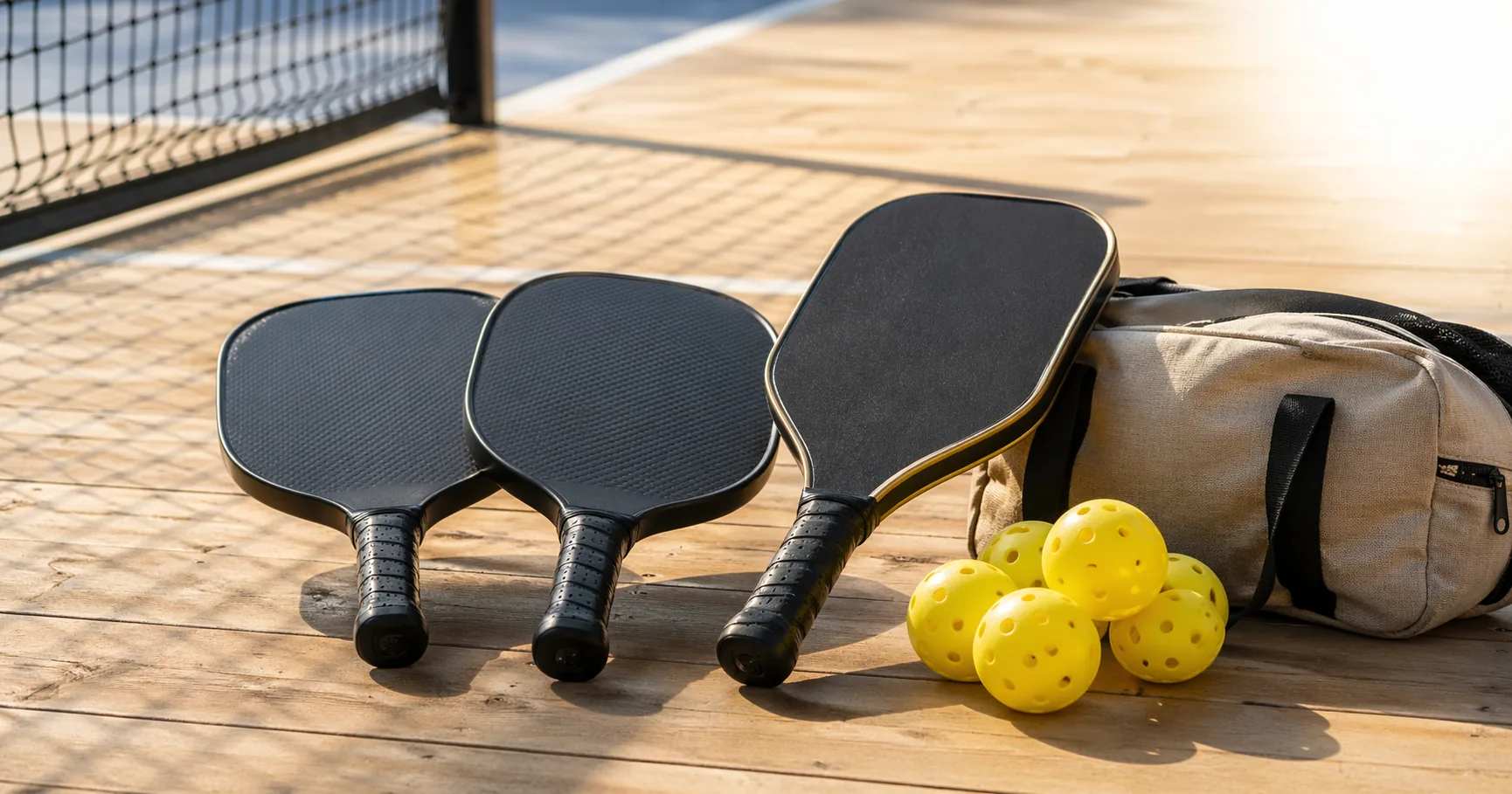
A "deal" on a pickleball paddle is one of the easier things to fake on Amazon. A seller lists a paddle at an inflated number for a week, crosses it out, and the same price you would have paid anyway suddenly looks like a 40% saving. Pickleball is still the fastest-growing sport in the country, new brands appear every season, and the discount badges multiply right along with them. So the useful question is not "which paddle is on sale today" but "how do I know a markdown on a paddle is real, and which paddles are worth buying when one shows up."
This page is built around that second question. Below is how to read a paddle listing without getting played, followed by five USAPA-approved paddles and sets that are genuinely worth your money when the price is fair. None of them depend on a flash sale to make sense. If a discount lands on top, good. If not, they are still the paddles most beginners and weekend players should be looking at.
- Products analyzed
- 5
- Average rating
- 4.6
- Price range
- budget sets to a premium single
- Top rated
- BAGAIL Fiberglass (4.7)
- Most reviewed
- VUFOXT Carbon (2K reviews)
Our Top Pick
If you want the most paddle for the least money, start with the VUFOXT carbon-fiber 2-pack. It is USAPA approved, ships with four balls and a carry bag, and has one of the largest and steadiest review bases on this page. Carbon-fiber bite at the price most brands charge for fiberglass is the reason it keeps selling.
How to Read a Pickleball Paddle "Deal"
Three things tell you whether a discount is worth acting on, and none of them is the percentage in the red badge.
The review base matters more than the price. A markdown on a paddle with a handful of reviews tells you nothing. A markdown on a paddle that has earned a high rating across thousands of buyers is a different story, because the rating is stable enough to trust. Every paddle below has cleared that bar by a wide margin. When you are comparing two listings, the one with a deep, high review count is almost always the safer buy even if its sale sign is smaller.
A set is a deal a single paddle usually cannot match. If you are buying so that you and a partner can both play, a two-paddle set that includes balls and a bag is structurally cheaper than two singles, before any discount enters the picture. Most of the value on this page lives in the sets for exactly that reason. A single paddle only beats a set on cost-per-quality when you already own gear and you are upgrading one paddle.
Face material sets the ceiling, so know what you are paying for. Fiberglass faces are cheaper and a little more forgiving on off-center hits, which is why true beginner sets lean that way. Carbon-fiber faces grip the ball for more spin and hold their texture far longer, which is why nearly every paddle priced above the rock-bottom tier uses it. A "deal" on a fiberglass paddle priced like carbon fiber is not a deal. Knowing which face you are looking at stops you from overpaying for the cheaper material.
A Quick Look at the Five
| Product | Check |
|---|---|
| BAGAIL Pickleball Paddles, USAPA Approved Fiberglass Surface Pickleball Set, Lightweight Pickle Ball Rackets with 4 Balls, 1 Bag, Designed in California for Traction and Stability | (opens on Amazon) |
| Pickleball Paddles Set of 2/4, USAPA Approved Carbon Fiber Surface Pickle Ball Set - 14mm PP Honeycomb Core of Lightweight Pickleball Rackets -Suitable for Beginners' Training and Game(Blue) | (opens on Amazon) |
| GARYE Pickleball Paddles Set of 2, USAPA Approved Carbon Fiber Pickleball Set, Lightweight Pickle Ball Rackets 2 Pack with 6 Balls, 1 Bag, Pair of Grip Tapes, Pickle Ball Paddle for Men and Women | (opens on Amazon) |
| RAV PRO Pickleball Paddle - Ultimate HIGH END 16mm Japanese Toray T700 Raw Carbon Fiber CFS w/Excellent GRIT Roughness Texture, Aero Dynamic Curve, USAPA Approved, Non Slip Grip | (opens on Amazon) |
| PRO-SPIN Carbon Fiber Pickleball Paddles Set of 2 | Lightweight Pickleball Set with Indoor/Outdoor Balls and Bag – Durable Pickle Ball Paddle Gift for Men, Women & Families | (opens on Amazon) |
The Paddles Worth Buying
BAGAIL Pickleball Paddles, USAPA Approved Fiberglass Surface Pickleball Set, Lightweight Pickle Ball Rackets with 4 Balls, 1 Bag, Designed in California for Traction and Stability
The BAGAIL fiberglass 2-pack is the lowest-cost USAPA-approved set worth trusting, and it carries the highest rating on this list across more than a thousand buyers. The build is plain rather than premium: a widened fiberglass face on a polypropylene honeycomb core, a perforated cushion grip, and reinforced edge guards. Weight sits in the meaty middle of the approved range, which is the most forgiving place for a new player to start. The box includes two paddles, a mix of indoor and outdoor balls, and a carry bag, so you can walk onto a driveway or a rec-center court without buying anything else first.
Owners who come to it from a big-box starter paddle tend to describe the same surprise, that it plays like a set costing several times more. That is the whole appeal here.
Skip this if you already know you want spin. The fiberglass face puts less bite on the ball than the carbon paddles further down, and a few buyers note the stock balls are basic.
Pros
- Lowest entry price of any approved set here, with the highest rating on the page
- Widened face and honeycomb core give beginners a forgiving sweet spot
- Complete kit: two paddles, balls, and a bag in one box
Cons
- Fiberglass grips the ball less than carbon fiber for spin
- Included balls are basic and lean outdoor
Pickleball Paddles Set of 2/4, USAPA Approved Carbon Fiber Surface Pickle Ball Set - 14mm PP Honeycomb Core of Lightweight Pickleball Rackets -Suitable for Beginners' Training and Game(Blue)
The VUFOXT carbon-fiber 2-pack is the most paddle per dollar on the page, and it has the deepest review base here, which is exactly the stability you want when a discount appears. The face is a full carbon-fiber shell over a thick polypropylene honeycomb core, so it bites the ball noticeably more than the fiberglass BAGAIL. The teardrop head widens the sweet spot, the handle is sweat-absorbent, and the set arrives with two paddles, four balls, and a carry bag.
Beginner-to-intermediate players are the sweet spot for this one. Owners regularly mention that the grip stays secure with sweaty hands and that the paddles hold up over months of regular play.
Skip this if you have larger hands and dislike adding an overgrip, because the handle runs a touch slim. Also note the included balls mix indoor and outdoor, so check which is which before a session.
Pros
- Carbon-fiber face at a near-fiberglass price, the best spin-per-dollar here
- Largest, steadiest review base on the page
- Complete two-player kit with balls and bag
Cons
- Handle runs slim for larger hands
- Stock balls mix indoor and outdoor
GARYE Pickleball Paddles Set of 2, USAPA Approved Carbon Fiber Pickleball Set, Lightweight Pickle Ball Rackets 2 Pack with 6 Balls, 1 Bag, Pair of Grip Tapes, Pickle Ball Paddle for Men and Women
The GARYE WL-01 is the carbon-fiber set to look at when you want extras in the box. It pairs a carbon face with a high-density honeycomb core in a slightly thicker build, and the kit is the most loaded of the two-packs: two paddles, six balls, two grip tapes, and a carry bag, backed by a two-year warranty that outlasts everything else here. Each paddle still lands in the normal recreational weight band, so the thicker build does not make it feel heavy.
Owners describe it as solid and well-balanced, and several mention owning a pricier paddle yet reaching for this one anyway. The rating slipped slightly this season but stays strong across a large review count.
Skip this if you prefer a thin, finesse-oriented paddle, since this one runs thicker. The included bag is also snug, fine for the paddles and balls but not much else.
Pros
- Most accessories in the box: six balls and two grip tapes
- Longest warranty on the list at two years
- Strong rating across a large review base
Cons
- Thicker profile than finesse players may want
- Carry bag is tight
RAV PRO Pickleball Paddle - Ultimate HIGH END 16mm Japanese Toray T700 Raw Carbon Fiber CFS w/Excellent GRIT Roughness Texture, Aero Dynamic Curve, USAPA Approved, Non Slip Grip
If you already own a beginner paddle and want to step up without buying another set, the HISK RAV PRO is the single worth tracking. It sits in a different tier than the kits above: a raw carbon-fiber face with a friction surface for aggressive spin, a foam-edged core that expands the sweet spot, and an elongated head that gives intermediate players extra reach. The box also includes a cover, a spare grip, and wristbands, which together usually cost more than buyers expect.
Players moving up from fiberglass tend to describe the jump in feel as dramatic, with the sweet spot reading as the whole face during a rally. The most useful criticism is that the handle leans rectangular, so anyone used to a strongly octagonal grip needs a short adjustment.
Skip this if you actually need a set, since it is a single paddle and you will still need a partner paddle and balls. Skip it too if a defined octagonal handle is non-negotiable for you.
Pros
- Raw carbon face and friction surface for genuine spin
- Foam edge and elongated head expand reach and sweet spot
- Cover, spare grip, and wristbands included
Cons
- Single paddle, not a set
- Handle shape runs rectangular
PRO-SPIN Carbon Fiber Pickleball Paddles Set of 2 | Lightweight Pickleball Set with Indoor/Outdoor Balls and Bag – Durable Pickle Ball Paddle Gift for Men, Women & Families
The PRO-SPIN GFS13 is the upgrade kit for couples or doubles partners who have outgrown beginner paddles and want more pop. It shares the highest rating on this page. The construction layers a durable edge guard, a graphite carbon friction surface, and a polypropylene honeycomb core, tuned for intermediate play. The face is larger than average for a wider sweet spot, the grip is cushioned and sweat-absorbing, and the set ships with two paddles, four balls, a paddle cover, and a carry bag, plus a warranty and satisfaction guarantee.
Owners who already play regularly call out the crisp, responsive touch and the fact that the included balls are genuinely usable, which is not a given at this level. The one thing to know is that PRO-SPIN markets it as intermediate, so some of the control payoff assumes you can already dink and place the ball.
Skip this if you are a true first-timer, because you will not use its full range yet and a cheaper set serves you better while you learn.
Pros
- Larger-than-average face for a wide sweet spot
- Graphite friction surface produces real spin on drives
- Shares the top rating here, with a complete kit and warranty
Cons
- Highest price in this group
- Tuned for intermediate skill, not first-timers
Matching a Deal to the Right Buyer
Start with set versus single, because it decides most of the spend. Buying so two people can play means a two-pack is the smarter purchase every time, and the BAGAIL and VUFOXT both put two approved paddles plus balls and a bag in your hands for less than one mid-range single. Already have a paddle and itching to improve after a few months of regular play? Then a single upgrade like the HISK is where your money does the most work.
Next, settle the face material against your goals. Fiberglass is cheaper and a hair more forgiving, which suits someone who just wants to get on the court and is not yet thinking about spin. Carbon fiber holds its texture far longer and grips the ball for spin you can actually use as you improve, so for almost any buyer planning to stick with the sport, it earns the small premium.
Weight is the quietest of the three decisions and the one most people skip. Recreational paddles generally land between roughly 7.3 and 8.3 ounces. Lighter paddles favor fast hands at the net, heavier ones favor power from the baseline, and the mid-weight band in between suits the widest range of players. Every paddle here sits in that middle zone on purpose, which is part of why they work for beginners and improvers alike.
Finally, treat the discount itself as the last filter, not the first. A markdown on a paddle nobody is buying is just a lower price on something unproven. A fair price on a paddle that thousands of players already rate highly is the actual deal, whether or not a badge is lit. Sort by the rating and the depth of the review base first, then let the price decide between two paddles that already passed.
Are USAPA-approved pickleball paddles actually better than non-approved ones?
Approval means the paddle passed the face-roughness, deflection, and size rules that govern tournament play. For recreational use it mostly works as a baseline quality signal. Any paddle on this list can be used in a local league or a municipal event without being turned away at check-in.
What is the cheapest paddle set worth buying?
The BAGAIL fiberglass two-pack is the lowest-cost approved set we would recommend, and it carries the top rating here. If you can stretch a little, the VUFOXT carbon-fiber set is a meaningful step up in spin and durability for not much more.
Is a carbon-fiber paddle worth it over fiberglass?
For most players, yes. Carbon fiber holds its texture far longer than fiberglass, so you keep the spin performance after months of play instead of weeks. The cost gap between an equivalent fiberglass and carbon set is usually small enough to make the upgrade easy.
What weight should my pickleball paddle be?
Most recreational paddles fall between roughly 7.3 and 8.3 ounces. A mid-weight paddle suits the widest range of players. Go lighter for quicker hands at the net and heavier for power on drives. Every paddle here sits in that mid-weight zone.
How long will a pickleball paddle last?
A carbon-fiber paddle played several times a week typically lasts a year or two before the face wears smooth enough to lose meaningful spin. Fiberglass usually shows wear sooner at the same volume. Edge guards protect the frame from court strikes but do not extend the life of the face.
Are the balls included with Amazon paddle sets any good?
It varies. The PRO-SPIN and GARYE sets ship balls that owners consistently rate as usable. Balls bundled with the cheapest sets are fine for driveway and rec play but not on par with dedicated tournament balls. If you plan to play competitive doubles, buy a bag of tournament balls separately.
As an Amazon Associate I earn from qualifying purchases. Prices and availability change frequently — use the Amazon button to check current pricing.