
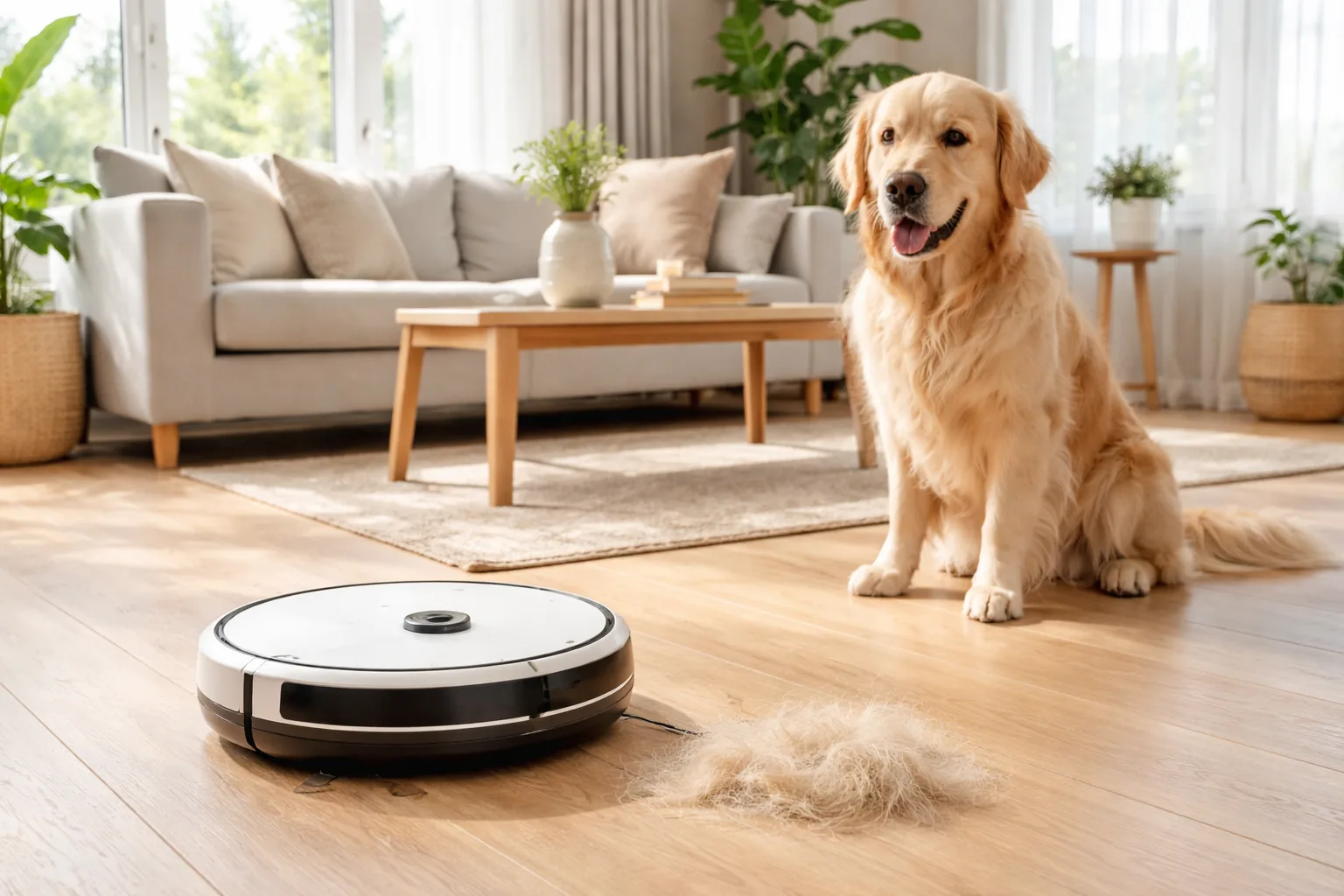
Hand a robot vacuum a house with a shedding dog and you find its limits fast. Hair wraps the brush roll until it stalls. It packs into the corners the machine can't quite reach, and it works deep into carpet fibers where weak suction simply glides over it. It also fills a dustbin far faster than ordinary household dust, which trips up vacuums that weren't built for it.
Two things follow from that, and they should steer your choice more than any brand name. Suction matters most on carpet, where embedded hair has to be pulled out rather than swept, while on hard floors the brush design and airflow do most of the work. And the bin question is bigger for pet owners than for anyone else, because a robot that can't empty itself needs your hands after nearly every run. So this list is sorted by your floors and how heavily your animal sheds.
The Picks at a Glance
| Product | Check |
|---|---|
| Shark Matrix Clean | Robot Vacuum Cleaner with Powerful Suction for Pet Hair, Rugs, Carpets & Hard Floors | Self-Empty Base | 60-Day Capacity | Voice Control | LiDAR Navigation | Cool Grey | AV2511AE | (opens on Amazon) |
| Shark IQ App-Controlled Self-Emptying Robot Vacuum, RV100AE/UR1000SR - Black (Renewed) | (opens on Amazon) |
| Tikom Robot Vacuum and Mop Combo, 5000Pa Robotic Vacuum Cleaner, 150 Min Max, App & Remote Control, Ideal for Hard Floor, Carpet, Pet Hair, Self-Charge(G8000 Max) | (opens on Amazon) |
| roborock Q7 M5 Robot Vacuum and Mop Combo, 10,000Pa HyperForce Suction, Robotic Vacuum Cleaner, Dual Anti-Tangle System, APP-Controlled Mopping, LiDAR Navigation, for Pet Hair and Carpet, Black | (opens on Amazon) |
Match it to your floors and your shedder
- Carpet plus a heavier shedder. Suction does the work here, and the Roborock Q7 has the strongest on this list plus a scrubbing mop.
- Hair spread across several rooms. Systematic mapping beats random bouncing, which is the Shark Matrix.
- You're tired of emptying the bin daily. Self-emptying is worth more to pet owners than anyone, and the Shark IQ is the affordable way in.
- Mostly hard floors, one smaller pet. You don't need to overspend, and the Tikom covers it.
- Tracked-in dirt and paw prints, not just hair. A real scrubbing mop earns its place, so the Roborock combo does double duty.
Reviews
Shark Matrix Clean | Robot Vacuum Cleaner with Powerful Suction for Pet Hair, Rugs, Carpets & Hard Floors | Self-Empty Base | 60-Day Capacity | Voice Control | LiDAR Navigation | Cool Grey | AV2511AE
The Shark Matrix is built around navigation. Its dual-camera mapping cleans in a methodical grid instead of bouncing at random, which is what you want when shedding is spread through several rooms rather than concentrated in one. Full, systematic coverage means fewer missed patches and fewer spots cleaned twice.
Room-by-room mapping lets you send it to the high-shedding zones, like the dog's bed or the couch perimeter, more often than the quiet rooms. Its filter captures pet dander alongside the visible hair, which matters in a home with allergy sufferers. It's the pick when coverage and scheduling matter more than maximum suction.
Skip this if your problem is embedded hair in thick carpet. This one prioritizes coverage over raw pulling power.
Pros
- Camera mapping for systematic, room-by-room coverage
- A filter that captures dander, not just hair
- Targeted scheduling for high-shedding zones
- A mid-range route to real navigation
Cons
- A self-empty dock isn't included at the base configuration
- Suction trails the strongest pick here
Shark IQ App-Controlled Self-Emptying Robot Vacuum, RV100AE/UR1000SR - Black (Renewed)
Self-emptying matters more for pet hair than for anything else, because pet hair fills a bin in a run or two. The Shark IQ is the most accessible way onto a self-emptying base here. It empties into its dock on its own, so you get weeks of runs instead of dumping a bin daily.
It maps the home and cleans in straight rows rather than wandering, which keeps coverage tidy. It's vacuum-only, with no mop, so it suits a hair-first household rather than one fighting tracked-in dirt. For the convenience of self-emptying without stepping up in price, it's the entry point.
Skip this if you also need mopping. This one vacuums only.
Pros
- Self-empties into its base for weeks of hands-off runs
- The most affordable self-emptying pick here
- Orderly row-by-row navigation
- Backed by widely available replacement parts
Cons
- No mopping function
- Suction is modest next to the Roborock pick
Tikom Robot Vacuum and Mop Combo, 5000Pa Robotic Vacuum Cleaner, 150 Min Max, App & Remote Control, Ideal for Hard Floor, Carpet, Pet Hair, Self-Charge(G8000 Max)
The Tikom is the most affordable complete pick here, and on the floors it's meant for it does the job without drama. Its suction handles pet hair on hard floors and low-pile carpet, and a long battery runtime lets it finish a larger apartment before heading back to charge.
It adds basic mopping that most budget robots leave out, so for a home of mostly hard floors like tile, hardwood, or vinyl plank, and one smaller pet, it covers both bases at a price that takes the risk out of the purchase. It's the value pick rather than the carpet powerhouse, and it's honest about that.
Pros
- The lowest price on this list
- Suction that's strong for the budget tier
- A long battery for full-apartment coverage on one charge
- Basic mopping included
Cons
- Less suction than the Roborock for deep carpet hair
- No self-emptying, so the bin fills fast with pet hair
roborock Q7 M5 Robot Vacuum and Mop Combo, 10,000Pa HyperForce Suction, Robotic Vacuum Cleaner, Dual Anti-Tangle System, APP-Controlled Mopping, LiDAR Navigation, for Pet Hair and Carpet, Black
The Roborock Q7 combo is the most capable pick here when your problem runs past loose hair into muddy paw prints, and it carries the strongest suction on this list for embedded carpet hair. Its mopping vibrates the cloth to scrub rather than smear, which actually lifts tracked-in dirt instead of spreading it around.
Carpet detection lifts the mop head automatically when it rolls onto a rug, so you don't end up with a wet carpet, a common headache on cheaper combo units. For a mixed-floor home where pets bring the outdoors inside, it's the most able all-rounder of the four.
Pros
- The strongest suction here for carpet pet hair
- A scrubbing mop action for tracked-in dirt
- Automatic mop lift on carpet to avoid wet rugs
- Strong all-round combo capability
Cons
- No self-emptying at this price
- The mop features add some app complexity
What suction actually buys you
It's easy to read the suction numbers as a simple "more is better" ranking, but they map to one thing in particular, and that's carpet. On hard floors, even a modest robot moves pet hair fine, because the brush and airflow carry the load. The stronger-suction pick justifies itself once carpet enters the picture, where loose surface hair gives way to fibers that grip and won't let go without real pull.
So spend where your floors demand it. A mostly-hard-floor home with a light shedder is well served by the budget Tikom or the self-emptying Shark IQ, and the extra suction of the Roborock is power you won't tap. A carpeted home with a heavier shedder is the opposite case, and that's where the Roborock earns its place. None of these four is a deep-carpet monster, so for thick plush carpet plan to pair any of them with an occasional upright pass. Brush design and self-emptying then decide the rest.
How to Choose a Robot Vacuum for Pet Hair
Set suction to your floors, not the spec race. Hard floors with normal shedding need only modest suction. Low-pile carpet with embedded hair benefits from a real step up, which is where the Roborock pulls ahead of the others here. Suction matters most on carpet.
For pet owners, self-emptying is the standout upgrade. Pet hair fills a standard bin in a run or two, so a robot that can't empty itself needs daily attention. A self-emptying base holds weeks of debris and is the single feature that most improves the hands-off experience for shedding households.
Mind the brush design. Anti-tangle rollers route hair so it doesn't wrap and stall the brush. If a previous robot kept jamming on your dog's hair, prioritize brush design over a bigger suction number on the next one.
Filtration matters if anyone has allergies. The trigger for pet allergies is dander, not the hair itself. If someone in the home reacts to pets, favor a model with stronger filtration to capture those finer particles, not just the visible hair.
What's the best robot vacuum for pet hair?
It depends on your floors. For carpet and a heavier shedder, the Roborock Q7 has the strongest suction here and a scrubbing mop. For mostly hard floors and one smaller pet, the Tikom handles it for far less. Match suction to your carpet first, then weigh self-emptying and brush design.
Can a robot vacuum handle dog hair every day?
Yes. These are built for daily runs, and for heavy shedders daily is the recommendation to keep hair from piling up in corners. With a self-emptying base, a robot can run daily for weeks untouched. Without one, you'll empty the bin every run or two.
Do robot vacuums work on carpet with pet hair?
On low and medium pile, any of these pull up surface hair well. Thick or plush carpet is where embedded hair needs the most suction, which is the Roborock's strength among the four. None fully replace a strong upright on deep carpet, but they keep things clean day to day between deeper cleans.
How often should I run one with pets?
Daily for heavy shedders like large dogs or multiple cats, every other day for a single cat or small dog. With self-emptying, daily scheduling while you're out is the easiest path to consistently clean floors. Without it, every other day keeps the bin from overflowing.
What do you get going from budget to the top pick here?
Mainly stronger suction, a scrubbing mop, and better carpet pickup. On hard floors with light shedding, the budget Tikom is fine. For carpet, a heavier shedder, or tracked-in dirt, the Roborock's added power and mop earn the step up.
As an Amazon Associate I earn from qualifying purchases. Prices and availability change frequently — use the Amazon button to check current pricing.