
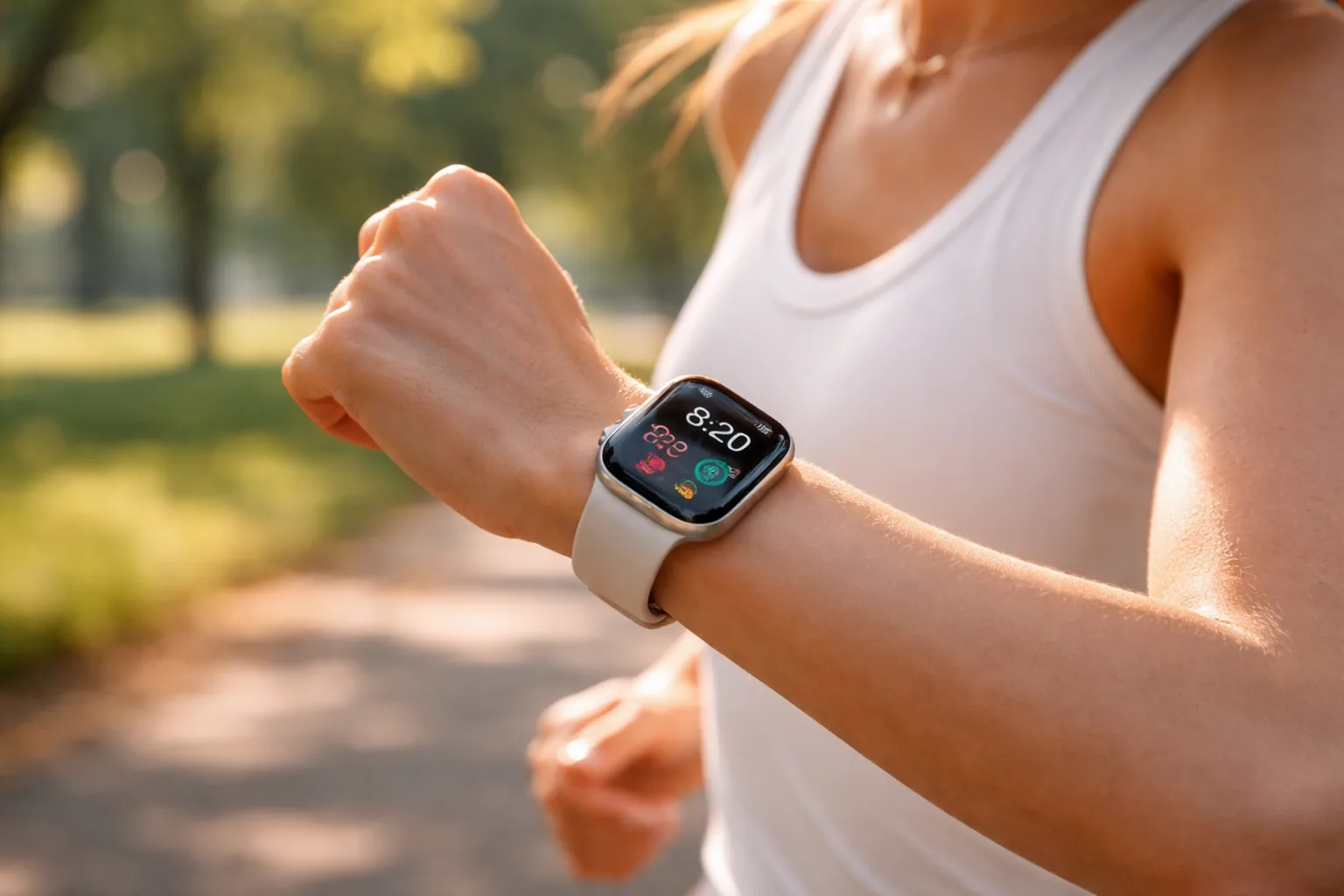
Smartwatch comparisons drown you in features, but two questions settle most of the choice before you read a single spec sheet. What phone do you carry, and how often are you willing to charge a watch? Answer those honestly and three of the five picks here usually fall away on their own.
The phone question is the harder fork. An Apple Watch is the obvious choice for an iPhone and a non-starter on Android, so your phone alone can decide it. The charging question is quieter but just as real. A watch you want to sleep in for sleep tracking has to last more than a day, which rules out some of the most capable options. Settle those two, and the rest is matching fitness features to how you'll actually use them.
Five Picks at a Glance
| Product | Check |
|---|---|
| Apple Watch SE 3 [GPS 40mm] Smartwatch with Starlight Aluminum Case with Starlight Sport Band - S/M. Fitness and Sleep Trackers, Heart Rate Monitor, Always-On Display, Water Resistant | (opens on Amazon) |
| Garmin vívoactive 5, Health and Fitness GPS Smartwatch, AMOLED Display, Up to 11 Days of Battery, Orchid | (opens on Amazon) |
| Fitbit Inspire 3 Health & Fitness Tracker with Stress Management, Workout Intensity, Sleep Tracking, 24/7 Heart Rate - 3-Month Google Health Premium Membership Included - Lilac Bliss/Black | (opens on Amazon) |
| Fitbit Charge 6 Fitness Tracker with Google Apps - Heart Rate on Exercise Equipment - 3-Month Google Health Premium Membership Included - Health Tools - Porcelain/Silver - Small&Large Bands Included | (opens on Amazon) |
| Smart Watch for Women Android & iPhone, Alexa Built-in, IP68 Waterproof Activity Fitness Tracker with Bluetooth Call (Answer/Make), 1.8" Smartwatch with Heart Rate/SpO2/Sleep Monitor, 100+ Sports Mode | (opens on Amazon) |
Answer these two first
- iPhone, and you want the full experience. The Apple Watch SE is the natural fit, and nothing else integrates as tightly.
- Serious about running, cycling, or training. Accuracy and a week-plus battery point to the Garmin.
- You want to wear it to sleep and charge rarely. A slim Fitbit tracker is the most comfortable long-battery pick.
- You want Fitbit health features plus GPS and Google apps. The Charge 6 adds both.
- Just trying the idea, on a budget. A capable budget watch covers the basics with almost no risk.
Reviews
Apple Watch SE 3 [GPS 40mm] Smartwatch with Starlight Aluminum Case with Starlight Sport Band - S/M. Fitness and Sleep Trackers, Heart Rate Monitor, Always-On Display, Water Resistant
The Apple Watch SE is the entry into Apple's ecosystem, and for an iPhone owner nothing else comes close on integration. It mirrors notifications, runs Siri, closes Activity rings, tracks workouts, and handles fall detection and emergency calls, all in a wearable case size that suits smaller wrists.
What it leaves out versus the pricier Apple models is the always-on display and a couple of advanced sensors, and for most people those omissions are easy to live with. It still covers sleep, heart rate, GPS, crash detection, and cycle tracking, the features that come up daily. The one real catch is battery. It needs charging about once a day, which shapes when you can wear it to sleep.
Skip this if you carry an Android phone. The Apple Watch simply won't work with it.
Pros
- The tightest phone integration for iPhone users
- Notifications, Siri, Activity rings, and GPS
- Cycle tracking and irregular-rhythm alerts
- Fall detection and emergency calling
Cons
- Requires an iPhone, with no Android support
- About a day of battery, so it needs daily charging
Garmin vívoactive 5, Health and Fitness GPS Smartwatch, AMOLED Display, Up to 11 Days of Battery, Orchid
The Garmin vivoactive 5 is the fitness-first pick, built around the quality of its tracking rather than a notification ecosystem. For someone who runs, rides, or swims and cares whether the distance and pace are right, Garmin's GPS accuracy is the draw, across a wide range of sport modes.
A bright AMOLED display, water resistance for swimming, and an energy-monitoring feature that gauges your readiness to train from sleep and heart-rate data round it out. The standout, though, is battery. It runs for many days in everyday use, so you charge it about once a week instead of nightly. It works with both iPhone and Android.
Pros
- Class-leading GPS accuracy for running and cycling
- Many days of battery, so weekly charging rather than daily
- A bright display with a wide range of sport modes
- Readiness and sleep tracking built in
Cons
- Priced below an Apple Watch but above the Fitbit trackers
- The notification experience is less polished than Apple's
Fitbit Inspire 3 Health & Fitness Tracker with Stress Management, Workout Intensity, Sleep Tracking, 24/7 Heart Rate - 3-Month Google Health Premium Membership Included - Lilac Bliss/Black
The Fitbit Inspire 3 is the most-bought option here, and it's the practical pick for credible health tracking without a full watch on your wrist. The slim band wears more like a bracelet than a watch, which makes it the most comfortable choice for around-the-clock wear, including sleep.
Fitbit's sleep tracking is its strength, with sleep stages and a readiness-style score that turn nightly data into something actionable rather than just a count of hours. Cycle tracking lives in the app, it works with iPhone and Android, and the battery runs for many days between charges. For someone who wants real wellness data in a featherweight form, it's the easy recommendation.
Skip this if you want on-wrist apps and full smartwatch features. This is a focused tracker, not a small computer.
Pros
- The slimmest, most comfortable pick for 24/7 wear
- Many days of battery, so weekly charging
- Strong sleep tracking and a readiness score
- Works with iPhone and Android
Cons
- Limited smartwatch features, with basic notifications only
- Some advanced app features sit behind a subscription
Fitbit Charge 6 Fitness Tracker with Google Apps - Heart Rate on Exercise Equipment - 3-Month Google Health Premium Membership Included - Health Tools - Porcelain/Silver - Small&Large Bands Included
The Fitbit Charge 6 is the step up from the Inspire 3, adding built-in GPS, Google apps, and a heart-rhythm check. It's the pick for someone who wants Fitbit's wellness tracking but also accurate route mapping without carrying a phone, and who lives in Google's services.
That Google integration is what sets it apart from every other Fitbit, with turn-by-turn maps on the wrist, contactless payments, and music controls. The built-in GPS tracks outdoor workouts on its own. It carries all of Fitbit's health features alongside those additions, which makes it the most connected tracker in the lineup for the right person.
Pros
- Built-in GPS for phone-free route tracking
- Google maps, payments, and music on the wrist
- A heart-rhythm assessment feature
- All of Fitbit's wellness tracking included
Cons
- A notable price jump from the Inspire 3
- Overkill if you don't need GPS or Google apps
Smart Watch for Women Android & iPhone, Alexa Built-in, IP68 Waterproof Activity Fitness Tracker with Bluetooth Call (Answer/Make), 1.8" Smartwatch with Heart Rate/SpO2/Sleep Monitor, 100+ Sports Mode
This budget smartwatch covers what most casual users actually touch: notifications, step and heart-rate tracking, sleep, a voice assistant, and water resistance. For someone who wants to try the idea of a smartwatch without committing real money, it's close to zero risk.
The display is large and bright for the price, it pairs with both iPhone and Android, and the built-in assistant handles quick voice commands. Its fitness tracking won't satisfy a serious athlete the way Garmin or Fitbit will, but for step counts, heart-rate trends, and sleep duration, it does the everyday job perfectly well.
Skip this if tracking accuracy or detailed sleep insight matters to you. That's where the branded options pull clearly ahead.
Pros
- The lowest price here, an easy first smartwatch
- A built-in voice assistant
- Works with iPhone and Android
- Water resistant, with a large, bright display
Cons
- Less accurate fitness tracking than branded options
- No GPS, so it estimates steps rather than mapping routes
The two trade-offs in plain terms
The first trade-off is the platform lock. An Apple Watch gives an iPhone the tightest experience available and gives an Android phone nothing. If you're on Android, or you want the freedom to switch phones later, the Garmin and Fitbit picks keep your options open. There's no splitting the difference here, since it's a fork in the road.
The second is battery against capability. The most feature-dense watch on this list also needs charging every day, which complicates wearing it to sleep for sleep tracking. The trackers that last a week or more give that up in exchange for fewer on-wrist apps. So the honest question is what you value more day to day: a rich on-wrist computer you top up nightly, or effortless multi-day wear that quietly logs your sleep and steps. Most people lean clearly one way once they put it like that.
How to Choose a Smartwatch
Start with your phone. An Apple Watch works only with an iPhone, while Garmin, Fitbit, and budget watches work with both platforms. If you want the deepest phone integration on an iPhone, Apple is the pick. On Android, or if you want flexibility, choose any of the others.
Match the tracking to your activity. For casual step counting, anything here is enough. For accurate running and cycling distances, the Garmin or Apple Watch lead. For the best sleep analysis, the Fitbit trackers stand out, since sleep is where their algorithm is strongest.
Treat battery as a lifestyle choice. A daily-charge watch is awkward to wear to sleep, while week-plus trackers are not. If sleep tracking matters, favor the longer-lasting Garmin or Fitbit options over a watch you'd have to charge overnight.
Mind size and comfort. Smaller cases and slimmer bands suit smaller wrists and all-day wear. The slim Fitbit is the most jewelry-like and the most comfortable to forget you're wearing, while large square budget watches feel bulkier to some.
What's the best smartwatch for women in 2026?
It depends on your phone and priorities. For iPhone users, the Apple Watch SE gives the fullest experience. For sleep and all-day comfort, the Fitbit Inspire 3 leads. For runners and cyclists, the Garmin vivoactive 5 wins on accuracy and battery.
Can I wear a smartwatch to sleep?
Yes, and the Fitbit and Garmin picks are designed for it, with battery that lasts well beyond a night. The Apple Watch can track sleep but needs near-daily charging, so you'll have to plan when it powers up. For sleep as a priority, the longer-battery options fit better.
Do these track menstrual cycles?
Yes. The Apple Watch, both Fitbit models, and the Garmin all include cycle tracking through their companion apps. The Apple Watch and Fitbits also offer irregular-rhythm notifications, and Fitbit's cycle tracking is among the more thorough in the category.
Is a budget smartwatch worth it over a pricier one?
For casual use like steps, notifications, and basic heart rate, a budget watch does the job at low risk. The gaps show in GPS accuracy and sleep depth. If those matter to you, a focused tracker like the Fitbit Inspire 3 is the point where the data gets reliably good.
How long do smartwatches last?
Three to five years is reasonable for a branded watch with care. Battery wear is the usual limiter, since capacity dips after a few hundred charge cycles. Apple, Fitbit, and Garmin all offer battery replacement, while budget watches tend to have shorter lifespans.
As an Amazon Associate I earn from qualifying purchases. Prices and availability change frequently — use the Amazon button to check current pricing.