
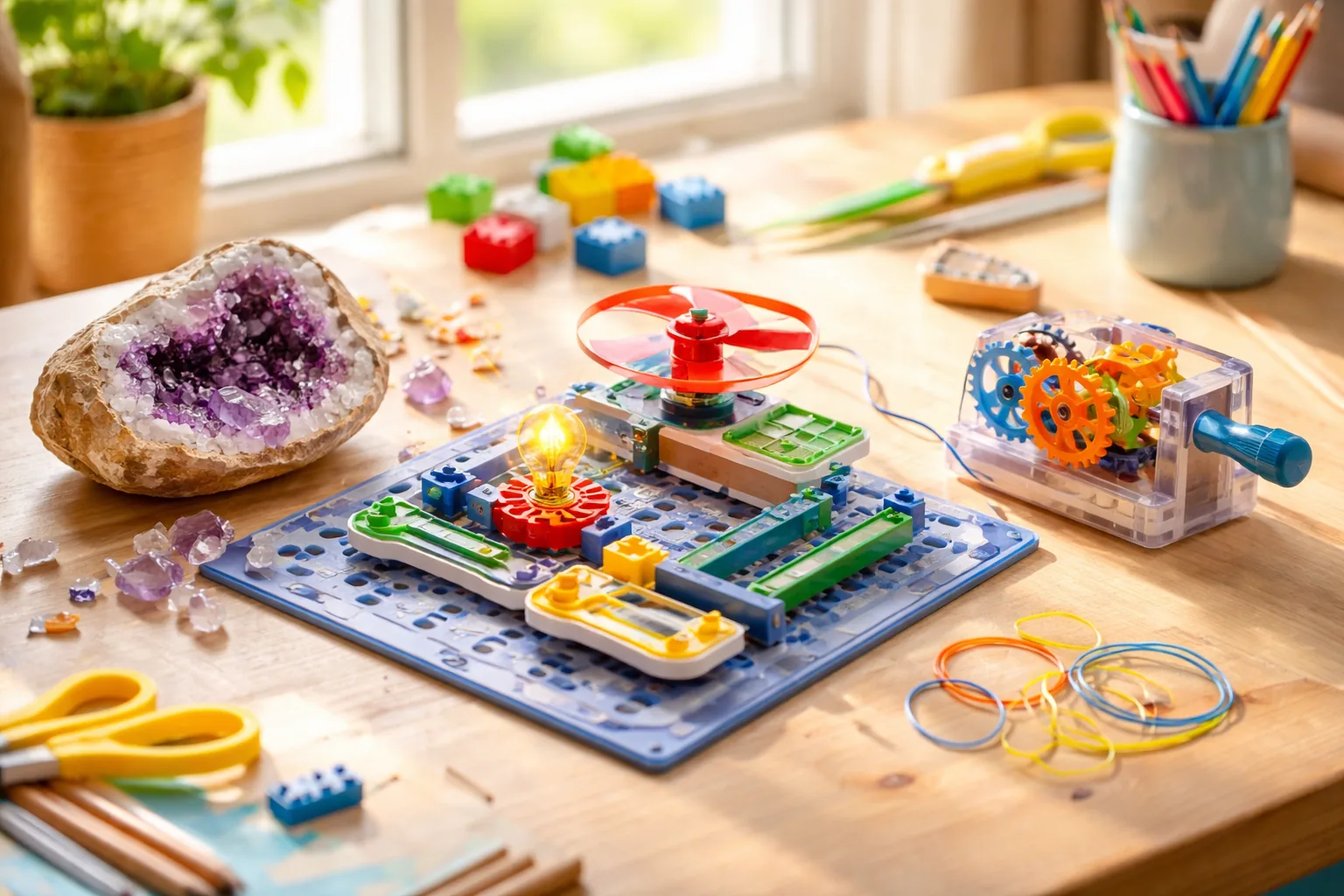
Buying a STEM toy for an older kid is a balancing act. Most kits miss the window for ages 8 to 12 in one of two ways. They skew too young, all oversized foam blocks and counting games, or they leap straight to soldering irons and code. The sweet spot sits in between: real concepts a kid can actually grasp, delivered through something they want to keep picking up. Get the level wrong and the kit ends up shoved under the bed by the weekend.
The toys that land at this age tend to share a trait. They give a child something to figure out and a reason to come back the next day, whether that is building a circuit that buzzes, cracking open a rock to see what is inside, or drawing an object into the air. A flashy box does not hold an eight-year-old. A genuine challenge that rewards patience does.
So instead of ranking by subject, this guide sorts by how your kid learns. Some children love following step-by-step builds; others want to explore with no single right answer. Read the short "who it's for" list, find your child, and pick from there. All five are long-proven favorites with deep, steady feedback from parents and teachers.
- Products analyzed
- 5
- Average rating
- 4.6
- Price range
- mid-range
- Top rated
- Snap Circuits SC-100 (4.8)
- Most reviewed
- Gravity Maze
Our Top Pick
If you want one safe starting point, the Snap Circuits Jr. SC-100 is it. It is the highest-rated kit in this group, with a huge range of no-soldering electronics projects and color-coded parts that simply snap together. It scales from a first light switch to genuinely tricky circuits, so it grows with the kid.
The Five Kits at a Glance
| Product | Check |
|---|---|
| Snap Circuits Jr. SC-100 Electronics Exploration Kit, Over 100 Projects, Full Color Project Manual, 28 Parts, STEM Educational Toy for Kids 8 + | (opens on Amazon) |
| ThinkFun Gravity Maze - Falling Marble Logic Game - Challenging STEM Toy for Kids 8-12 - Gravity Marble Maze - Brain-Building Fun - Educational Gift - Boosts Critical Thinking & Problem Solving | (opens on Amazon) |
| National Geographic Break Open 10 Premium Geodes – Includes Goggles & 2 Display Stands - Great STEM Science Kit, Geology Gift for Kids, Break Your Own Geodes with Crystals | (opens on Amazon) |
| Klutz Lego Gear Bots Science/STEM Activity Kit for 8-12 years | (opens on Amazon) |
| 3Doodler Start+ Essentials 3D Pen Set for Kids, Easy to Use, Learn from Home Art, Educational STEM Toy for Boys & Girls Ages 6+ | (opens on Amazon) |
Which Kid Are You Shopping For?
- The kid who loves following instructions and building real things: Snap Circuits.
- The quiet problem-solver who likes a puzzle: ThinkFun Gravity Maze.
- The hands-on kid who wants to discover, not follow steps: the Nat Geo Geodes kit.
- The kid fascinated by how machines move: Klutz Lego Gear Bots.
- The artistic kid who would rather create than assemble: the 3Doodler Start+.
The Picks
Snap Circuits Jr. SC-100 Electronics Exploration Kit, Over 100 Projects, Full Color Project Manual, 28 Parts, STEM Educational Toy for Kids 8 +
The Snap Circuits Jr. SC-100 is the highest-rated kit in this group, and it has earned that over more than a decade of refinement. Color-coded, numbered components snap onto a plastic grid to build working circuits: alarms, fans, doorbells, sirens, even a small flying saucer. There is no soldering, no loose wiring, and no tools, which is what makes it genuinely independent play for this age.
What sets it apart from cheaper circuit kits is the range of projects and how well the difficulty ramps. A beginner starts with a simple light switch and works up to digital circuits and sound effects, so the kit keeps giving for months rather than days. The illustrated manual is clear enough for an eight-year-old to follow alone, and the maker is well known for replacing worn or damaged parts without a fuss. If a child burns through it, matching upgrade kits unlock hundreds more projects using the same base.
Skip this if: you want a no-batteries, grab-and-go gift. It needs a couple of AA batteries that are not in the box, which can catch a gift-giver out.
Pros
- The highest-rated kit in this group
- A huge range of projects that scale from beginner to advanced
- No tools or soldering, so the color-coded pieces suit independent play
- Maker known for replacing damaged parts at no charge
Cons
- Some snap connectors can loosen with heavy repeated use
- Requires AA batteries that are not included
ThinkFun Gravity Maze - Falling Marble Logic Game - Challenging STEM Toy for Kids 8-12 - Gravity Marble Maze - Brain-Building Fun - Educational Gift - Boosts Critical Thinking & Problem Solving
ThinkFun's Gravity Maze is the most-owned kit in this group, and it is the one for the kid who likes to sit and crack a puzzle. The idea sounds simple: arrange clear towers on a grid so a marble drops in and rolls to a target. In practice the challenge cards climb from solved-in-seconds to stare-at-it-for-half-an-hour, which is exactly the curve that keeps a child working.
It earns its place as a screen-time alternative because it is genuinely educational, not just a time-filler. To solve each card a kid has to think in three dimensions about gravity, angles, and tower height, which is real spatial reasoning dressed up as a game. The pieces are sturdy, and the single-box format makes it an easy, affordable gift that does not need batteries or setup.
Skip this if: your child tears through logic games. A strong puzzle-solver around the older end of this range can exhaust the challenge cards quickly, and there is no built-in way to add more beyond inventing your own.
Pros
- The most-owned kit in this group
- Progressive challenges that train spatial reasoning and logic
- Sturdy pieces and a self-contained, no-power design
- One of the cheaper picks here, so it is strong value for gifting
Cons
- Advanced solvers can run through the challenges fast
- Single-player only, with no co-op mode
National Geographic Break Open 10 Premium Geodes – Includes Goggles & 2 Display Stands - Great STEM Science Kit, Geology Gift for Kids, Break Your Own Geodes with Crystals
The National Geographic Break Open 10 Premium Geodes kit is the most tactile pick here, and it suits the kid who wants to find things out rather than follow steps. Children physically crack open real geodes to reveal the crystal formations hidden inside, and the box comes with everything for the job: a set of hand-picked geodes, safety goggles, a magnifying glass, display stands, and an illustrated guide on how geodes form.
The magic is the discovery moment, the few seconds after the shell splits when a kid sees crystals for the first time. The guide covers genuine geology, and the display stands let a child start a little mineral collection to show off. Because these are natural specimens, it doubles as a low-key lesson in how science deals with the real and the unpredictable.
Skip this if: you expect ten identical crystal caves. Natural variation means some geodes are more impressive than others, a few can be nearly solid, and the larger ones are genuinely hard to crack without an adult and a hammer.
Pros
- Real hands-on geology, with each geode a unique find
- Comes with goggles, a magnifier, display stands, and a learning guide
- A natural fit for a budding rock-and-mineral collector
- One of the most battle-tested science kits around
Cons
- Natural variation means some geodes underwhelm
- Larger specimens are hard to crack and need adult supervision
Klutz Lego Gear Bots Science/STEM Activity Kit for 8-12 years
Klutz Lego Gear Bots takes two things kids this age already trust, LEGO bricks and Klutz activity books, and turns them into a kit that teaches real mechanical engineering. Using LEGO Technic elements and a full-color instruction book, a child builds kinetic creatures that actually move when you turn a crank, while the book explains the axles, cams, and cranks that make them go.
That moving payoff is the hook. This is not a build-and-display set; the finished models do something, which is what keeps a kid engaged and curious about how the gears work. The instructions are clear enough for an eight-year-old to follow alone, and because it uses genuine LEGO Technic parts, the pieces are durable and compatible with bricks a child may already own. The engineering ideas translate directly to how real machines work.
Skip this if: your child hates taking their builds apart. The same pieces are reused across every design, so making a new creature means disassembling the last one, which frustrates kids who like to keep what they make.
Pros
- Teaches axles, cams, and cranks through build-and-crank moving models
- Uses genuine LEGO Technic elements, durable and compatible with other sets
- A clear, colorful instruction book packed with real STEM context
- Affordable and needs no batteries or extra tools
Cons
- Only enough pieces for one model at a time, so builds must be taken apart
- The papercraft parts are less durable than the bricks and can tear
3Doodler Start+ Essentials 3D Pen Set for Kids, Easy to Use, Learn from Home Art, Educational STEM Toy for Boys & Girls Ages 6+
The 3Doodler Start+ is the wild card, a 3D printing pen built for children rather than adults. There are no hot parts: the nozzle and the plastic it extrudes are warm but safe enough that a kid can shape creations with bare fingers, with no burn risk. It charges over USB and comes with a starter supply of colorful filament, a project pad, and an activity guide so a child can begin right away.
Where the other kits follow set projects, this one is wide open. Kids draw in three dimensions, building anything from flowers to eyeglass frames to tiny furniture, and the creative ceiling is essentially unlimited, which is rare for a STEM toy. It suits the artistic kid who would rather invent than assemble, and the maker has a strong reputation for responsive support if a pen acts up.
Skip this if: you want a one-and-done purchase with no follow-up cost. It is the priciest pick here, the filament runs out fairly quickly, and refills are an ongoing expense.
Pros
- A fully child-safe 3D pen with no hot parts
- Open-ended creativity, so kids design their own objects from scratch
- Responsive customer support that owners praise
- Comes with a project pad, guide, and starter filament
Cons
- The most expensive kit here, and filament refills add recurring cost
- Battery life is limited, so the pen can die mid-project
The Real Trade-Off
The honest tension in this group is structure versus open-endedness. The kits with clear instructions, Snap Circuits and the Gear Bots, are the easiest to hand a kid who likes to follow a path and feel the satisfaction of finishing. The open tools, the geodes and the 3Doodler, reward a child who would rather explore, but they offer less of that step-by-step scaffolding and, in the pen's case, ongoing cost. There is no single kit that is both tightly guided and totally open, so you are really choosing which suits your child's temperament.
The way through is to buy for how your kid actually plays. A rule-follower thrives with a manual and a clear goal. An explorer wants room to make a mess and discover. Match the kit to that, and even the cheapest pick here will outperform a pricier one that fights the way your child likes to learn.
How to Choose a STEM Toy for Kids 8–12
Start with how your child learns, not the subject. A kid who loves following directions will thrive with the structured builds of Snap Circuits or the Gear Bots. A kid who prefers to explore on their own terms will lean toward the geodes kit or the 3Doodler, where there is no single correct outcome. The subject matters less than the style of play.
Think about total cost, not just the price. Most of these are one-time purchases with nothing to refill. The 3Doodler is the exception: the pen is the most expensive pick and the filament is a recurring cost, so factor that in. If you are buying for someone else's child and want zero follow-up expense, the no-consumable kits are the safer bet.
Mind where your child sits in the 8-to-12 range. The marble puzzle and the geodes kit make great entry points for a younger child just getting comfortable with independent projects. Snap Circuits and the Gear Bots reward the longer attention span of an older kid. The 3Doodler fits the child who already leans artistic and wants to blend making with creating.
What age is best to start with these STEM toys?
Eight is the practical floor for the kits here. Younger children can use simpler versions from the same makers, but these are designed to challenge an eight-year-old while still engaging a twelve-year-old, so they suit the whole range.
Are these safe to use without supervision?
Mostly, yes. They are built for independent play: there is no soldering, the 3D pen has no hot parts, and the puzzle and engineering kits use no electricity. The one to supervise is the geodes kit, since cracking rocks with a hammer needs an adult nearby, especially for younger kids.
Do any of these need batteries or charging?
Two do. The Snap Circuits kit needs AA batteries that are not included, and the 3Doodler charges over USB. The marble puzzle, the geodes kit, and the Gear Bots are fully manual and need no power at all.
Which one has the most replay value?
Snap Circuits leads, with a huge project range and upgrade kits that extend it further on the same base. The 3Doodler is open-ended and effectively unlimited, though filament cost is a factor. The marble puzzle has a fixed set of challenges unless your child starts inventing their own.
Can these be used in a classroom or for homeschooling?
Yes. Teachers commonly use the electronics kit in class, the marble puzzle works well as a solo station, the geodes kit fits an earth-science unit, the Gear Bots align with mechanical engineering basics, and the 3D pen pairs well with art-integrated STEM lessons.
As an Amazon Associate I earn from qualifying purchases. Prices and availability change frequently — use the Amazon button to check current pricing.