
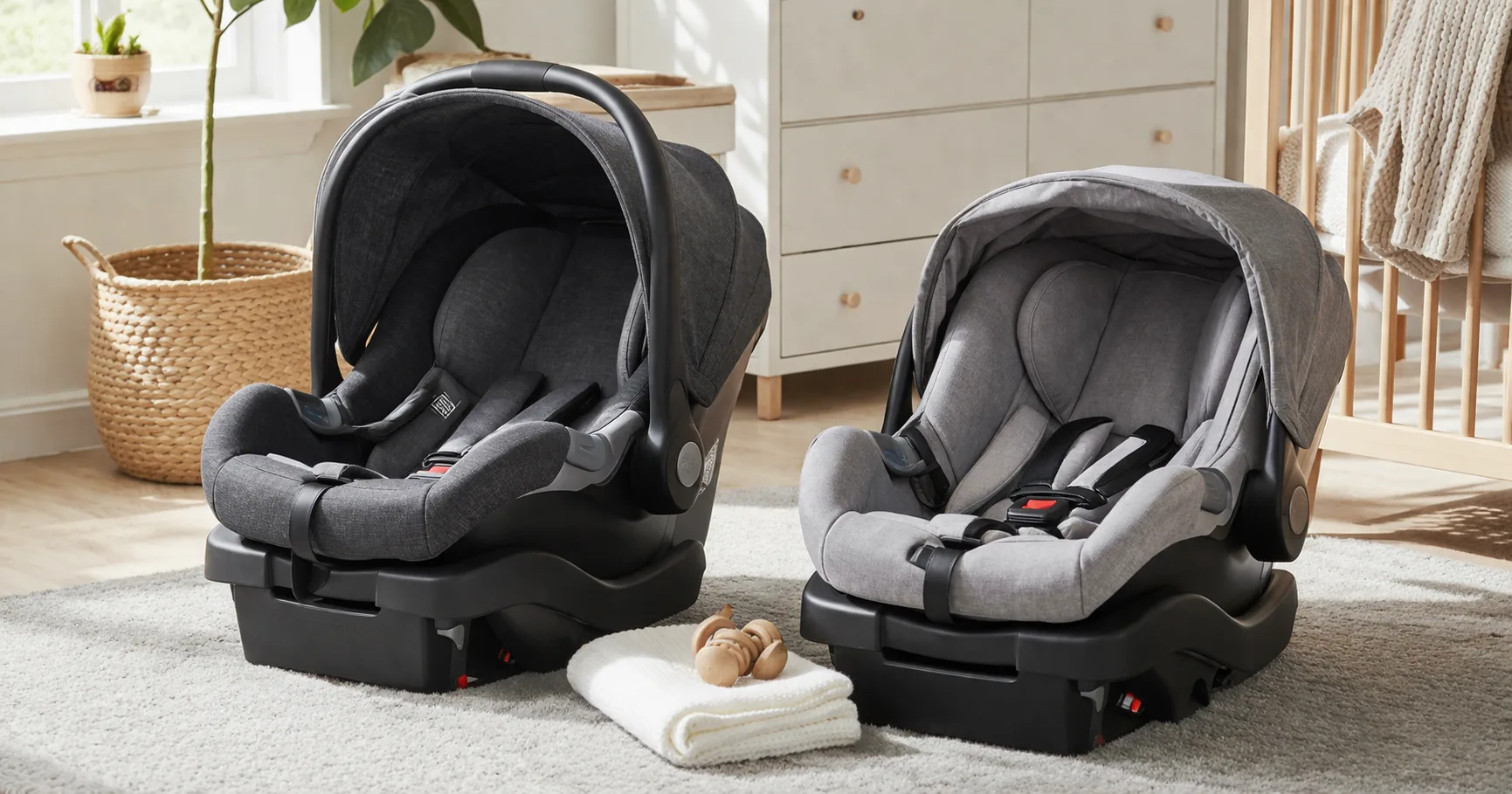
The Chicco KeyFit 30 and the Graco SnugRide Lite LX sit in the same aisle and do the same core job, rear-facing protection for a 4-to-30-pound infant, yet they're built around different priorities. One leans into making a correct installation foolproof and adds flame-retardant-free fabric. The other leans into a featherweight carrier and a price that's much easier on a new-baby budget.
Both pass every required US safety test, so this isn't a question of which one is "safe." They both are. The real decision comes down to three things about how you'll actually live with the seat: how often you'll move it between cars, how much flame-retardant-free, low-emission materials matter to you, and which brand's stroller you own or plan to buy. Get clear on those, and the choice mostly makes itself.
What follows isn't a spec sheet. It's a look at the scenarios where each seat clearly wins, followed by the tie-breakers for the close calls. The seats themselves are similar enough that the right answer depends more on your situation than on any single number.
- Products analyzed
- 2
- Average rating
- 4.9
- Top rated
- Chicco KeyFit 30 (4.9)
- Most reviewed
- Graco SnugRide (7.3K)
Our Top Pick
For most first-time parents, the Chicco KeyFit 30 ClearTex is the safer default. Its force-multiplying LATCH tightener and leveling foot make a correct, snug install far easier to achieve, and its ClearTex fabric is flame-retardant-free. It holds a 4.9-star rating.
Side by Side
| Product | Check |
|---|---|
| Chicco KeyFit 30 ClearTex Infant Car Seat and Base, Rear-Facing Seat for Infants 4-30 lbs., Includes Infant Head and Body Support, Compatible with Chicco Strollers, Baby Travel Gear, Pewter/Grey | (opens on Amazon) |
| Graco® SnugRide Lite LX Infant Car Seat, Lightweight Rear-Facing Seat for Babies 4–30 lb, 4-Position Adjustable Base, LATCH Installation & ProtectPlus Engineered, Studio | (opens on Amazon) |
Reviews
Chicco KeyFit 30 ClearTex Infant Car Seat and Base, Rear-Facing Seat for Infants 4-30 lbs., Includes Infant Head and Body Support, Compatible with Chicco Strollers, Baby Travel Gear, Pewter/Grey
The Chicco KeyFit 30 ClearTex carries a 4.9-star rating, and its reputation rests on one thing: it's consistently among the easiest infant seats to install correctly. The price includes both the carrier and the stay-in-car base.
The installation hardware is where the seat earns its premium. The SuperCinch force-multiplying LATCH tightener is a lever system that lets you cinch the strap tight with much less effort than a standard pull-through, which makes it far more likely you'll hit the snug, under-one-inch-of-movement install that certified technicians check for. Two bubble-level indicators and a spring-loaded leveling foot confirm the base is at the right angle, which matters because a base set too upright can let a newborn's head slump forward.
The ClearTex fabric is the second draw. It's flame-retardant-free and certified for low chemical emissions, which appeals to parents wary of babies breathing off-gassed flame retardants for hours at a time. The shell is lined with the same kind of energy-absorbing foam used in bicycle helmets. Owners describe the seat as sturdy and easy to pop in and out of the base, with many using it across multiple children. The carrier does get heavy once a baby nears the upper weight range, and it costs noticeably more than the Graco, which are the two tradeoffs to weigh.
Pros
- Force-multiplying LATCH tightener makes a correct install dramatically easier
- Flame-retardant-free, low-emission ClearTex fabric
- Energy-absorbing foam shell for impact protection
- Bubble levels and a leveling foot confirm the proper base angle
Cons
- Carrier gets heavy as the baby approaches the upper weight range
- Costs noticeably more than the comparable Graco
Graco® SnugRide Lite LX Infant Car Seat, Lightweight Rear-Facing Seat for Babies 4–30 lb, 4-Position Adjustable Base, LATCH Installation & ProtectPlus Engineered, Studio
The Graco SnugRide Lite LX holds a 4.8-star rating across a deeper review base than the Chicco, tops Amazon's infant car seat category, and costs roughly 40% less. The base is included in that price.
Its defining spec is carrier weight: around 7.2 pounds, one of the lightest in the category. That pays off in two everyday situations. First, when you're carrying the seat plus a sleeping baby across a parking lot and into the house, a lighter carrier adds up across dozens of daily transfers. Second, for grandparents or anyone with back or shoulder issues, the lighter load is a genuine relief.
The safety package is serious despite the lower price. Graco's internal standard combines frontal, side, rear, and rollover testing plus extreme-temperature testing, and the seat is side-impact tested under the current federal standard. A four-position adjustable base with a built-in level indicator handles the recline angle, it installs with either LATCH or the vehicle belt in about five minutes, and it clicks into Graco strollers in one step. The one real compromise versus the Chicco is materials: Graco hasn't specifically certified this fabric as flame-retardant-free or low-emission, so parents who prioritize that will want the Chicco or should read the full specs.
Pros
- Roughly 7.2-pound carrier, one of the lightest in the category
- Costs about 40% less than the Chicco at comparable specs
- Side-impact tested to the current federal standard
- Four-position adjustable base with a clear level indicator
Cons
- Canopy can be stiff and noisy to adjust one-handed
- No flame-retardant-free or low-emission fabric certification
When Each Seat Wins
Both seats cover the same 4-to-30-pound range and last until your baby outgrows the infant stage and moves to a convertible, so the lifespan math is a wash. The differences show up in specific situations.
Pick the Chicco if you'll move the base between cars often. Grandparent's car, a second vehicle, the occasional rideshare, every reinstall is another chance to get the tension wrong. The SuperCinch tightener converts the force you apply into much more cinching force at the base, so a snug install is easier to repeat without a struggle. The more often you reinstall, the more that advantage compounds, and for a first-time parent who has never wrangled a car seat, it's the single biggest reason to spend more.
Pick the Chicco if low-emission materials are a priority. The ClearTex fabric is flame-retardant-free and certified for low chemical emissions, and the Graco isn't. For parents who research nursery products for off-gassing, that's a concrete specification difference, not marketing. If you've already chosen a flame-retardant-free mattress and crib, the matching car seat is the Chicco.
Pick the Graco if you'll carry the seat constantly. The lighter carrier is a real quality-of-life difference for anyone doing multiple car-to-house-to-stroller transfers a day, and especially for caregivers with back or shoulder strain. Over months of daily lifting, a couple of pounds is the kind of thing you stop noticing only because you chose the lighter seat.
Pick the Graco if the budget is tight. It costs about 40% less for a seat that meets the same federal safety standard and carries the brand's own crash testing. Over the few years you'll use an infant seat, that gap is real money you could put toward the convertible seat that comes next.
The Tie-Breakers
If the scenarios above leave you on the fence, a few smaller factors usually settle it.
Stroller brand is the most decisive. Each seat clicks only into strollers from its own brand, the KeyFit into Chicco strollers, the SnugRide into Graco strollers. If you already own a stroller, the matching infant seat is the practical pick, full stop, and it can outweigh everything else.
Reviewer sentiment leans positive for both, so it won't break the tie. The Chicco rates a touch higher overall and the Graco has more reviews behind it, but neither shows the cluster of installation complaints that flags a genuinely hard-to-install seat. Both are well-liked by the parents who own them.
Finally, weigh ease against everything else honestly. If you're confident you'll install the base once and leave it, and materials aren't a top concern, the Graco's lower price and lighter carrier make it the smarter all-around buy. If installation anxiety is real for you, or you're handing the seat between caregivers who each reinstall it, the Chicco's hardware is worth the premium. An incorrectly installed seat is the biggest safety risk in this whole comparison, which is why the Chicco's install advantage carries more weight than the modest differences between the seats themselves.
Which seat is actually safer in a crash?
Both meet the current federal safety standard, including side-impact testing, and both use energy-absorbing foam. The Chicco's force-multiplying LATCH system makes a correct install easier to achieve, which matters more for real-world crash outcomes than the small differences between the seats. A poorly installed seat is the single biggest risk either way.
Is the Chicco KeyFit 30 worth the higher price?
It's worth it if installation ease and flame-retardant-free materials matter to you, or if you'll reinstall the base often. If you'll install once and leave it in one car and aren't focused on chemical emissions, the Graco covers the same safety standard for less.
Which is lighter to carry?
The Graco SnugRide Lite LX, at roughly 7.2 pounds, is one of the lightest infant seats in the category. The Chicco weighs more. For parents moving the seat multiple times a day, the Graco's lighter carrier is a real daily difference.
Do they both fit the same strollers?
No. Each clicks only into strollers from its own brand. The KeyFit pairs with Chicco strollers and the SnugRide Lite LX pairs with Graco strollers. If you already own a stroller, choose the matching car seat.
How long does each seat last?
Both cover 4 to 30 pounds and have expiration dates roughly seven years from manufacture. In practice, most babies outgrow an infant seat well before that and move to a convertible, so the expiration rarely becomes the limiting factor.
Which is easier to install correctly for a first-timer?
The Chicco KeyFit 30. Its LATCH tightener, bubble levels, and leveling foot are designed to reduce the common errors, a loose strap or the wrong recline angle, that produce a seat which looks fine but fails a real installation check.
As an Amazon Associate I earn from qualifying purchases. Prices and availability change frequently — use the Amazon button to check current pricing.