
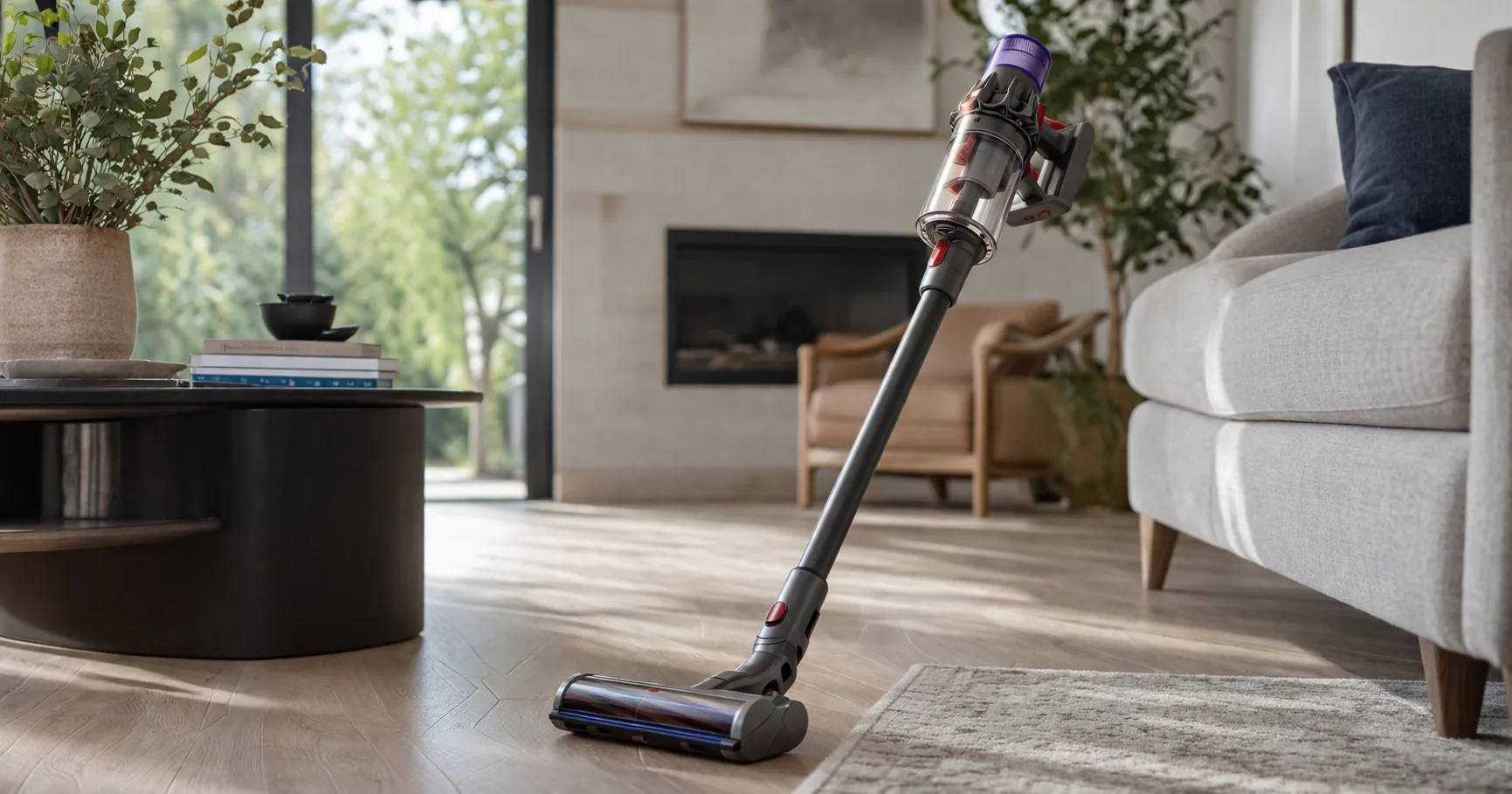
Nobody really doubts that a Dyson cordless vacuum cleans well. The hard part in 2026 is deciding which one, because the gap between the entry V8, the mid-range V11 Origin, and the flagship V15 Detect Plus comes down mostly to how much you are willing to pay for headroom you may never use. That is where buyers stall, and it is the question this review is built around.
This is a focused look at the V11 Origin as the core decision, with the V8 sitting below it and the V15 Detect Plus above it as the reference points that frame the value question. All three are premium machines. The real choice is where on that ladder your floors, your home size, and your patience actually sit.
- Products analyzed
- 3
- Average rating
- 4.3
- Price range
- premium across the board
- Top rated
- Dyson V11 (4.4)
- Most reviewed
- Dyson V8
Our Top Pick
The Dyson V11 Origin is the model that best captures the Dyson trade-off in 2026. It is premium, it cleans hard, and it adds enough over the entry V8 to feel like a real step up without climbing all the way to flagship money. For most households weighing this lineup, it is the rational stopping point.
The Lineup at a Glance
| Product | Check |
|---|---|
| Dyson V11 Origin Cordless Vacuum, 185AW, 3 Power Modes, Up to 60 Minutes,² Deep Cleans Hard Floors and Carpets, Detangles pet Hair, Converts to Handheld | (opens on Amazon) |
| Dyson V15 Detect Plus Cordless Vacuum, Illumination Reveals dust, 240AW, 3 Power Modes, Up to 60 Minutes,² Deep Cleans Hard Floors and Carpets, Detangles pet Hair, Converts to Handheld | (opens on Amazon) |
| Dyson V8 Cordless Vacuum, Cleans Hard Floors and Carpets, Detangles, Converts to Handheld, 115AW, 2 Power Modes, Up to 40 Minutes¹ | (opens on Amazon) |
What Actually Changes as You Move Up the Range
Going from V8 to V11 to V15 is mostly about power, runtime, cleaner-head sophistication, and how much feedback the vacuum gives you on screen. It is not a different ownership experience. All three are cordless, convert to handheld use, and aim at whole-home cleaning. What you are paying for as you climb is performance headroom and nicer hardware.
That is why the V11 is the pivot. It sits in the middle of the range, more capable than the V8 and less lavish than the V15. If the middle is good enough for most people, it is the sensible place to stop. If it is not, the whole value argument shifts toward one of the other two.
The Review
Dyson V11 Origin Cordless Vacuum, 185AW, 3 Power Modes, Up to 60 Minutes,² Deep Cleans Hard Floors and Carpets, Detangles pet Hair, Converts to Handheld
Start with the honest weakness: the V11 Origin lives in an awkward middle, and its price is firmly premium. It is not an impulse buy, and it only makes sense if you actively want the center of the Dyson range rather than the cheapest way in or the most advanced version. If you cannot articulate why you want more than the V8 but less than the V15, the V11 will feel like an expensive non-decision.
Once you do want that middle, though, the case is strong. The V11 delivers genuinely useful suction across power modes, runs close to an hour on a charge in its lighter mode, and adds an LCD screen that shows the current mode and remaining runtime. Its Motorbar cleaner head handles both hard floors and carpet while detangling long hair and pet hair, which is the kind of everyday reliability a basic cordless vacuum struggles to match.
This is where it earns its keep. The V11 is the point where Dyson's premium positioning becomes easier to justify for a normal household. You get strong runtime, a clearer control interface, and enough flexibility to use it as a true primary cordless cleaner rather than a backup. For mixed flooring, pet hair, and frequent quick cleans, that balance still holds up.
The downside stays the same as it starts: cost. Above a certain point a cordless vacuum stops being an easy recommendation, and the V11 sits there. If you do not care about the screen, the longer runtime, or the higher performance tier, the V8 looks smarter. If you want every last feature, the V15 pulls at your attention. That leaves the V11 in a narrow but very real sweet spot.
My read is simple. The V11 Origin is worth buying in 2026 if you want a premium cordless vacuum with the best overall balance in the Dyson range. It is not the cheapest smart buy, and it is not the most advanced. It is the most sensible middle-tier Dyson.
Who it suits: buyers with mixed floors, pets, and regular cleaning who want a primary cordless vacuum and do not want to overthink the flagship.
Who should look elsewhere: anyone with light, small-home cleaning needs (the V8 is enough) or anyone who wants the absolute top hard-floor tech (the V15).
Pros
- Strong middle-ground position in the Dyson range
- Close to an hour of runtime in lighter mode, with real whole-home reach
- LCD screen and maintenance alerts make daily use feel polished
- Motorbar head covers hard floors and carpet and handles hair well
Cons
- Price is still firmly premium
- Hard to justify if your needs are light enough for the V8
The Alternatives, Up and Down
Dyson V15 Detect Plus Cordless Vacuum, Illumination Reveals dust, 240AW, 3 Power Modes, Up to 60 Minutes,² Deep Cleans Hard Floors and Carpets, Detangles pet Hair, Converts to Handheld
The Dyson V15 Detect Plus is the upgrade path, and it is the priciest model in this review, so the case rests on whether you want Dyson at its most feature-heavy rather than Dyson at its most balanced. This is for buyers who have already made peace with the price structure and want the top of it.
On hardware it outruns the V11. You get the strongest suction of these three, the same long-runtime class, two advanced cleaner heads, illuminated optics that reveal fine dust on hard floors, and adaptive power with on-screen particle feedback. It feels more obviously premium in a way the V11 does not always try to be.
The issue is not capability, it is restraint. For a lot of homes the V15 crosses the line where the extra technology gets harder to defend, unless you genuinely care about top-tier hard-floor visibility, the highest suction here, or simply owning the most advanced version of the experience.
Pros
- Most advanced feature set in this lineup
- Illuminated hard-floor head and adaptive power add real appeal
- The strongest suction of the three
- Best for buyers who want the top tier, not the value tier
Cons
- Highest price in this review
- Smaller feedback base than the V8 and V11
Dyson V8 Cordless Vacuum, Cleans Hard Floors and Carpets, Detangles, Converts to Handheld, 115AW, 2 Power Modes, Up to 40 Minutes¹
The Dyson V8 is the model that keeps the brand within reach. It is not cheap in absolute terms, but it is meaningfully easier to justify than the V11 or V15 if you simply want a well-known cordless Dyson for lighter whole-home use.
It makes the strongest case for buyers who value lower weight and a lower entry cost over top-end specs. Expect roughly forty minutes of runtime, two power modes, handheld conversion, and a Motorbar head that still covers hard floors and carpet. That keeps it relevant even as the clearly lower-tier unit here, and it carries the deepest feedback base of the three.
Its limits are exactly why the V11 exists. The V8 is less powerful, runs shorter, and skips the V11's informative display. For quick jobs, apartments, or a lighter routine, it can be all you need. For a true primary cordless role, the V11 is easier to defend.
Pros
- Lowest price in this review
- Lighter-duty Dyson that still covers hard floors and carpet
- Easier to justify for smaller homes and lighter routines
- Deepest feedback base in this lineup
Cons
- Shorter runtime and a lower spec ceiling than the V11 and V15
- Less compelling as a true premium primary vacuum
So, Is It Worth the Upgrade?
Yes, but only at the right tier, and that is the honest answer rather than a dodge. If you want the best overall balance in the current Dyson cordless range, the V11 Origin is the one to buy. It gives you a fuller premium experience than the V8 without pushing into flagship pricing. If you want the cheapest sensible entry into this trio, the V8 is the better call. If you want the most advanced hard-floor and suction package Dyson offers here, the V15 is the upgrade.
What does not make sense is buying the top model by reflex just because it is the top model. In this lineup the V11 is the most rational answer for most buyers, which is the real reason the Dyson cordless platform still holds up in 2026.
Is a Dyson cordless vacuum worth the upgrade in 2026?
Yes, if the upgrade buys features you will actually use. The V11 is the best-balanced choice for most buyers, the V8 is the cheaper fallback, and the V15 is the premium step-up.
What should I check before buying?
Figure out where you fit in the lineup. The real decision is not whether to buy Dyson, but whether your routine needs V11 or V15 capability instead of the cheaper V8.
Is the V11 Origin still worth buying in 2026?
Yes. It remains the strongest middle-tier choice because it balances price, runtime, controls, and cleaning ability better than the other two for most households.
Are the pricier Dyson models always better?
Not automatically. The V15 is the most advanced here, but that does not make it the best value. The higher price only pays off if you care about the extra power and premium cleaner heads.
Who should buy the V8 instead?
Buyers with lighter cleaning needs, smaller homes, or tighter budgets. It is the easiest model here to justify if you want cordless Dyson convenience without mid-tier or flagship pricing.
As an Amazon Associate I earn from qualifying purchases. Prices and availability change frequently — use the Amazon button to check current pricing.