
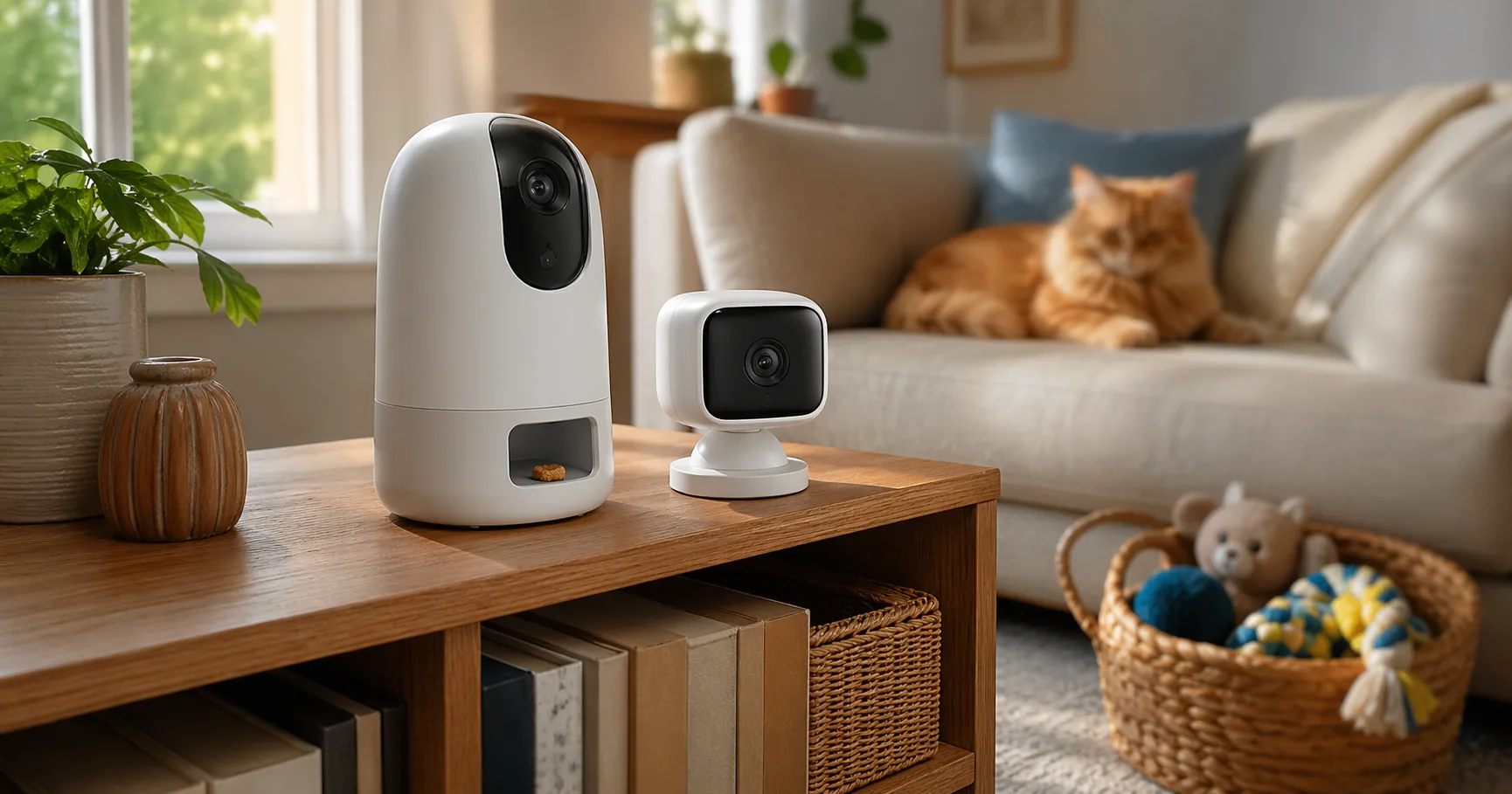
Furbo and Petcube built the pet camera category, and they've stayed at the top of it by serving two fundamentally different kinds of pet owner. Furbo went premium: a rotating head, a treat dispenser, color night vision, and a subscription AI layer for owners who want to actively manage their pet's day from the office. Petcube went practical: a compact, wall-mountable camera with reliable video and two-way audio at a price that invites buying multiple units for different rooms.
The price gap between these two is the largest in the category, and it creates the central question: is the Furbo's feature set worth the multiple-times higher cost, or are most buyers paying for hardware they'll rarely use? The answer splits almost entirely along pet type and use case rather than a simple better/worse verdict.
- Products analyzed
- 2
- Average rating
- 4.3
- Price range
- budget to premium
- Top rated
- Furbo 360° (4.4)
- Most reviewed
- Petcube Cam (19K)
Our Top Pick
Our pick for dog owners (especially those with dogs that have separation anxiety or high energy) is the Furbo 360°. The rotating head and treat dispenser are the only features in this comparison that let you actively intervene with your pet remotely, not just watch. If you have a cat or need coverage across multiple rooms on a budget, read the Petcube section first.
At a Glance
| Product | Check |
|---|---|
| Furbo 360° Dog Camera: Pet Security Cam w/Barking Alerts, Rotating View, Treat Toss w/Phone App, Smart Home Puppy Monitoring, 2-Way Speaker, No Subscription Needed. Standard See, Talk, & Toss Features | (opens on Amazon) |
| Petcube Cam | Indoor Wi-Fi Pet and Security Camera with Phone App, Pet Monitor with 2-Way Audio and Video, Night Vision, 1080p HD Video and Smart Alerts for Ultimate Home Security | (opens on Amazon) |
Reviews
Furbo 360° Dog Camera: Pet Security Cam w/Barking Alerts, Rotating View, Treat Toss w/Phone App, Smart Home Puppy Monitoring, 2-Way Speaker, No Subscription Needed. Standard See, Talk, & Toss Features
The Furbo 360° is the camera that moves. A rotating head sweeps a full 360 degrees on command from the app, auto-tracking kicks in to follow a pet's movement around a room, and a treat dispenser mounted in the front fires kibble or small biscuits on command. The combination turns a monitoring camera into an interactive tool: you can follow your dog across a room, toss a treat from the office, and hear and speak through two-way audio in one session without moving to a different app view.
1080p video pairs with color night vision rather than the infrared-only black-and-white most cameras offer, which gives a cleaner read on the room after dark. The sound sensor sends alerts when barking starts, and the camera's onboard processing handles the initial detection so it doesn't depend entirely on the app staying active. Bark alerts are one of the most consistently praised features in the owner base, arriving fast enough to be useful rather than as a delayed notification.
One honest note about the software: Furbo's AI-powered alerts, activity timeline, and video history require a subscription after a trial period ends. The core hardware features (live view, treat toss, two-way audio, and bark alerts) work without it. If the AI features are part of why you're considering the Furbo, factor the ongoing cost into your decision before buying.
Skip this if you're buying primarily to watch a cat who sleeps in predictable spots and isn't treat-motivated, or if the premium price and potential subscription make the total ownership cost impractical.
Pros
- True 360° rotating head with auto-tracking, the only camera in this comparison that follows pets
- Treat dispenser works reliably with round treats and provides real remote interaction
- Color night vision with solid range and 1080p resolution
- Bark and activity alerts arrive with low latency according to long-term owners
Cons
- Premium price is a significant step above the Petcube Cam
- AI-powered alerts and video history require a subscription after the trial ends
- Treat dispenser performs less reliably with non-round or non-standard treats
Petcube Cam | Indoor Wi-Fi Pet and Security Camera with Phone App, Pet Monitor with 2-Way Audio and Video, Night Vision, 1080p HD Video and Smart Alerts for Ultimate Home Security
The Petcube Cam takes the opposite philosophy: a compact, fixed-position camera with a 110-degree wide-angle lens that stays where you point it and does its job without moving parts to maintain or subscription features to navigate. Magnetic mounting and a compact form factor make it easy to position anywhere: on a shelf edge, a windowsill, or mounted flat to a wall with included adhesive, and the setup process is one of the fastest in the category.
Two-way audio, motion and sound detection with basic human-versus-pet identification, night vision, and 1080p video are the complete feature list. No treat dispenser, no rotating head, no laser. Petcube sells those features in other models in its lineup, but the Cam is their monitoring-first option. What you get is a reliable window into a room that the camera stays pointed at.
The advantage over the Furbo is the price point, which is low enough to buy two or three units for full-apartment or multi-room coverage at a fraction of the cost of a single Furbo. Cat owners who want to cover the bedroom, the living room, and the kitchen can do that with Petcube Cams for roughly the price of one Furbo. The coverage math changes the conversation entirely for multi-room monitoring use cases.
Petcube Care, the optional cloud subscription, adds video history and enhanced smart alerts but is not required for basic function, a meaningful distinction from the Furbo model. Live view and standard alerts are available without subscribing.
Skip this if your dog has separation anxiety that needs active management rather than passive monitoring, or if you need to cover a large open space where a 110-degree fixed angle will leave significant blind spots.
Pros
- Most-reviewed pet camera in this comparison, reflecting years of widespread owner use
- Compact form factor and magnetic mount work in spaces where a larger camera won't fit
- Multi-room coverage is affordable at this price point, with multiple units available for the price of one Furbo
- Core features work without a subscription; the paid tier is genuinely optional
Cons
- Fixed 110-degree angle with no movement; can't follow a pet across a room
- No treat dispenser or interactive toy; monitoring only
- Fixed angle can leave blind spots in large or open-plan spaces
When Each One Wins
The dog with separation anxiety. This is Furbo's clearest use case. A dog that paces, barks, or chews when alone benefits directly from the treat dispenser: you can interrupt a behavior pattern from the office by tossing a treat, call through the two-way audio, and track where the dog is moving. Petcube Cam gives you a view of whatever corner you pointed it at, which may or may not include where the dog went.
The cat owner. Petcube wins almost every time. Cats tend to sleep in predictable spots, don't respond to tossed treats the way dogs do, and don't bark, so the Furbo's three standout features are largely wasted on a cat that mostly naps in the same chair. A Petcube Cam pointed at the cat's usual spot gives a cat owner everything they actually need at a fraction of the price.
Multi-room coverage. For owners who want to cover a kitchen, a living room, and a hallway, the Petcube's price point is the decisive factor. Two or three Petcube Cams cover more ground than one Furbo, at lower total cost, with no rotating mechanism to rely on. The tradeoff is no active engagement capability in any of the rooms.
Active dog interaction. Furbo, no contest. The rotating head follows the dog around the room, and treat tossing creates a real feedback loop between the owner and the pet. Petcube Cam is a passive tool; Furbo is an active one.
Budget households. Petcube Cam for basic monitoring. The gap in price is large enough that if budget is genuinely a constraint, the Furbo adds features the buyer may never use, while Petcube delivers the core value proposition (live video and two-way audio) at minimal cost.
The Tie-Breakers
When the scenarios above don't clearly point one way, three questions settle it. First: do you have a dog or a cat? Dogs with separation anxiety or high activity get meaningfully more from the Furbo. Cats almost universally do fine with the Petcube. Second: how many rooms do you need covered? If the answer is more than one, the budget for multiple Petcube units beats the cost of a single Furbo with blind spots. Third: will you actually use the treat dispenser? Furbo's price premium is mostly paying for treat tossing and the rotating head. If you work from home, don't leave pets alone long, or have a pet that wouldn't engage with dispensed treats anyway, the premium doesn't pay off.
Both cameras require 2.4GHz WiFi rather than 5GHz, which is worth checking before ordering. Routers that only broadcast on 5GHz or aggressively merge both bands can prevent either camera from connecting, and this is the single most consistent source of setup problems in both products' reviews. A dedicated 2.4GHz network solves it.
How to Think About the Subscription Question
Furbo's AI-powered features (activity tracking, smart alerts, and home hazard detection) sit behind a paid tier after a trial window. This changes the total ownership math in a way the sticker price doesn't capture. Core features still work without subscribing. But if the AI features are what made the Furbo appealing, the subscription adds ongoing cost to an already expensive piece of hardware.
Petcube Care is optional in a more straightforward way: most owners use the camera perfectly well on the free tier, and the paid tier adds video history and enhanced alerts as genuinely incremental features rather than gates on core function. For buyers uncertain about committing to a subscription model, Petcube Cam's optional-feeling paid tier is meaningfully less friction than Furbo's trial-then-subscribe structure.
Is Furbo worth the premium over Petcube Cam?
For dog owners managing separation anxiety or needing active remote engagement, yes. The treat dispenser and rotating head are unique to the Furbo in this comparison and provide real value for dogs who respond to interaction. For cat owners or passive monitoring, the premium rarely pays off.
Does either camera require a subscription to work?
No. Both function without subscriptions. Furbo's live view, treat toss, two-way audio, and barking alerts work without paying for the Nanny tier. Petcube Cam's live view, basic alerts, and two-way audio work without Care. Paid tiers on both add video history and enhanced smart alerts but are not required.
Which camera is better for night vision?
Furbo. It uses color night vision alongside standard infrared, producing cleaner and more detailed images after dark. Petcube Cam's night vision is infrared-only and renders in black-and-white, which is functional but less detailed.
Can I use either camera with 5GHz WiFi?
No. Both connect to 2.4GHz WiFi only. If your router only broadcasts 5GHz or merges both bands automatically, set up a 2.4GHz dedicated network before purchasing either camera. This is the most common setup failure for both products.
Which camera is better for cats specifically?
Petcube Cam. Cats sleep in predictable spots, don't respond to treat dispensers the way dogs do, and don't bark. A fixed-angle camera pointed at the usual spot covers most cat-monitoring needs, and the lower price makes buying a second unit for another room practical.
Can Petcube Cam cover a large open-plan apartment?
One unit can't, but multiple units can. The 110-degree fixed angle has real limits in large or L-shaped spaces. Two Petcube Cams placed strategically cover the same area a single Furbo might handle with rotation, often at lower total cost. The tradeoff is no treat dispensing or active engagement capability.
As an Amazon Associate I earn from qualifying purchases. Prices and availability change frequently — use the Amazon button to check current pricing.