
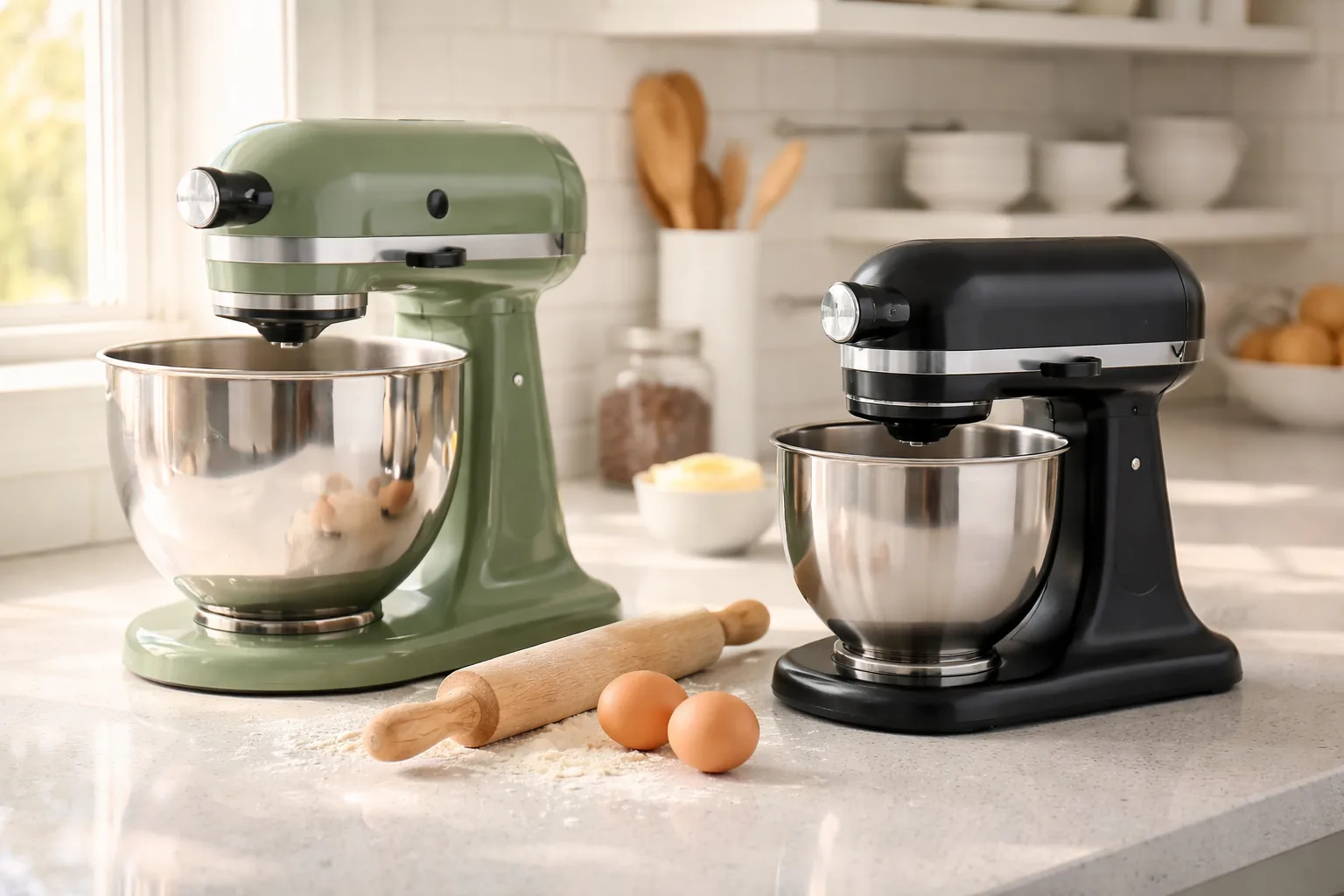
The strange thing about this matchup is how small the performance gap is compared to the price gap. The KitchenAid Artisan costs several times what the Hamilton Beach does, yet for a tray of cookies or a single loaf of bread, most bakers would struggle to tell the results apart. So the honest framing is not "which mixer is better." It is "which gap matters more to you, the one in price or the one in build and capability."
Both are well-proven machines with thousands of owners behind them, and both use the same basic planetary mixing motion that gives you even coverage around the bowl. Neither will let you down on everyday baking. Where they split is on the things you only notice over years of use: how heavy the machine is, how big a batch it can take, how long it will last, and whether you ever want it to do more than mix.
This comparison skips the spec-sheet duel and walks through the situations where each one is clearly the right call, then ends with the small tie-breakers that usually settle a close decision.
- Products analyzed
- 2
- Average rating
- 4.6
- Price range
- budget to premium
- Top rated
- KitchenAid Artisan (4.7)
- Most reviewed
- KitchenAid Artisan
Our Top Pick
For most home bakers, the Hamilton Beach Electric Stand Mixer is the smarter buy. It delivers planetary mixing, a useful range of speeds, and a strong rating for a fraction of the KitchenAid's price. The KitchenAid wins on build and expandability, but the Hamilton Beach handles cookies, cakes, and standard bread dough without strain or sticker shock.
The Two Mixers at a Glance
| Product | Check |
|---|---|
| KitchenAid Artisan Series 5 Quart Tilt Head Stand Mixer, KSM150PS, Juniper | (opens on Amazon) |
| Hamilton Beach Electric Stand Mixer, 4 Quarts, Dough Hook, Flat Beater Attachments, Splash Guard, 7 Speeds with Whisk, Easy-Carry Top Handle, Aqua | (opens on Amazon) |
When the KitchenAid Artisan Is the Right Call
Buy the KitchenAid if you think of a mixer as a long-term fixture rather than a tool you replace. Its defining trait in owner feedback is longevity. The all-metal body and gearbox are built to outlast nearly everything else on the counter, and owners routinely describe theirs running for a decade or more without trouble. If you bake often and want to buy once, that durability is the whole argument, and it is a strong one.
The other reason to spend up is expansion. KitchenAid's power hub turns the mixer into a platform: a pasta roller, a grinder, a spiralizer, and more all run off the same machine. If you can picture yourself adding an attachment a year and slowly building a system around it, the KitchenAid is the only one of these two that grows with you. The Hamilton Beach has no equivalent.
Capacity rounds it out. The larger bowl handles big-batch baking, holiday quantities, and doubled recipes that a smaller bowl would choke on. Add in the all-metal weight that keeps it planted at high speed, the wide range of finishes that make people happy to leave it out, and a reputation for replacing chipped parts without a fight, and you can see why owners treat it as a forever appliance.
KitchenAid Artisan Series 5 Quart Tilt Head Stand Mixer, KSM150PS, Juniper
The KitchenAid Artisan Series 5-Quart is the higher-rated and more-owned mixer in this matchup, and it earns that on durability above all. The all-metal construction is heavy enough to stay planted at high speed, and owners regularly report a decade or more of regular use with no mechanical trouble. It ships with the core attachments, and its power hub opens the door to pasta makers, grinders, and spiralizers that turn it into a modular kitchen system.
The larger bowl handles big batches that smaller mixers struggle with, and the wide range of colors is a genuine selling point: plenty of people buy it partly because they are happy to leave it on the counter. The downsides are the price, which is the highest in the consumer category, and the weight, which makes it a chore to haul out of a low cabinet. The coated beater and hook can also chip over time.
Skip this if: you bake a few times a month, will never use an attachment, and would rather not lift a heavy machine in and out of storage.
Pros
- All-metal build that owners report lasting a decade or more
- Wide speed range that handles everything from meringue to stiff bread dough
- Larger bowl suited to big-batch and holiday baking
- Power hub supports pasta, grinding, and spiralizing attachments
Cons
- The highest price in the consumer stand mixer category
- Heavy enough to be awkward to move or store in lower cabinets
When the Hamilton Beach Is the Smarter Buy
Flip the logic and the Hamilton Beach makes just as much sense. Buy it if you bake regularly but normally, in single-recipe quantities, and you would rather put the price difference toward ingredients than toward build quality you will not fully use. It delivers the same planetary mixing motion and covers cookies, cakes, frostings, and standard bread dough without complaint. For the large majority of home baking, that is all the machine you need.
Its practical advantages are real, not just consolation prizes. It is much lighter and has a carry handle, so it is genuinely easy to lift, move, and tuck away. For a small kitchen or anyone who does not want a permanent counter resident, that portability is a daily benefit the KitchenAid cannot match. A slow first speed helps keep dry ingredients from puffing up out of the bowl, and the base stays stable despite the lighter weight.
The honest limits are capacity and ceiling. The smaller bowl starts to labor with very large flour quantities, so big-batch bakers will hit a wall. The partly plastic body does not inspire the same decades-long confidence as metal, and there is no attachment hub, so what comes in the box is the whole story. None of that matters if you are baking weekly batches and never planned to make fresh pasta. It matters a lot if you are.
Hamilton Beach Electric Stand Mixer, 4 Quarts, Dough Hook, Flat Beater Attachments, Splash Guard, 7 Speeds with Whisk, Easy-Carry Top Handle, Aqua
The Hamilton Beach Electric Stand Mixer delivers planetary mixing and a useful range of speeds for a fraction of the KitchenAid's cost. The partly plastic and stainless body keeps it light, and a top carry handle makes it easy to move and store, which owners repeatedly call out as the deciding factor over heavier machines. A built-in speed guide and a gentle starting speed help reduce splatter when you add dry ingredients to wet.
For most home baking it does roughly what the premium machines do at a small fraction of the price, and reviewers making cookies, cakes, frosting, and standard bread dough consistently report no struggle. The main limits are capacity, since the smaller bowl labors with very large doughs, and expansion, since there is no attachment hub. The beaters can also sit a touch high, so you may need to scrape the bowl to fully incorporate everything at the bottom.
Skip this if: you do large-batch or holiday baking, or you want a mixer you can expand into pasta, grinding, or other attachments down the line.
Pros
- Planetary mixing at a small fraction of the KitchenAid's price
- Light with a carry handle, so it is easy to move, lift, and store
- Gentle starting speed reduces dry-ingredient splatter
- Stable base despite the lighter weight
Cons
- Smaller bowl limits batch size and labors with heavy dough
- No attachment hub, so there is no expanding beyond the included parts
The Tie-Breakers
Plenty of bakers will already know their answer from the sections above. For a close call, these smaller factors usually decide it.
How long you plan to keep it. If you measure appliance lifespan in decades and hate replacing things, the KitchenAid is the buy. If you are comfortable replacing a mixer in a handful of years and would rather spend less now, the Hamilton Beach fits that mindset and still bakes well in the meantime.
Storage and kitchen size. In a tight kitchen, weight and footprint matter more than specs. The Hamilton Beach lifts and stores easily; the KitchenAid tends to stay wherever you set it because moving it is a hassle. If counter space is scarce and you cannot leave a mixer out, lean toward the lighter machine.
Whether you will ever want attachments. This is the cleanest divider. If making fresh pasta or grinding your own meat is even a maybe, the KitchenAid is the only one that can do it. If that is not your kitchen, the hub is a feature you would pay for and never touch.
Batch size. If you regularly double recipes or bake in holiday quantities, the bigger bowl earns its keep. For single loaves and standard trays, both bowls are plenty, and the extra capacity is not worth the premium on its own.
So Which One Should You Buy?
For serious, frequent bakers who want a machine that lasts, expands, and handles big batches, the KitchenAid Artisan is the right long-term buy, and its high rating and deep ownership history back that up. The premium makes sense if you will actually use the durability, the capacity, and the attachment system.
For everyone else who bakes regularly in normal quantities, the Hamilton Beach is the smarter spend. It covers the baking most people actually do, it is far easier to live with in a small kitchen, and it leaves money in your pocket for ingredients. Buy it without feeling like you settled.
The short rule: pick the KitchenAid if you are buying for the next decade and want room to grow, and the Hamilton Beach if you want a capable mixer for weekly baking without paying for features you will not use.
Is the Hamilton Beach as powerful as the KitchenAid?
For standard recipes like cookies, cakes, frostings, and moderate bread dough, owners report comparable results. The KitchenAid pulls ahead on very stiff doughs and extra-large batches, but the everyday gap is much smaller than the price difference suggests.
Can the Hamilton Beach handle bread dough?
Yes. It includes a dough hook and manages standard loaves well. The limit is batch size: the smaller bowl starts to struggle with very large quantities of flour, so it suits single-loaf recipes better than bulk baking.
Is the KitchenAid Artisan worth the higher price?
It depends on how you bake. If you bake often, want the attachment ecosystem, and plan to keep it for many years, the cost per use becomes very reasonable. If you bake occasionally and just need mixing, kneading, and whipping, the Hamilton Beach covers those for far less.
Which is better for a small kitchen?
The Hamilton Beach, clearly. It is lighter, has a carry handle, and takes up less space. The KitchenAid is heavy enough that most owners simply leave it on the counter, so it needs a permanent home.
Do KitchenAid attachments work on the Hamilton Beach?
No. KitchenAid's hub attachments are proprietary and only fit KitchenAid mixers, and the Hamilton Beach has no hub at all. Each mixer uses its own accessories, so plan around what each includes.
How long do these mixers usually last?
KitchenAid owners commonly report a decade or more of regular use thanks to the all-metal build. The Hamilton Beach is generally reported to give several reliable years of normal home use. Both carry a one-year manufacturer warranty, so factor expected lifespan into the value math.
As an Amazon Associate I earn from qualifying purchases. Prices and availability change frequently — use the Amazon button to check current pricing.