
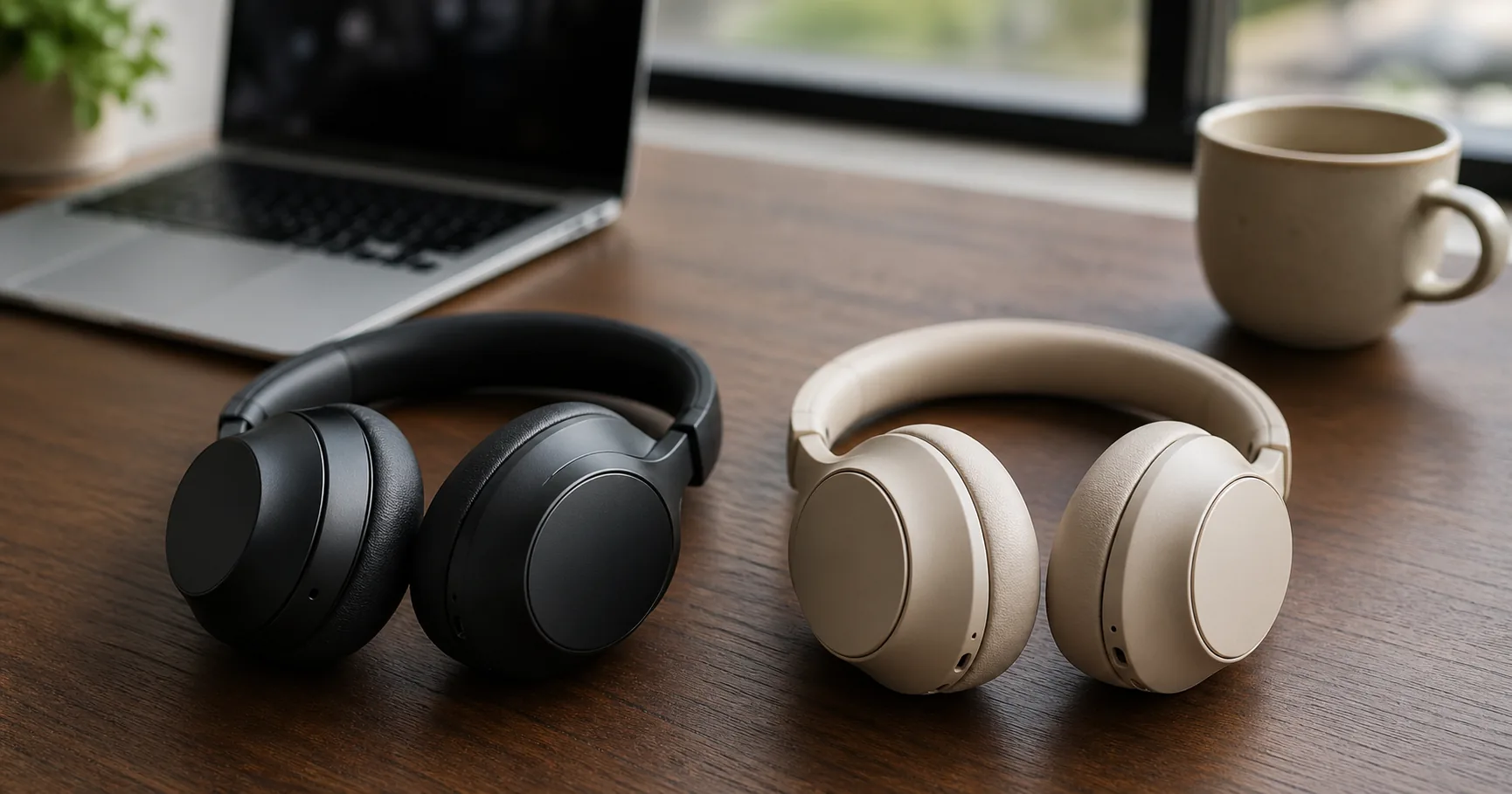
Shop for premium noise-cancelling headphones and you keep landing on the same two. They carry the same star rating, they’re aimed at the same buyer, and the reviews are glowing for both, which is exactly why the choice feels stuck. The rating tie is real, but it hides the fact that these two solve the problem with different priorities. One is built around sound, value, and call quality. The other is built around comfort and shutting out a chaotic, changing environment.
That’s the useful frame here. Forget which is “better” in the abstract, because at this level both are excellent, and you’d be happy with either. The question is which set of strengths matches your day. A person who lives at a desk and takes a lot of calls wants something different from a person who’s on planes and in cafes with a laptop and a movie.
This comparison walks through the two headphones, then lays out the situations where each one clearly wins, and finishes with the tie-breakers that settle it when you’re still on the fence.
For most buyers, the Sony WH-1000XM5 is the smarter pick. It usually costs less, lasts longer per charge, sounds more detailed out of the box, and handles calls better. The Bose wins on pure comfort and spatial audio, but those are situational; the Sony’s strengths apply to almost everyone.
The Sony has been the benchmark in this category for years, and it’s the more heavily reviewed of the two by a wide margin. It usually sells for less than the Bose, which already tilts the value math in its favor before you weigh anything else. Sony has since released a newer flagship, but that mostly cemented the XM5 as the sensible choice in the lineup: nearly all of the experience, for a good deal less.
Its strengths are the ones most people actually feel day to day. The sound is detailed and dynamic straight out of the box, with hi-res streaming support on compatible Android phones for listeners who care. Battery life is genuinely long, comfortably outlasting the Bose on a charge, with a fast top-up that buys hours from a few minutes on the cable. And the microphones handle calls noticeably better in noisy rooms, which matters if you take calls every day. Owners repeatedly describe the noise cancellation as quietly excellent in steady settings like offices, commutes, and even as a sleep aid.
The honest downsides are minor. The XM5 doesn’t fold flat the way the older model did, so the case is a little bulkier for a bag. And a small number of owners mention a hinge or button quirk developing after long, heavy use, which the return window covers if you hit it early.
Sony WH-1000XM5
The Bose is the comfort champion, and it adds spatial audio that the Sony doesn’t try to match. It tunes itself to the shape of your ears each time you put it on, and its standout feature places stereo content out in front of you rather than centered in your head, with head-tracking that keeps the sound anchored as you turn. On the right content, movies especially, that effect is genuinely impressive.
The comfort claim holds up. The lighter clamp and contoured cushions make it the easier pair to wear for hours at a stretch, and people who wear glasses tend to find it the friendlier of the two. Its noise cancellation is the more aggressive of the pair in unpredictable places, briefly clamping down harder when a sudden loud sound hits, which is why it shines on planes and in busy cafes. It also supports a high-quality codec on compatible Android phones.
The trade-offs are real, though. It typically costs more, its battery doesn’t last as long per charge, and that gap widens when the spatial mode is on. And while the sound is good, detail-focused listeners often find it a touch processed and flat next to the Sony, since the tuning aims for consistency over raw fidelity. Plenty of owners switch the spatial mode off after the novelty fades and just listen in standard stereo.
Bose QuietComfort Ultra
Tie-Breakers
Rather than scoring them spec by spec, here’s how the choice plays out in the situations people actually buy these for.
You work at a desk and take a lot of calls. This is the Sony’s home turf. Its noise cancellation is at its best in steady environments, the longer battery means you rarely think about charging during the day, and the microphones make you sound clearer to the people on your calls. The Bose is fine here, but you’d be paying more for comfort and spatial audio while giving up the call quality and battery that matter most at a desk.
You’re constantly traveling or working in noisy public spaces. This is where the Bose earns its premium. Its ANC reacts better to chaos, the sudden blender, the shifting cabin drone, the cafe that gets loud without warning, and its lighter clamp makes a long flight or a full day in a coffee shop genuinely more comfortable. If your headphones spend their life out in unpredictable noise, the Bose is the one that disappears on your head and keeps the world out.
You care most about sound for the money. Go Sony. It delivers the more detailed, lively sound of the two right out of the box, and it usually does it for less. Audio-first listeners tend to prefer it, and the hi-res support on Android is a bonus if your phone and library can use it.
You watch a lot of movies or shows on a laptop or tablet. This is the one case where the Bose’s spatial mode is a real draw rather than a party trick. That front-and-center, head-tracked effect adds something to film and certain music that the Sony simply doesn’t offer. If that’s a big part of how you’ll use them, it’s worth the premium; if you’ll turn it off after a week, it isn’t.
Still split? These usually decide it.
Glasses. If you wear them all day, lean Bose. The softer clamp is noticeably kinder over the arms of your frames during long sessions.
Budget and battery. If you want to spend less and charge less often, lean Sony. It’s typically the cheaper pair and the longer-lasting one, and that combination is hard to argue with for everyday use.
How you’ll carry them. If they’re going in a packed bag constantly, note that the Sony doesn’t fold flat, so its case takes a little more room. Not a dealbreaker, but worth knowing if space is tight.
The newer Sony flagship. There’s a more recent Sony model above the XM5. For most people the XM5 captures the great majority of the experience for meaningfully less, so don’t feel you have to chase the newest one. Buy up only if it solves a specific problem you actually have.
When you genuinely can’t choose, the Sony is the safer default. Its strengths, sound, value, battery, and calls, apply to almost everyone, while the Bose’s strengths shine brightest in specific situations. Buy the Sony, use it for a couple of weeks, and if comfort or spatial audio turn out to matter more to you than you expected, the return window lets you switch.
Which has better noise cancellation, the Sony or the Bose?
The Bose has a slight edge in unpredictable, noisy places like planes and busy cafes, because it reacts harder to sudden loud sounds. The Sony is just as strong, sometimes a touch cleaner, in steady environments like an office or a commute. For most people the gap is small enough that it shouldn’t be the only deciding factor, since both are far ahead of anything cheaper.
Which one is more comfortable for long listening?
The Bose, clearly. A lighter clamp and softer cushions make it the easier pair to wear for hours, and glasses-wearers especially tend to prefer it. The Sony is comfortable too, just firmer, and some people feel that after very long stretches. If all-day comfort is your top priority, the Bose is the pick.
Which sounds better?
The Sony, for most listeners. It’s more detailed and dynamic out of the box and supports hi-res audio on compatible Android phones. The Bose aims for a consistent, easy tuning that detail-focused listeners can find slightly flat. The exception is spatial audio: if you mostly watch movies, the Bose’s spatial mode adds something the Sony doesn’t offer.
Is the Bose worth the higher price?
Only if its specific strengths match how you’ll use them: long all-day comfort, frequent travel through unpredictable noise, or regular use of spatial audio for movies. If you mostly listen at a desk or on a commute and take calls, the Sony gives you more of what matters for less money. Decide based on your situation, not the spec sheet.
Can both connect to two devices at once?
Yes, both support connecting to two devices simultaneously, so you can switch between a phone and a laptop without re-pairing. Both handle it reliably in day-to-day use. The Bose also remembers more devices in its app, but for the common phone-and-laptop setup the two are effectively equal.
Should I wait for the newer Sony model or buy this one?
For most buyers, buy this one. The newer Sony flagship adds refinements, but reviewers consistently feel the XM5 delivers nearly the same experience for a good deal less. Unless the newer model fixes a problem you’re specifically dealing with, the savings are better spent elsewhere, and the XM5 remains an easy recommendation.