
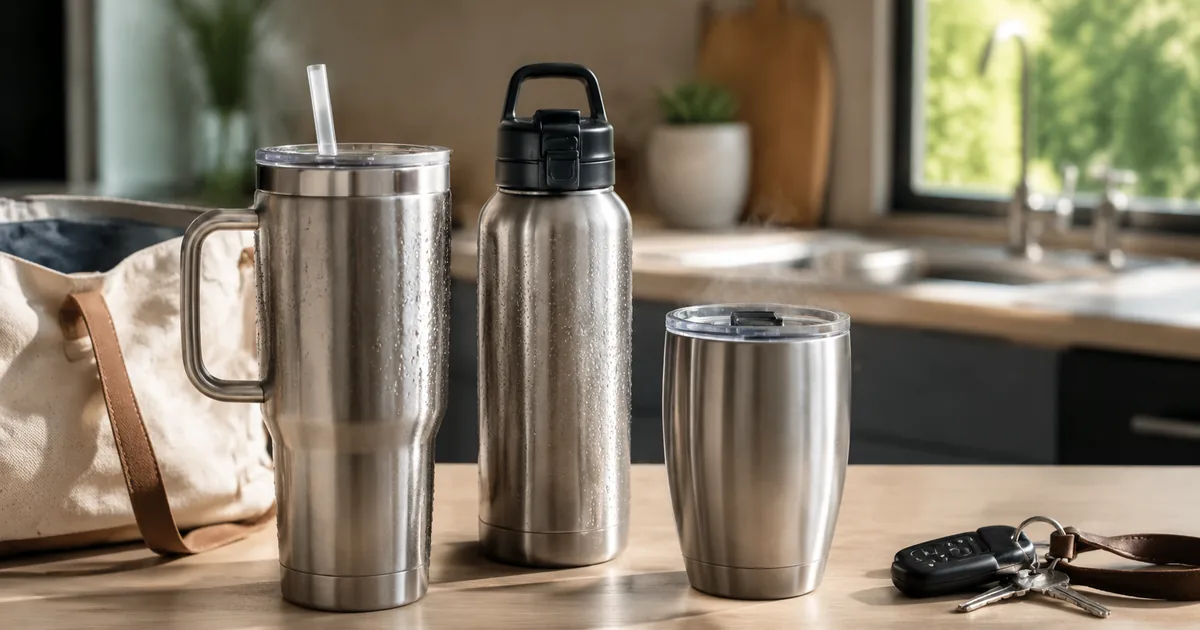
Three cups own the American desk right now, and shoppers line them up as though the choice were about color and status. It is not. One of them is not built to hold your coffee at all. One has a lid that was never designed to seal, so it will empty into a tote bag if it goes over. One is wide enough that it misses a standard cupholder in a compact car.
Insulation is the part all three get right, which is exactly why it is useless as a tiebreaker. Every one of them will keep ice overnight and cold water cold through a workday. What separates them is everything that happens around the drinking: whether the lid closes, whether hot liquid is allowed, whether the thing goes in a dishwasher, and whether it fits where you need to put it down.
Ratings hide this. A cup that leaks when tipped still collects five stars from someone who only ever moves it between a desk and a kitchen counter. The complaints that matter are concentrated in the small group of owners who asked their cup to do a job it was never built for. Sorting those out first is the fastest way to a decision you will not resent in a month.
The three at a glance
| Product | Check |
|---|---|
| STANLEY Quencher H2.0 Tumbler with Handle and Straw 30 oz | Flowstate 3-Position Lid | Cup Holder Compatible for Travel | Insulated Stainless Steel Cup | BPA-Free | Rose Quartz 2.0 | (opens on Amazon) |
| Owala FreeSip Insulated Stainless Steel Water Bottle with Straw, BPA-Free, 24 Oz | (opens on Amazon) |
| YETI Rambler 20 oz Stainless Steel Vacuum Insulated Tumbler w/MagSlider Lid | (opens on Amazon) |
Who this is for
- Water at a desk, all day, refilled twice → the Stanley Quencher. The handle and the large capacity are the point, and the tapered base drops into a cupholder. Sealing does not matter if the cup never leaves a flat surface.
- A bag, a backpack, a gym locker → the Owala FreeSip. It is the only one of the three with a lid that actively locks, and it is the only one designed to survive going sideways among your other belongings.
- Morning coffee, then iced tea in the afternoon → the YETI Rambler. It is the only one here rated for hot drinks, and it is the only one you can put in a dishwasher without thinking about it.
- A compact car with narrow cupholders → the YETI. Its tumblers are sized for standard cupholders. The wide Owala body is documented by the maker as a fit only for oversized or specialty holders.
- You want one cup for hot coffee AND a locking lid for your bag → none of these three does both. That combination does not exist in this trio, and picking either one means giving up the other.
Reviews
STANLEY Quencher H2.0 Tumbler with Handle and Straw 30 oz | Flowstate 3-Position Lid | Cup Holder Compatible for Travel | Insulated Stainless Steel Cup | BPA-Free | Rose Quartz 2.0
The Quencher is the one that turned insulated drinkware into a category people have opinions about, and it earns its place on volume: it is among the most-bought items in its category month after month, with a rating distribution that stays heavily weighted to five stars. The vast majority of buyers are happy, and the small unhappy group is unusually consistent about why.
What it does well is simple and slightly boring. It is large, so a refill cycle covers most of a working day. It has a handle, which sounds trivial until you carry a full cup of ice water across an office with one hand. The base tapers so it seats in a car cupholder despite the width at the top. The three-position lid rotates to cover the drink opening, expose the straw, or open fully for cleaning and ice.
Where owners get frustrated is portability in the strict sense. This is a tumbler with a straw port, not a sealed bottle. It is built to stand upright, and it behaves like it. A second and quieter thread comes from people who bought after the category peaked and describe the build as feeling less substantial than they had been led to expect. That perception shows up in a minority of reports, not the bulk of them, but it is real enough to name.
Skip this if you plan to carry it loose in a bag. The straw opening means it is not built to travel on its side, and no amount of lid rotation changes that.
Pros
- Large capacity covers most of a workday on two fills
- Handle makes a full cup genuinely one-hand portable
- Tapered base clears standard car cupholders
- Three-position lid covers the opening or exposes the straw
Cons
- Not built to lie sideways in a bag
- Wide footprint takes real desk space
- Some post-peak buyers report the build feels lighter than expected
Owala FreeSip Insulated Stainless Steel Water Bottle with Straw, BPA-Free, 24 Oz
The FreeSip is the current volume leader of the three, sitting at the top of its category and moving more units per month than either rival. Its rating profile mirrors the Stanley almost exactly, heavily concentrated in five stars with a thin band of complaints, which tells you the disagreements here are about fit rather than quality.
The design idea is the spout. You can sip upright through the built-in straw or tilt back and drink from the wide opening without swapping lids, which covers both the slow desk sip and the fast gulp after a run. The push-button lid protects the spout from whatever else is in your bag, and the carry loop doubles as a lock so the button cannot open by accident. Double-wall insulation holds cold for a full day, and the mouth is wide enough to load ice and get a brush inside.
Two limits are worth taking seriously before buying. First, it is not made for hot liquids, and that is not a nuance to negotiate around. If you want the same cup for morning coffee, this is the wrong one. Second, the maker states plainly that the body is wider than a standard cupholder and may fit only oversized ones, so the car question needs answering before you order. Owners also flag maintenance: the cup is hand wash, and the gasket under the lid has to come out during cleaning or it becomes a problem.
Skip this if you drink anything hot. It is a cold-only bottle by design, not by preference.
Pros
- The only pick here with a locking lid built for bags
- Sip through the straw or swig from the spout without changing lids
- Wide mouth takes ice and a cleaning brush easily
- Cold retention rated to a full day
Cons
- Not for hot liquids at all
- Body may not fit a standard cupholder
- Cup is hand wash, and the lid gasket needs regular removal
YETI Rambler 20 oz Stainless Steel Vacuum Insulated Tumbler w/MagSlider Lid
The Rambler has the cleanest rating profile of the three. It carries the highest average of the group, with the largest share of five-star reports and the thinnest band of one-star reports, which is notable given how long it has been on sale and how many people own one. It also sells in far lower monthly volume than the other two, so it is the quiet pick rather than the trend pick.
It is the only cup here that takes hot and cold with equal seriousness, and the only one you can put in a dishwasher and forget about. The body is heavy-gauge stainless with an exterior coat meant to resist fading and chipping, and the no-sweat exterior means it does not leave rings on paper. The MagSlider lid closes with a magnet, which is genuinely pleasant to use and trivial to pull apart for cleaning. All Ramblers in this line are sized to drop into standard cupholders.
The magnet is also the catch. It is a cover, not a seal, and owners are blunt about the consequence: knock it over and liquid comes out. YETI does not market it as leakproof, so this is a design choice rather than a defect, but it does rule the cup out for bags. The other recurring note is capacity. Owners report the stated size drinks smaller than the number suggests, which matters if you are matching it to a specific coffee order.
Skip this if the cup needs to survive a bag or a tipped-over desk. The sliding lid will not hold liquid in.
Pros
- The only pick rated for both hot and cold drinks
- Fully dishwasher safe with no special handling
- Sized to fit standard car cupholders
- Highest rating and thinnest complaint band of the three
Cons
- Magnetic lid is a cover, not a seal
- Usable capacity reads smaller than the stated size
- No handle
The trade-off nobody puts on the box
Every real decision here reduces to one exchange: a lid that seals costs you hot drinks, and a cup that takes hot drinks costs you the seal.
The Owala locks because it is a cold-only bottle. A pressure-tight closure and hot liquid are an uncomfortable pairing, which is why the maker rules hot drinks out rather than adding a warning. The YETI accepts hot liquid because its lid vents by simply not sealing, and a magnet that slides open is about as far from pressure-tight as a lid gets. The Stanley sits in between and solves neither: it is a cold-focused tumbler with a straw port, which is why it lives on desks and in cupholders rather than in bags.
This is why cross-shopping the three on insulation numbers goes nowhere. They all insulate. What you are actually buying is a position on that exchange, and there is no pick in this trio that escapes it. Anyone who wants sealed and hot in the same object is shopping the wrong three products and should be looking at screw-top travel flasks instead.
The second thing the box will not tell you is that capacity is not comparable across these shapes. A tall narrow bottle, a wide handled tumbler and a short cupholder tumbler with the same number printed on them behave nothing alike on a desk, in a hand, or in a car door.
How to Choose an Insulated Cup
Answer the hot-drinks question first
This single question eliminates a third of the field before you compare anything else. If coffee or tea ever goes in the cup, the cold-only bottles are out, and no feature list changes that. If it is water only, you have unlocked the sealed options and should use the seal.
Measure your cupholder, not your expectations
Cupholder failure is the most preventable disappointment in this category, because the numbers are published and the fit is binary. A cup marketed as cupholder friendly at the base can still be too wide at the body. If the car matters, prefer a cup whose maker states it is sized for standard holders rather than one that warns you about oversized ones.
Decide whether it ever goes in a bag
If the honest answer is no, and for most desk and car users it is, then leak resistance is not worth paying for and you should optimize for capacity and handle instead. If the answer is yes even occasionally, a locking lid is not a luxury, and a magnetic or straw-port lid will eventually cost you a bag.
Check the cleaning terms before the color
Dishwasher safe versus hand wash is a decision you live with several times a week for years. Straw and gasket assemblies need to come apart, and any lid with a hidden seal needs that seal removed during washing. Cups that hide a gasket and forbid the dishwasher demand a routine, and buyers who skip that routine are the ones who end up with an odor problem and blame the brand.
Which of these three can hold hot coffee?
Only the YETI Rambler. The Owala FreeSip is explicitly not for hot liquids, and the Stanley Quencher is built as a cold-drink tumbler with a straw. If a single cup has to cover morning coffee and afternoon ice water, the Rambler is the only pick in this group that does both.
Which one actually survives being knocked over?
The Owala, and only the Owala. Its push-button lid locks shut and the carry loop doubles as the lock. The YETI MagSlider is a magnetic cover rather than a seal, and owners consistently report liquid escaping when it tips. The Stanley has an open straw port and is not built to travel on its side.
Will these fit in a car cupholder?
The YETI line is sized for standard cupholders, and the Stanley Quencher tapers at the base to clear them despite being wide at the top. The Owala is the risk: the maker states the body is wider than a standard cupholder and may fit only oversized or specialty holders. Check the car before ordering that one.
Can all three go in the dishwasher?
No. The YETI Rambler is fully dishwasher safe. On the Owala, the lid is dishwasher safe but the cup is hand wash, and the gasket under the lid has to be removed during cleaning or it traps moisture. Treat any hidden gasket as a weekly task rather than a monthly one.
Does a bigger number on the cup mean more usable drink?
Not reliably. Owners of the 20-ounce Rambler report it drinks smaller than the number implies, which matters if you are matching it to a specific coffee size. Shape also changes the answer: a wide handled tumbler and a tall narrow bottle with the same stated capacity occupy completely different amounts of desk and hand.