
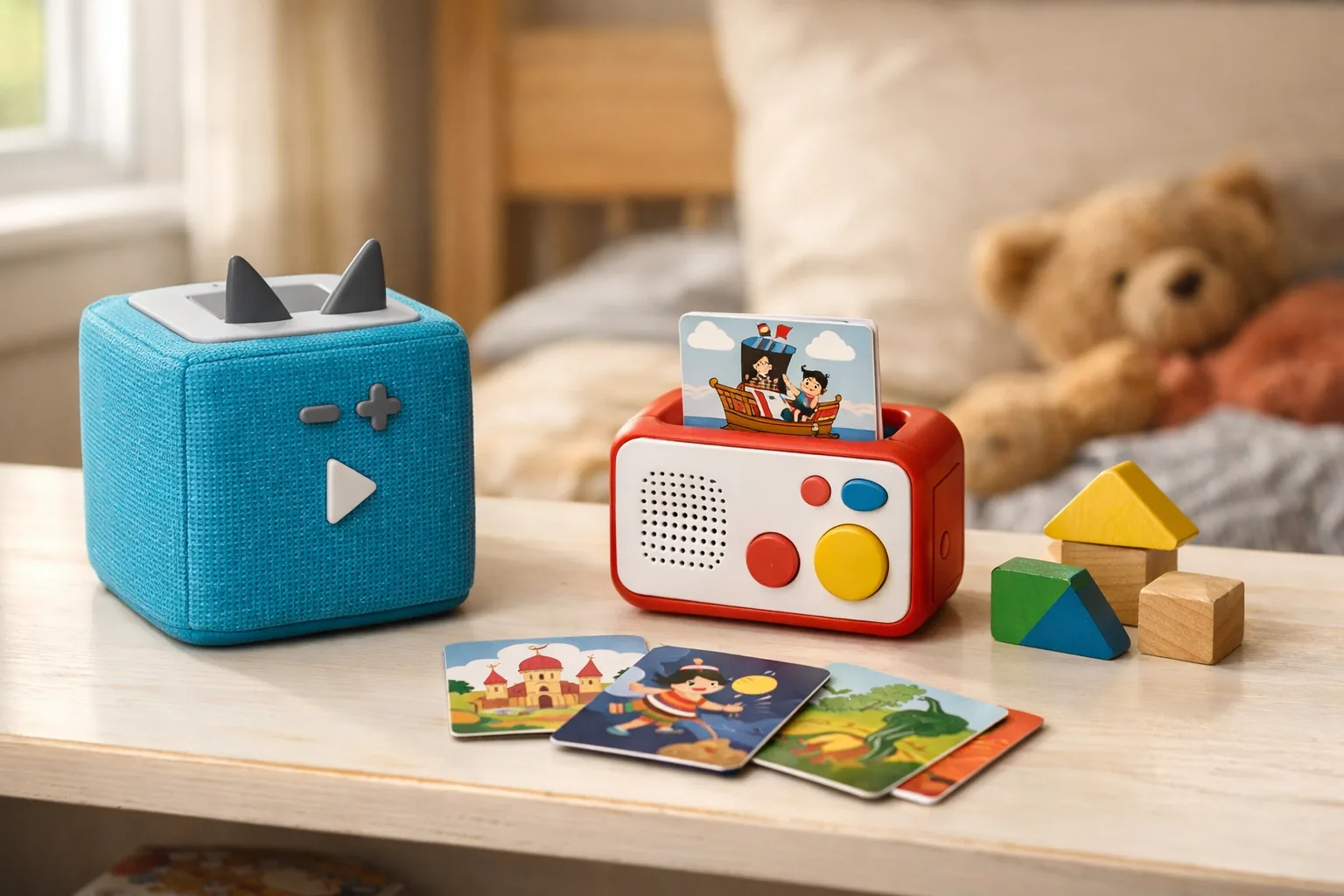
Both of these players cost the same, so this isn’t a budget-versus-premium decision. It’s a question of which design fits your kid and your life. The Toniebox is a soft, toy-like box built around collectible character figurines. The Yoto Mini is a smaller, travel-friendly player built around cards, an app, and a feature set that stretches further as a child gets older. Same money, two very different bets.
Both solve the same parent problem: less screen time, more independent listening. The difference is how they get there. Toniebox leans into tactile play and toddler-friendliness, the kind of thing a three-year-old grabs, drops a figurine onto, and figures out instantly. Yoto Mini leans into portability, card-based flexibility, and a longer runway through stories, music, podcasts, and quiet travel use. Neither approach is wrong; they suit different ages and different households.
For most families buying one device today, the Yoto Mini comes out ahead on the strength of a higher current rating, stronger recent demand, and a cleaner fit for car trips, headphones, and older kids. But the Toniebox keeps a real edge for the youngest children, the ones who respond better to soft hardware and a character they can hold. Below are the scenarios where each one clearly wins, then the tie-breakers for the close calls.
For most families, the Yoto Mini is the better pick. It costs the same as the Toniebox, rates a little higher, travels better, and gives older kids more room to keep using it as they grow.
The Toniebox makes the strongest first impression if your child is very young and you want a device that feels like a toy rather than a gadget. It holds 4.7 stars across the deeper review base in this matchup by a wide margin, which matters: it means the box has already survived years of real family use rather than just launch-period enthusiasm.
Its biggest advantage is how kids interact with it. Instead of cards, it uses character figurines that sit on top of the speaker to start playback. The controls are deliberately simple: squeeze the ears for volume, tap the sides to skip, drop a figure on top to begin. The box itself is soft, durable, and huggable, and the review pattern backs that up. Little kids work it out quickly and use it on their own without wrestling tiny buttons or menus. The starter set comes with a figure that plays a stretch of children’s songs out of the box, and the wider library leans heavily into recognizable characters and bedtime tracks.
That toy-first design shapes daily use in good ways for the youngest kids and in costly ways over time. Building a bigger library means buying more figurines, which adds up. It also needs 2.4GHz Wi-Fi during setup and when adding new content, and it’s bulkier to pack than the Yoto Mini. Skip this if you’re shopping with the next several years in mind rather than the toddler stage. It’s still the better fit for toddlers and preschoolers who want the most tactile, forgiving, character-driven experience.
Toniebox
The Yoto Mini wins this comparison because it does more with the same budget. It holds a slightly higher 4.8-star rating and shows the stronger current demand signal of the two. When two products cost the same, the one with better momentum and a broader use case usually deserves the edge.
The key difference is flexibility. The Yoto Mini is built around audio cards, app control, and a compact speaker that works especially well for travel. It promises long battery life on a charge, generous internal memory, headphone support, Bluetooth, USB-C charging, podcasts, radio, sleep sounds, and an ok-to-wake clock. That’s a far wider practical feature set than the Toniebox, particularly once a child wants more than nursery songs and branded character stories.
It also has the better long runway. Parents describe it working around the house, in the car, at bedtime, and even in classrooms. It’s small, durable, and simple enough for young kids, but it doesn’t feel locked to one narrow age band: families mention it becoming a daily carry item, loud enough to matter and sturdy enough to survive drops in a case, and they value the custom cards and parental controls. It isn’t perfect. It’s less tactile and less toy-like than the Toniebox, and cards are easier to misplace than chunky figurines. Skip this if your child specifically loves the ritual of grabbing and placing a physical character. For most families spending the same money, though, it covers more situations and ages without forcing a switch later.
Yoto Mini
The Tie-Breakers
Both players cost the same and both keep kids listening instead of staring at a screen, so the decision comes down to who’s using it and where.
Pick the Toniebox if your child is a toddler or preschooler. The soft box and collectible characters are easier to love on day one, and the put-the-figure-on-top-and-listen flow is about as simple as a device gets. For a three-year-old who wants a physical object to hold, trade, and place on the box, that tactile ritual is a genuine advantage that no feature list can replicate.
Pick the Yoto Mini if you’re buying for the next few years. It stretches comfortably from a young child up through school age, supports headphones naturally, and slips into backpacks, carry-ons, and back seats. A five-year-old and a ten-year-old can both keep using it, which is the real reason it wins as a one-device answer for most families.
Pick the Toniebox if character content is the whole point. If your kid is fixated on specific characters and the joy is in the figurines themselves, the Toniebox turns the library into collectible toys. That’s fun, and for the right child it’s the deciding factor.
Pick the Yoto Mini if you want variety over collectibles. Its card system is less playful but covers a wider mix of stories, music, podcasts, radio, and custom audio, and it’s easier to expand without filling a shelf with character toys.
If the scenarios leave you undecided, a few smaller factors usually settle it.
Think about ongoing cost and clutter. The Toniebox tends to cost more to live with, because growing the library usually means buying more figurines, and those figures pile up. The Yoto Mini can still get expensive, but its card-based system is easier to expand without turning a shelf into a character-toy museum. If you’re cost-conscious over the long haul, that leans Yoto.
Think about where the device will actually live. If it mostly stays in a bedroom or playroom, the Toniebox’s size is a non-issue and its toy feel is pure upside. If it’s going in backpacks, carry-ons, back seats, and waiting rooms, the Yoto Mini’s smaller shape and headphone support make it the easier travel companion.
Finally, weigh review depth against current rating honestly. The Toniebox has the deeper history, which is reassuring, but the Yoto Mini has the higher current rating and the broader everyday use case at the exact same price. For a toddler obsessed with tactile character play, the Toniebox still has a strong case. For a family buying one device to last, the Yoto Mini is the better decision.
Is the Toniebox or the Yoto Mini better for toddlers?
The Toniebox is usually the easier toddler pick. The figurines are more tactile and the box is soft, simple, and forgiving, so it feels more like a toy than the Yoto Mini does.
Why does the Yoto Mini win if the Toniebox has more reviews?
The Toniebox has the deeper review base, but the Yoto Mini has the higher current rating and the broader everyday use case at the same price. That makes it the better overall value for most families.
Which one is better for travel?
The Yoto Mini. It’s smaller, easier to pack, supports headphones naturally, and is built around portability in a way the Toniebox is not.
Does the Toniebox have better content than the Yoto Mini?
Not automatically. The Toniebox is stronger if your child loves character-based content and collectible figures. The Yoto Mini is stronger for a wider mix of stories, music, podcasts, radio, and custom audio.
Is the Yoto Mini too advanced for younger kids?
Not really. Kids can use it independently once they understand the cards and dials. It just feels less toy-like than the Toniebox, which is why some younger children take to the Toniebox faster.
Which one costs more to live with long term?
The Toniebox often does, since building the library usually means buying more figurines. The Yoto Mini can still add up, but its card system is generally easier to expand without accumulating a shelf of character toys.