
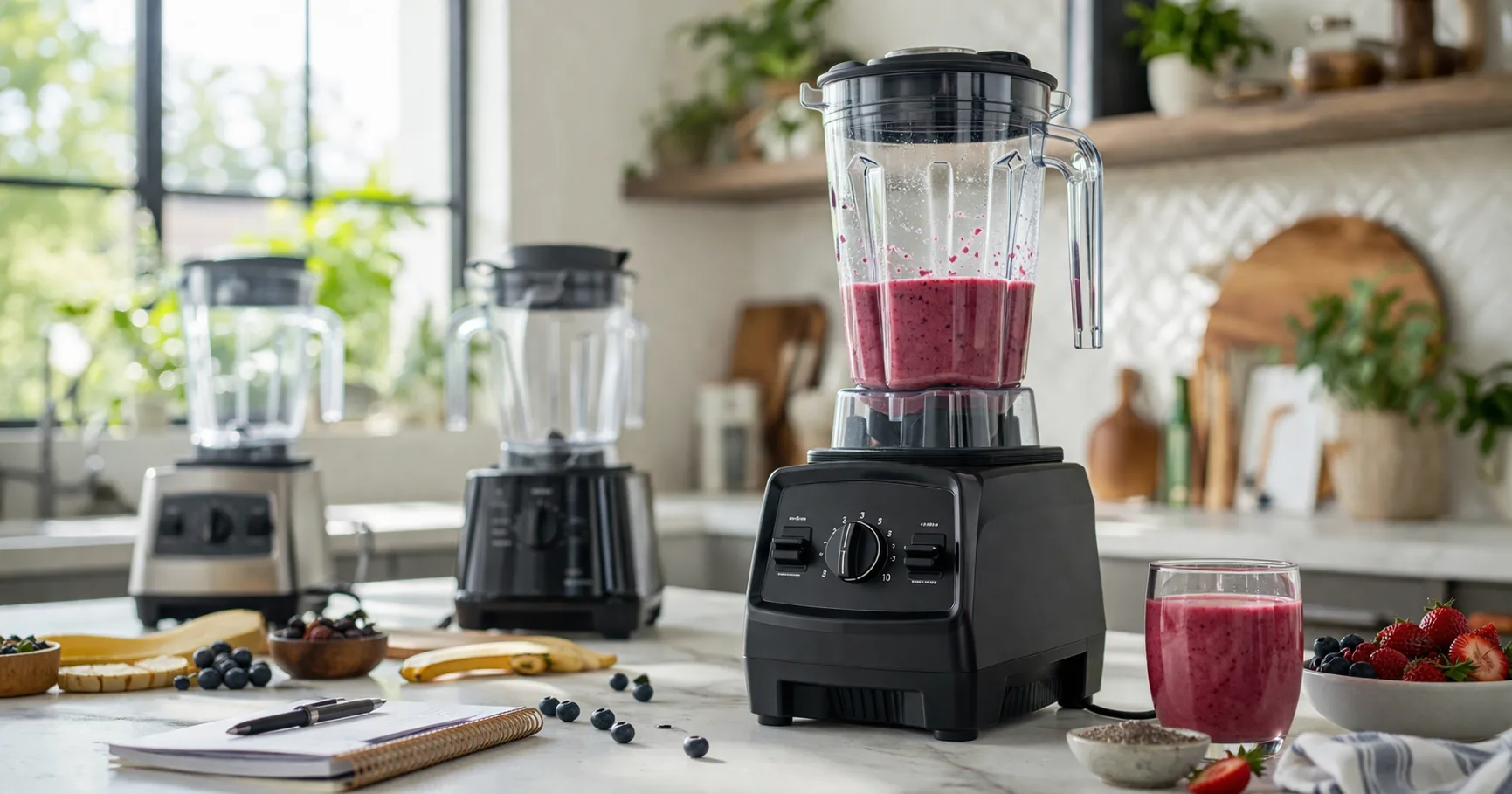
A Vitamix costs several times what a perfectly decent blender costs, and the smoothie it makes does not look several times better in the glass. That is the honest starting point, and it is where most Vitamix reviews quietly skip ahead to the praise. The real question is not whether a Vitamix is good. It is whether the gap between it and a much cheaper blender shows up often enough in your kitchen to be worth the money.
The answer depends almost entirely on how you blend. Run it daily through fibrous greens, frozen fruit, nut butters, and hot soups, and the difference is obvious and ongoing. Make the occasional weekend smoothie and a Vitamix is a lot of machine sitting idle on the counter. This review looks at the classic 5200 as the main event, then the two models people cross-shop against it, so you can tell which group you are in before you spend.
- Products analyzed
- 3
- Average rating
- 4.5
- Price range
- premium across the board
- Top rated
- Vitamix Explorian E310 (4.6)
- Most reviewed
- Vitamix 5200 (8.2K reviews)
Our Top Pick
The Vitamix 5200 is the model this review centers on. It is still the cleanest expression of the core Vitamix promise: serious motor power, a big container for family-size batches, manual control, and a build people keep for years rather than replace.
At a Glance
| Product | Check |
|---|---|
| Vitamix 5200 Blender, Professional-Grade Blender for Smoothies, Soups, Ice Cream and More, Stainless-Steel Blades, Self-Cleaning Kitchen Appliance, 64 Oz Container, Black | (opens on Amazon) |
| Vitamix Propel Series 750 Professional-Grade Blender with Four Blending Programs for Smoothies, Soups and More, Self-Cleaning, Stainless-Steel Blades, 64 Oz Container, Black | (opens on Amazon) |
| Vitamix Explorian E310 Blender, Professional-Grade Kitchen Blender for Smoothies, Soups, Juices and More, 10-Speed, Stainless Steel Blades, Self-Cleaning Kitchen Appliance, 48 Oz Container, Slate | (opens on Amazon) |
What Actually Changes Across the Lineup
The reassuring part is that these three machines are not wildly different in what they can blend. All three share the core Vitamix idea: enough motor to power through fibrous produce, frozen fruit, nut-heavy blends, soups, and dense recipes that bog down weaker blenders fast.
The differences are about shape, convenience, and how the machine fits your kitchen, not raw capability. The 5200 is the classic full-size manual machine with a tall container and do-it-yourself control. The Explorian E310 is the lower-cost entry point with a smaller container and a value-first approach. The Propel 750 keeps the large capacity but adds a lower, cabinet-friendly container and automatic programs for people who want a more hands-off routine.
So the smartest buy is not the most expensive one by default. It is the one that matches how much blender you need, how much counter and cabinet space you have, and whether you value manual control or convenience more.
The Review
Vitamix 5200 Blender, Professional-Grade Blender for Smoothies, Soups, Ice Cream and More, Stainless-Steel Blades, Self-Cleaning Kitchen Appliance, 64 Oz Container, Black
Lead with the catch. The 5200 feels utilitarian next to newer premium blenders. There are no automatic programs, the tall classic container does not slide neatly under low cabinets, and if you only make the occasional smoothie, the price is genuinely hard to defend. This is not a machine that earns its keep through convenience features, and it will not charm anyone shopping for one-touch ease.
What it does deliver is consistency. A strong motor, a large container for family-size batches, a wide range of manual speeds plus a high setting, self-cleaning, a tamper, and a long warranty add up to the machine people buy when they want the classic Vitamix formula rather than the trendy one. It is powerful, it is built to last, and it has earned one of the deepest, most-reviewed track records in the category.
So the verdict is conditional on purpose. If you like direct control and make big batches often, the trade-offs barely register and the 5200 is an easy keeper. If you want a blender that feels modern and hands-off, it is not the most appealing Vitamix on this list, and that is fine, because one of the others probably fits you better.
Skip this if: you want automatic programs or a low-profile container, or you mostly make small one-off blends where the price never pays off.
Pros
- The classic high-power blending the brand is known for
- Large container suits big batches, families, and meal prep
- Manual speed control gives precise command over texture
- Long warranty and a deep review history back the buy-it-for-years case
Cons
- Hard to justify if you mainly make small everyday blends
- Tall container is awkward where under-cabinet fit matters
The Alternatives Worth Weighing
Vitamix Propel Series 750 Professional-Grade Blender with Four Blending Programs for Smoothies, Soups and More, Self-Cleaning, Stainless-Steel Blades, 64 Oz Container, Black
The Vitamix Propel 750 is for buyers who want a Vitamix that is easier to live with day to day. It is the priciest model in this review, so its case rests on whether the convenience upgrades matter enough to you to outspend the 5200 and the E310.
Its real edge is usability, not just a slightly stronger motor. The lower-profile container fits under cabinets more easily, the automatic programs cover smoothies, hot soup, frozen dessert, and dips, and there is a pulse function plus a dedicated self-cleaning cycle. Those are the touches that make a blender feel refined when it lives on your counter and runs most days.
If you already know you want a Vitamix and you value convenience as much as performance, this is the cleanest premium case here. If you do not, it risks feeling like you are paying extra for polish rather than a real jump in blending results, since the core performance is close to the cheaper models.
Skip this if: you are happy with manual control and do not need automatic programs, where the 5200 or E310 saves you money.
Pros
- Best convenience package here, with automatic programs and a low-profile design
- Keeps large-batch capacity without the tall 5200 footprint
- Self-cleaning and a dishwasher-safe container ease cleanup
- Strong rating suggests buyers are happy with the step-up
Cons
- Highest price in the lineup
- The premium features matter most to frequent users, not casual blenders
Vitamix Explorian E310 Blender, Professional-Grade Kitchen Blender for Smoothies, Soups, Juices and More, 10-Speed, Stainless Steel Blades, Self-Cleaning Kitchen Appliance, 48 Oz Container, Slate
The Vitamix Explorian E310 is the most sensible starting point for buyers who want genuine Vitamix performance without paying for a bigger container or premium convenience. It is still expensive next to mainstream blenders, but inside the Vitamix range it is the easiest model to justify, and it currently holds the highest rating of the three.
It keeps the parts that matter most: a strong motor, stainless-steel blades, a full range of manual speeds, pulse control, self-cleaning, and a tamper. What you give up is size and a little finish. The smaller container suits small-to-medium batches better than large family prep, and the warranty is shorter than the 5200's, though still substantial.
For a lot of home kitchens, that trade is easy. If you mostly make smoothies, sauces, soups, or modest family batches and do not need the 5200's larger container, the E310 may be the smartest buy in this entire review, and the one I would steer most first-time Vitamix buyers toward.
Skip this if: you regularly make large batches and want the bigger classic container.
Pros
- Lowest price here while still delivering real Vitamix power
- Smaller container is easier to manage in tighter kitchens
- Deep review history makes it easy to trust
- Pulse and manual speeds keep it flexible across recipes
Cons
- Smaller container is less ideal for big-batch prep
- Shorter warranty than the 5200 and Propel 750
Is a Vitamix Worth It in 2026?
Yes, but only if you will actually use what makes a Vitamix different. The value is not the badge. It is the power, the durability, the self-cleaning, and the ability to chew through tough ingredients without sounding like it is about to give up. Use those regularly and the price amortizes into years of dependable performance.
The smarter framing is that not every Vitamix buyer needs the same Vitamix. The 5200 fits people who want the classic large-container machine and manual control. The Propel 750 fits people who want the most convenient premium version. The Explorian E310 is the one most value-minded buyers should look at first.
So the short answer: a Vitamix is still worth it for frequent blenders and home cooks who plan to keep it for years. If you only make occasional smoothies, a far cheaper blender will leave you just as happy and a lot richer.
Is a Vitamix still worth the money in 2026?
For frequent users, yes. If you blend often, make thick or hot recipes, or want a machine built to last for years, it makes sense. If you blend only occasionally, the price is hard to justify over a good mainstream blender.
Is the 5200 better than the Explorian E310?
Not automatically. The 5200 is better for large batches and the classic full-size experience. The E310 is the better value if you want strong performance for less and do not need the bigger container.
Is the Propel 750 worth paying more for?
It can be, mainly for buyers who value convenience. The automatic programs and low-profile container make it easier to live with, but not everyone needs those extras.
How long should a Vitamix last?
A big part of the value is longevity. These machines are designed to run for many years of regular use, which is reflected in their multi-year warranties, so the high price is meant to be spread across a long ownership window rather than a few seasons.
What is the main reason to buy a Vitamix over a cheaper blender?
Long-term performance on tough ingredients. A Vitamix earns its price when you regularly blend fibrous or frozen items, want reliable texture, and expect to keep the machine for years instead of replacing a cheaper one.
As an Amazon Associate I earn from qualifying purchases. Prices and availability change frequently — use the Amazon button to check current pricing.