
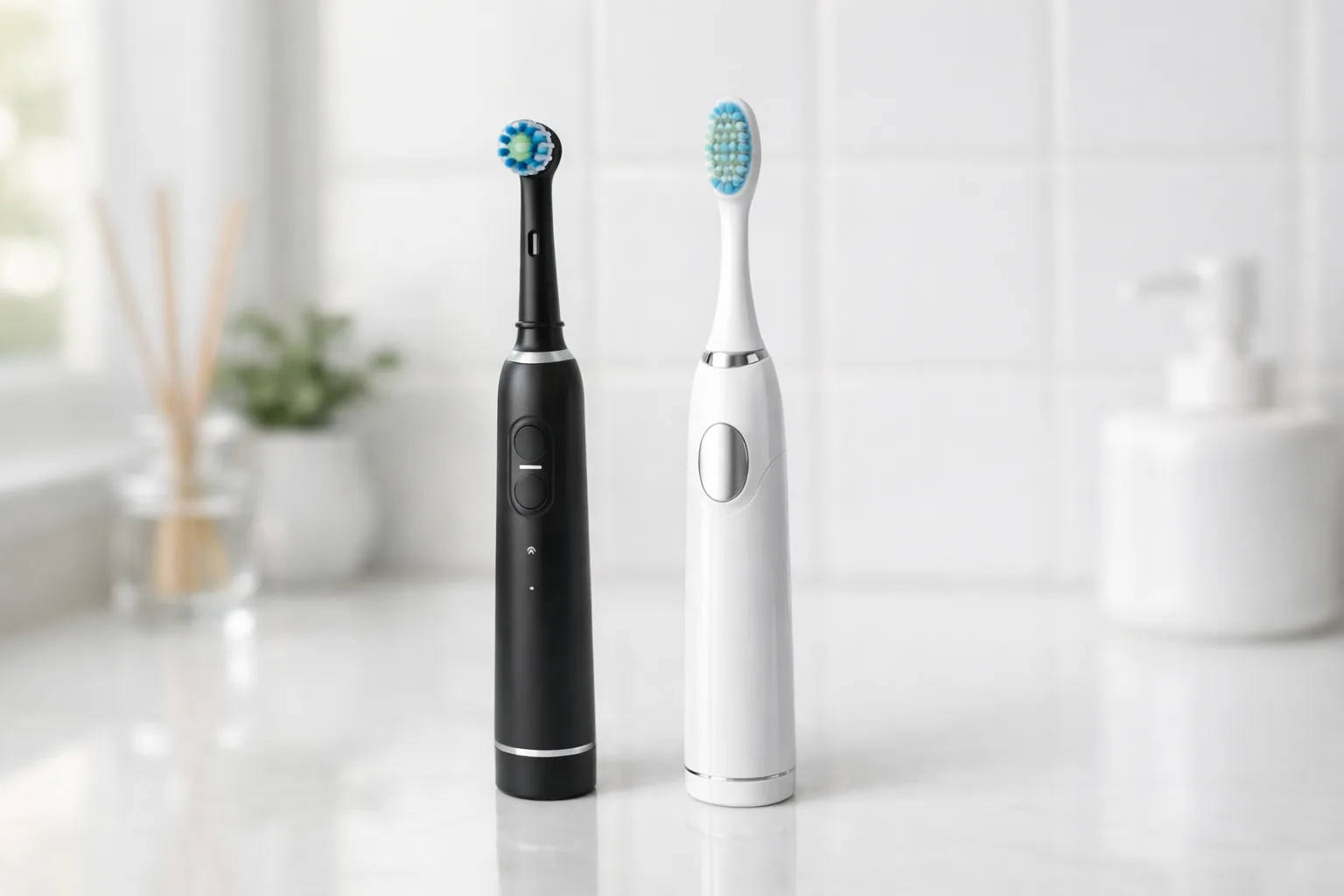
Ask ten dentists which electric toothbrush to buy and you'll get a near-even split. Roughly half say Oral-B, half say Philips Sonicare, and both brands stamp "#1 dentist recommended" on the box with surveys to back it up. That stalemate is actually the useful part: it means neither brand is simply better. They clean in completely different ways, and the right one depends on the shape of your teeth, how hard you brush, and what you can't stand in a bathroom.
The split is mechanical versus fluid. Oral-B uses a small round head that physically works one tooth at a time, the motion a hygienist's tool makes. Sonicare uses high-frequency vibration that drives fluid between teeth and along the gumline, cleaning a bit beyond where the bristles actually touch. Below are the two most popular models from each brand. Instead of declaring a single winner, here's how to figure out which side you're on.
- Products analyzed
- 4
- Average rating
- 4.5
- Price range
- budget to mid-range
- Top rated
- Oral-B Smart 1500 (4.6)
- Most reviewed
- Oral-B Pro 1000
Our Top Pick
If you want the safe, proven default, it's the Oral-B Pro 1000. The bestselling rotating toothbrush on Amazon, with a small round 3D head that strips far more plaque than a manual brush, a gum pressure sensor, and three modes. It's the model most dentists name as a first electric brush, especially for crowded teeth.
All Four at a Glance
| Product | Check |
|---|---|
| Oral-B Pro 1000 Rechargeable Electric Toothbrush, Black | (opens on Amazon) |
| Oral-B Smart 1500 Electric Power Rechargeable Battery Toothbrush, Black | (opens on Amazon) |
| Philips Sonicare 1100 Series Electric Toothbrush - Sonic Toothbrush with Advanced Sonic Technology, EasyStart, Smartimer & Quadpacer, White, Model HX3641/02 | (opens on Amazon) |
| Philips Sonicare 4100 Series Electric Toothbrush - Sonic Toothbrush with Advanced Sonic Technology, Pressure Sensor, Two Intensity Settings, Smartimer & Quadpacer, Deep Pink, Model HX3681/26 | (opens on Amazon) |
Which Brand Wins, By Situation
Your teeth are crowded, overlapping, or tightly spaced. This is Oral-B territory. The small round head surrounds each tooth and reaches into tight contacts that flat sonic heads skim over, which is exactly why dentists steer crowded-mouth patients toward the rotating design. If a hygienist has ever pointed out a spot you keep missing, the Pro 1000 or Smart 1500 is the better mechanical fit.
Your spacing is normal and you want a gentle, quiet clean. Sonicare's case. The sonic vibration is easier on gum tissue, covers more surface per stroke, and is noticeably quieter, which matters if you brush early next to a sleeping partner. For a history of gum sensitivity rather than tight contacts, the fluid-driven approach tends to feel kinder while still cleaning thoroughly.
You just want effective electric brushing for the least money. The Sonicare 1100 stands alone here. It delivers the core sonic experience from a brand dentists recommend at a price the Oral-B line can't touch, keeping the full timer-and-ramp guidance system while dropping only the pressure sensor and extra speed. For students, a travel backup, or a first electric brush, it's the value pick of the whole group.
You want the most capable Oral-B without going premium. Step up to the Smart 1500. It's a real upgrade over the Pro 1000: a stronger motor, a lithium-ion battery that doubles the runtime, a four-mode set with whitening, and a visible pressure ring that lights up instead of just cutting the motion. If you already know you prefer the rotating feel, this is the one to grow into.
Tie-breakers, when it's still close: Sonicare wins on battery life at both price tiers and on noise, hands down. Oral-B wins on finding replacement heads at any drugstore shelf, and the Smart 1500's glowing pressure ring teaches lighter brushing better than a subtle haptic buzz. Split the deciding vote on what you'll actually notice daily: quiet and long battery, or a head that fits crowded teeth.
Oral-B Models
Oral-B Pro 1000 Rechargeable Electric Toothbrush, Black
The Pro 1000 is the entry to Oral-B's rechargeable line and has held the top spot among rotating toothbrushes on Amazon for years. It's the most field-tested electric brush in its price range, and the reason is one design choice: the small, round CrossAction head. It oscillates, rotates, and pulsates at once, working a single tooth at a time with bristles angled to wrap each one, the same geometry professional cleaning tools use.
That mechanical precision is why dentists recommend it for crowded, overlapping, or plaque-prone teeth, since the round head fits spaces flat heads can't. A gum pressure sensor cuts the pulsing the moment you push too hard, removing one of the most common causes of gum recession. Three modes run off a single button, and a timer paces you by quadrant. The honest limit is the battery: it uses older chemistry and needs charging more often than anything else here.
Skip this if you share a bathroom with light sleepers or want long battery life, since it's the loudest brush here and the shortest-lived per charge. A Sonicare solves both.
Pros
- Round head reaches crowded, tight teeth
- 3D oscillating-rotating-pulsating motion
- Pressure sensor stops over-brushing
- Most dentist-recommended design
- Replacement heads stocked everywhere
Cons
- Shortest battery life in this comparison
- Louder mechanical sound than sonic brushes
Oral-B Smart 1500 Electric Power Rechargeable Battery Toothbrush, Black
The Smart 1500 is the direct upgrade from the Pro 1000 and the clearest case of a modest price bump buying real improvement. The motor runs meaningfully faster, and the switch to a lithium-ion battery stretches runtime to a full two weeks. People who've used both describe it as a level above, and the highest owner ratings in this comparison back that up.
The headline upgrade is the 360-degree pressure sensor. Instead of just cutting the pulsations when you press too hard, it lights a colored ring around the handle that's visible from any angle while you brush. That visual cue trains better pressure habits rather than just correcting after the fact. Four modes replace the Pro 1000's three, adding a whitening mode with dedicated polishing. It's the pick for anyone who likes the rotating feel and wants the most capable Oral-B short of premium.
Skip this if you're set on staying entry-level, since it costs more than the Pro 1000, or you specifically want a quiet brush, because it shares the same loud rotating motor as the rest of the line.
Pros
- Highest owner ratings in this comparison
- Stronger motor than the Pro 1000
- Visible 360-degree pressure ring
- Two-week lithium-ion battery
- Four modes including whitening
- Same wide head ecosystem
Cons
- Costs more than the Pro 1000
- No travel case, and as loud as other Oral-B models
Philips Sonicare Models
Philips Sonicare 1100 Series Electric Toothbrush - Sonic Toothbrush with Advanced Sonic Technology, EasyStart, Smartimer & Quadpacer, White, Model HX3641/02
The Sonicare 1100 makes the strongest value argument in this whole comparison: genuine Sonicare sonic technology from a brand dentists recommend, at the lowest price here. You still get the full guidance system, the EasyStart ramp that eases you in over the first couple of weeks, the two-minute timer, and the quadrant pacing, all of which the pricier 4100 also has.
The difference from Oral-B is the cleaning action itself. Sonic vibration drives fluid between teeth and along the gumline, so the clean reaches a little past where the bristles touch, into gaps that direct contact alone can miss. The 1100 has one speed and no pressure sensor, the honest trade-off, but its battery matches the more expensive 4100 at two weeks, the handle is the lightest here, and longtime Sonicare owners report it performs like older, far costlier models for daily use.
Skip this if you want intensity settings or a pressure sensor, since this is single-speed and stripped down by design. Step up to the 4100 for those.
Pros
- Cheapest genuine Sonicare here
- Two-week battery, same as the 4100
- Full EasyStart and timer guidance
- Takes all Sonicare heads, including cheap third-party
- Quieter than any Oral-B
- Lightest handle, great for travel
Cons
- Single speed, no pressure sensor
- USB cable but no wall plug in the box
Philips Sonicare 4100 Series Electric Toothbrush - Sonic Toothbrush with Advanced Sonic Technology, Pressure Sensor, Two Intensity Settings, Smartimer & Quadpacer, Deep Pink, Model HX3681/26
The 4100 is the upgrade from the 1100 and the natural rival to the Oral-B Pro 1000, both sitting at each brand's most-reviewed entry tier. It adds what the 1100 lacks: a more effective C2 Optimal Plaque head, a pressure sensor that pulses the handle when you over-brush, a second intensity setting, and a replacement reminder that tracks real wear.
Its pressure feedback is haptic rather than visual, a subtle pulse in the hand that's less distracting than a glowing ring during the two-minute session. The two intensity settings let you drop to a softer mode after dental work or during sensitive stretches without swapping heads, and the warranty is among the longest in the category. Where it clearly beats the Oral-B Pro 1000 is noise and battery: reviewers consistently call it quieter, and it runs about two weeks per charge. The trade depends on your mouth: crowded teeth or tight-contact plaque may still clean better with the Oral-B's individual-tooth action.
Skip this if your teeth are crowded or you have a history of plaque packing into tight contacts, where the Oral-B's mechanical head tends to do better. For normal spacing, the 4100 is excellent.
Pros
- More effective C2 head than the 1100
- Haptic pressure sensor, subtle and quiet
- Two intensity settings
- Two-week battery life
- Long manufacturer warranty
- Noticeably quieter than Oral-B
Cons
- USB cable but no wall plug in the box
- A few units report charging issues within a year or two
The Verdict
For most first-time electric-brush buyers, the Oral-B Pro 1000 is the safest, most proven pick: a huge track record, a dentist-backed round head, and pressure protection in one package, especially if your teeth run crowded. If your spacing is normal, you brush early next to someone asleep, or you just want a quieter, gentler feel, the Sonicare 4100 is every bit as compelling at the same tier. For the most value by a wide margin, the Sonicare 1100 is in a class of its own. And if you already love the rotating feel and want Oral-B's best short of premium, the Smart 1500 is the clear step up.
Is Oral-B or Philips Sonicare better overall?
Neither is universally better. They use different cleaning technologies. Oral-B's rotating head works tooth by tooth and is favored by dentists for crowded or overlapping teeth. Sonicare's sonic vibration covers more area and runs quieter. Both are dentist-endorsed. The right choice comes down to your tooth spacing, budget, and noise tolerance.
What is the difference between rotating and sonic toothbrush technology?
Rotating brushes (Oral-B) use a small round head that oscillates and pulsates against each tooth in a mechanical scrubbing motion. Sonic brushes (Sonicare) generate high-frequency vibration that drives cleaning fluid between teeth and along the gumline, so the clean extends past direct bristle contact. Rotating suits tight spaces, sonic covers more area with a gentler feel.
Which electric toothbrush lasts longer on a single charge?
Both Sonicare models run about two weeks on a lithium-ion battery. The Oral-B Pro 1000 lasts roughly a week to ten days on older battery chemistry. The Oral-B Smart 1500 upgrades to lithium-ion and matches Sonicare's two-week life.
Is Oral-B louder than Philips Sonicare?
Yes, consistently. Oral-B's rotating motor makes a louder mechanical sound than Sonicare's sonic vibration. People who switch from Oral-B to Sonicare often mention the quieter operation as a real improvement, which matters for shared bedrooms and early-morning brushing.
Can I use Oral-B brush heads on a Sonicare handle, or the reverse?
No. Oral-B and Sonicare heads are not cross-compatible and fit only their own handles. Both brands have wide ranges of official and third-party heads. Oral-B heads are easier to find at physical stores, and both are well stocked online.
Which is better for sensitive gums, Oral-B or Sonicare?
Sonicare is generally gentler on sensitive gums because the sonic vibration puts less direct mechanical pressure on the tissue. Its EasyStart ramp also eases the transition from a manual brush over the first couple of weeks. That said, both brands' sensitive modes and pressure sensors protect gums well when used correctly.
As an Amazon Associate I earn from qualifying purchases. Prices and availability change frequently — use the Amazon button to check current pricing.