
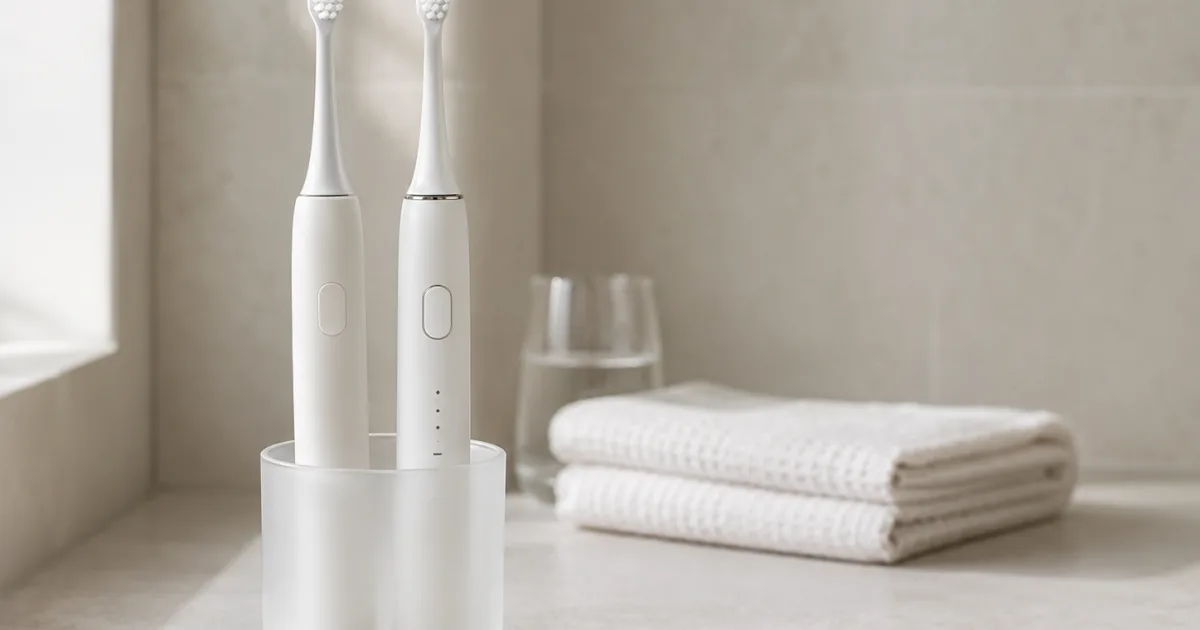
Both of these brushes run the same sonic motor, pace you through the same two-minute routine, and take the exact same snap-on heads. Put them in two hands on the standard Clean setting and most people could not tell which is which. Yet the 5100 asks for roughly double the money. That gap is the whole story of this comparison, and it has almost nothing to do with how clean your teeth get.
What the extra money actually buys is options. The 4100 has one cleaning mode and two intensity levels. The 5100 adds a White mode for surface stains and a Gum Care mode that runs an extra gentle minute along the gumline, ships with a gum-care head instead of the plaque head, and comes with a travel case and a charging stand in the box. None of that changes the daily clean on Clean mode. So the honest question is not which brush is better. It is whether you will genuinely use the modes and extras the 5100 adds, or whether you will brush on Clean every morning like nearly everyone does and quietly pay twice for the privilege.
This guide answers that by use, not by spec sheet. The verdict sits right below for anyone who just wants the call, and the situation-by-situation breakdown after the table sorts out the rest.
- Products analyzed
- 2
- Average rating
- 4.5
- Price range
- entry-level to mid-range
- Top rated
- Sonicare 5100 (4.6)
- Most reviewed
- Sonicare 5100
Our Top Pick
For most people the smart-money pick is the Sonicare 4100. It is the best-selling sonic toothbrush on Amazon, it delivers the identical sonic clean the 5100 gives on its Clean mode, and it keeps the parts that actually matter every day: the pressure sensor that warns you off scrubbing too hard, the two-minute timer with thirty-second quadrant pacing, and the same two-week battery. Step up to the 5100 only if you will really use Gum Care or White mode, you have sensitive or receding gums, or you want the travel case and charging stand it includes. If you only ever brush on one setting, the 4100 is the same brush for less.
Both Sonicare Models at a Glance
| Product | Check |
|---|---|
| Philips Sonicare 4100 Series Electric Toothbrush - Sonic Toothbrush with Advanced Sonic Technology, Pressure Sensor, Two Intensity Settings, Smartimer & Quadpacer, Deep Pink, Model HX3681/26 | (opens on Amazon) |
| Philips Sonicare ProtectiveClean 5100 Rechargeable Electric Toothbrush, with Pressure Sensor, 3 Cleaning Modes, SmarTimer and QuadPacer, 14-Day Battery Life, Travel Case, White, Model HX6857/11 | (opens on Amazon) |
Which One Fits You, By Situation
You brush on one setting and never touch the rest. This is the 4100, no contest. The single biggest thing your extra money buys on the 5100 is the White and Gum Care modes, so if you already know you will leave it on Clean forever, the cheaper brush gives you the same clean from the same motor. Plenty of owners admit they bought the pricier model and use only the standard mode, which is exactly the spend to avoid.
You have sensitive or receding gums. Here the 5100 earns its keep. Its Gum Care mode adds a low-power minute that gently works the gumline, and it ships with the gentler gum-care head rather than the plaque head. If a hygienist has pointed out recession or you wince at the gumline, that mode is a real reason to step up, not a gimmick.
You travel often, or you just want it ready on the counter. The 5100 again. It comes with a travel case and a charging base you set the handle on, so it lives on the bathroom shelf without a cable hanging off it. The 4100 charges from a bare USB cable with no wall plug in the box and no case, which is fine at home but awkward on the road.
You want surface-stain whitening built in. That is the 5100's White mode. If coffee or wine staining is your main complaint and you would rather press a button than buy a separate whitening head, it is the only one of the two that offers it.
You want the proven default for the least money, a first electric brush, or a second handle for a partner or a guest. Back to the 4100. It is the most-bought sonic brush on Amazon for a reason: it covers the essentials, it is gentle and quiet next to a rotating brush, and at half the price it is the easy call when you are buying two or trying electric for the first time.
Tie-breakers, when it is still close. Both run about two weeks per charge, both stop you at two minutes and nudge you every thirty seconds to switch quadrants, both pulse the handle when you press too hard, and both take the identical click-on heads, so refills cost the same either way. The newer 4100 has a lighter handle that some people prefer and others read as less solid, while the older 5100 draws more praise for build but still has a few owners reporting it quit near the one-year mark. Neither connects to an app, so you are not paying for tracking on either. Settle the deciding vote on one thing: will you actually run a second and third mode. If yes, the 5100 is worth the premium. If no, you are choosing between twins on the only mode you will use.
The Two Brushes in Detail
Philips Sonicare 4100 Series Electric Toothbrush - Sonic Toothbrush with Advanced Sonic Technology, Pressure Sensor, Two Intensity Settings, Smartimer & Quadpacer, Deep Pink, Model HX3681/26
The 4100 is the entry to the current Sonicare line and the best-selling sonic toothbrush on Amazon, which is the clearest signal of what it gets right. It runs the same advanced sonic technology as the pricier models, pulsing fluid between teeth and along the gumline, and pairs it with the C2 plaque-control head. You get a single Clean mode with two intensity settings, which covers what the large majority of people ever do at the sink.
The parts that protect your teeth are all here. A pressure sensor pulses the handle the moment you push too hard, the kind of feedback that quietly trains a lighter touch and heads off gum recession. EasyStart eases you up to full power over the first couple of weeks if you are coming off a manual brush, the two-minute timer keeps you honest, and the quadrant pacer splits the session into even thirds. The battery runs about two weeks per charge. The honest catch: it charges off a USB cable with no wall plug in the box and no travel case, and because the newer handle is light, a thread of owners describe it as feeling hollow or report charging trouble down the line.
Skip this if you have sensitive gums that would benefit from a dedicated Gum Care mode, you want surface-stain whitening built in, or you need a travel case in the box. Those are the reasons to spend up on the 5100.
Pros
- Best-selling sonic brush on Amazon
- Same core sonic clean as the 5100 on Clean mode
- Pressure sensor protects gums
- Two-week lithium-ion battery
- Roughly half the price of the 5100
- Takes all standard Sonicare click-on heads
Cons
- One cleaning mode only, no Gum Care or White
- USB cable but no wall plug or travel case in the box
Philips Sonicare ProtectiveClean 5100 Rechargeable Electric Toothbrush, with Pressure Sensor, 3 Cleaning Modes, SmarTimer and QuadPacer, 14-Day Battery Life, Travel Case, White, Model HX6857/11
The 5100 is the mid-tier ProtectiveClean and the model to buy when you will actually use more than one setting. It carries the longest track record of the two, the highest owner rating here, and a build that reviewers who cross-shopped both tend to trust more. The core clean is the same sonic action as the 4100, so the upgrade is not about power. It is about range and what comes in the box.
The headline addition is the mode set. Clean handles the daily job, White adds a stain-focused cycle, and Gum Care runs an extra reduced-power minute to massage the gumline, paired with the G2 gum-care head it ships with rather than a plaque head. That makes it the natural pick for anyone managing sensitive or receding gums. It also includes a travel case and a charging stand you rest the handle on, so it suits people on the go and anyone who would rather not deal with a loose cable. Same pressure sensor, same two-minute pacing, same two-week battery as the 4100, and the same heads fit it. The trade is plain: you pay about double, and a small share of owners still report a unit failing near the one-year mark.
Skip this if you only ever brush on one mode and rarely travel, because then you are paying roughly twice the price for a White and Gum Care mode you will not touch and a case you will not pack. The 4100 is the same daily clean for less.
Pros
- Three modes: Clean, White, and Gum Care
- Gentler gum-care head included
- Travel case and charging stand in the box
- Highest owner rating in this comparison
- Two-week lithium-ion battery
- Longer, well-established track record
Cons
- Costs about double the 4100
- Extra modes are wasted money if you only use Clean
The Verdict
For most people, the Sonicare 4100 is the smarter buy, and it is not close. It gives the identical sonic clean the 5100 delivers on its everyday mode, keeps every part that protects your gums, runs the same two-week battery, and costs roughly half as much. If you brush on one setting like nearly everyone does, the extra money on the 5100 buys you almost nothing you will feel.
The 5100 is the right call in a narrower set of cases, and a genuinely good one there. If you have sensitive or receding gums, the Gum Care mode and its gentler head are a real benefit. If you travel often or want a charging stand and a case rather than a loose cable, those come in the box. And if surface-stain whitening is your main goal, only the 5100 has a mode for it. Decide on what you will actually use, not on which number is bigger, and the choice makes itself.
Still choosing between brands rather than Sonicare models? Our Oral-B vs Philips Sonicare comparison sorts out the rotating-versus-sonic split, and if you are weighing the 4100 against an Oral-B in particular, see Oral-B Pro 1000 vs Sonicare 4100.
What is the real difference between the Philips Sonicare 4100 and 5100?
Three things, none of which is the core clean. The 4100 has one cleaning mode (Clean) and two intensity settings; the 5100 has three modes (Clean, White, and Gum Care). The 4100 ships with a plaque-control head and a USB charging cable; the 5100 ships with a gentler gum-care head plus a travel case and a charging stand. And the 5100 costs about double. Both use the same sonic motor, the same two-minute timer with thirty-second quadrant pacing, the same pressure sensor, and the same click-on heads.
Do the 4100 and 5100 actually clean differently?
On the standard Clean mode, no. Both drive the same high-frequency sonic action, so the daily clean is effectively identical. The 5100's advantage is the extra Gum Care and White modes and the gum-care head it includes, not a stronger or deeper clean on the mode you will use most.
Is the Sonicare 5100 worth roughly double the 4100?
Only if you will use what it adds. It is worth the premium if you have sensitive or receding gums and want the Gum Care mode, if you travel and want the case and charging stand, or if you want built-in stain whitening. If you only ever brush on one mode and stay home, the 4100 is the same clean for about half the price.
Do the same brush heads fit both the 4100 and the 5100?
Yes. Both use the standard click-on Philips Sonicare heads, including the C2 plaque-control and G2 gum-care heads, so refills are interchangeable and cost the same for either handle. You are not locked into a different head ecosystem by choosing one over the other.
How long does the battery last on each one?
Both run about two weeks on a full charge, based on two daily two-minute sessions, using a lithium-ion battery. Battery life is not a reason to pick one over the other.
Does either toothbrush come with a wall plug or a travel case?
The 4100 includes a USB charging cable but no wall adapter and no case. The 5100 includes a charging base you stand the handle on plus a travel case. If charging convenience or travel matters to you, that difference favors the 5100.